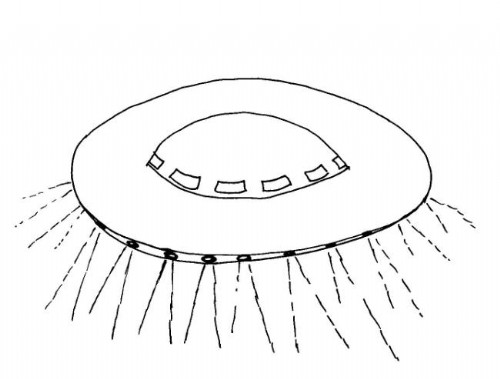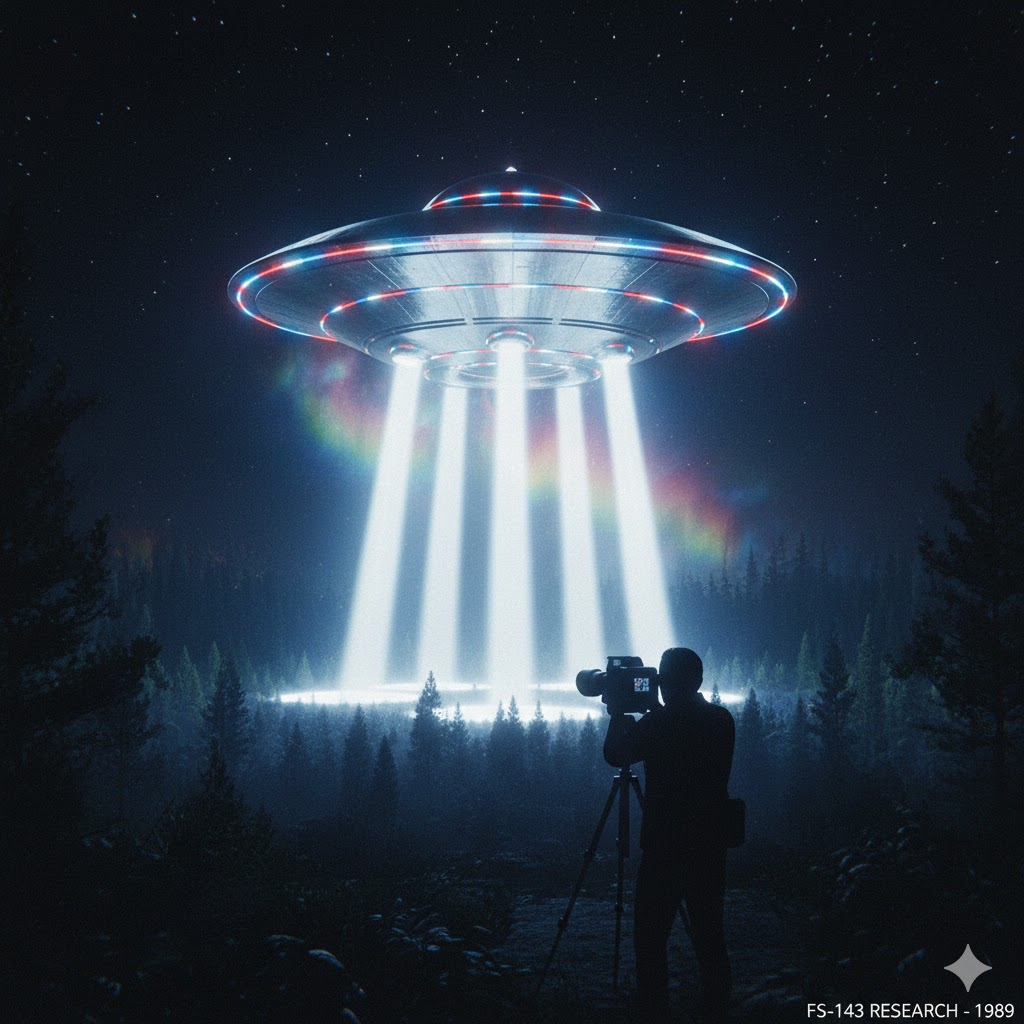
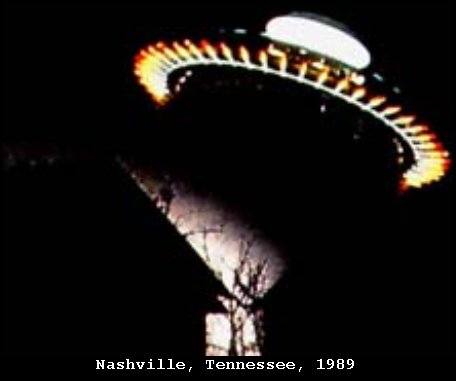
The FS-143 saucer photographed near Nashville in 1989, exhibiting unique 'solid' light columns and coronal discharge.
THINK ABOUTIT UFO SIGHTINGS REPORT
On September 27, 1989, an experienced photographer captured a series of vivid images of a FS-143 saucer-shaped craft in a remote area near Nashville. The object, estimated to be 100 feet in diameter, exhibited anomalous properties including “coronal discharges” similar to the Aurora Borealis and powerful downward-shining light columns that appeared to stop abruptly in mid-air. The photographer reported a sense of “lost control” and a feeling of being in “another world” during the five-to-ten-minute encounter.
Date: September 27, 1989
Sighting Time: Approximately 9:00 PM
Day/Night: Night
Location: Near Nashville, Tennessee (Mountainous remote area)
Urban or Rural: Rural
No. of Entity(‘s): 0 (Close friend claimed rendezvous with another intelligence, but no entities were photographed)
Entity Type: n/a
Entity Description: n/a
Hynek Classification: NL (Nocturnal Light) / CE-I (Close Encounter of the First Kind)
Duration: Between five and ten minutes
No. of Object(s): 1
Appearance / Description of the Object(s): FS-143 saucer-shaped craft with a glowing perimeter and powerful downward light columns
Distance to Object(s): Approximately four to six miles
Height & Speed: Stationary/Hovering at approximately 30 to 50 degrees above the horizon
Shape of Object(s): Saucer-shaped
Size of Object(s): Estimated 100 feet in diameter
Color of Object(s): Multi-colored perimeter lights (32 red, white, and blue) with blue central lights
Number of Witnesses: Multiple (Photographer plus others who were reluctant to come forward)
Special Features/Characteristics: “Solid” light columns that truncated abruptly in mid-air; coronal discharge similar to Aurora Borealis
Source: Commander Graham Bethune, US Navy
Summary/Description: High-resolution photographic capture of a structured saucer craft using professional-grade Canon T-90 equipment and push-processed film
Full Report
The photographs of these UFOs were provided by Commander Graham Bethune of the US Navy. He obtained these photographs of a FS-143 saucer from a close friend who claimed to have rendezvoused with another intelligence and requests anonymity. These photographs were allegedly taken on September 27, 1989, near Nashville,Tennessee and used to build a model for theatrical events.
The photographs show strong circular columns of light shining down from the craft that suddenly stop in mid-air. Our spotlights do not function in this manner.
THE PHOTOGRAPHER’S STORY
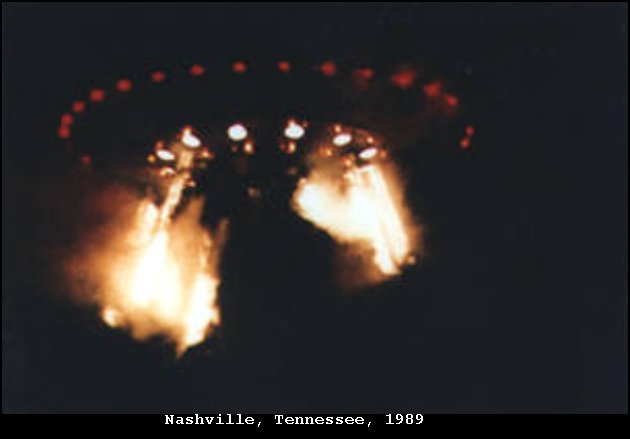
An experienced photographer was driving in a remote area near Nashville, Tennessee on the night of July 14, 1989. He saw a light behind the trees on top of a mountain several miles away at about 9:00 PM. He stopped his car, opened the trunk, picked up two cameras, a Canon AE-1 and a Canon T-90, that had previously been loaded with film. He started walking toward the bright light.
The light came over the mountain several miles away and he started taking pictures with the cameras. He noticed a coronal discharge from around the perimeter of the object. It appeared to be materializing and coming into his vision.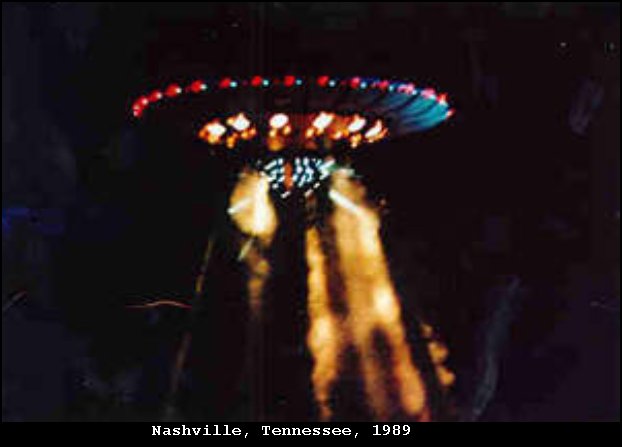
The bright light continued moving toward him. He aimed the camera at the light and started taking photos. His first photo was taken about 30 degrees above the horizon. When the object stopped he was shooting at about 50 degree up with the object still about four to six miles away.
The photographer states, “I had a feeling that the craft was behind the mountain waiting for me and when it appeared it felt like I was in another world, the sounds were far, far away.” He looked at the object but could not see any definition, the light was far too bright and too far away.
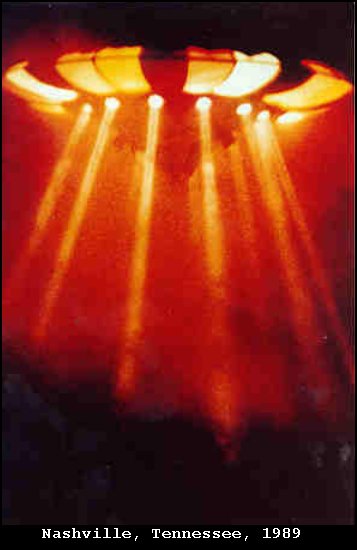
When he looked through the lens the craft was sharp and vivid. The craft was visible for more than five minutes, but less than ten. It seemed like forever. He changed the lens package from the T-90 to the AE-1 camera and continued shooting using all his film.
He felt he was not in control of what was happening. He remembers constantly pushing the buttons on the back of the T-90, each time he made a change it sharpened the image.
The T-90 Canon with his lens package cost $3,400.00. It has four computer chips and at the time was one of the most professional cameras you could buy when purchased in 1985.”
There were other witnesses, but they have been reluctant to come forward. They also were taking pictures, but the field around the craft interfered with the film as the craft moved away.
They did not have high magnification lens so there was not enough definition to make the craft identifiable. The photographer has had a recent heart attack and an auto accident and does not want his name revealed.
The Canon T-9- was set up with a spacer, two 2-2 X multipliers and 500 mm mirror lens with five filters. The lens package was 2000 mm plus. The speed of the film using the film push process is close to 3000. The camera was set up to take scenery at a distance. The computerized camera with computer chips was set to open the aperture as wide as possible. Commander Graham Bethune. was told by Bill Sherwood of Kodak that the object photographed with this package used on the camera was about five miles distant and would be 100 feet in diameter. ASA Kodak 400 or above film was used. Push processing was ordered when developing the film.
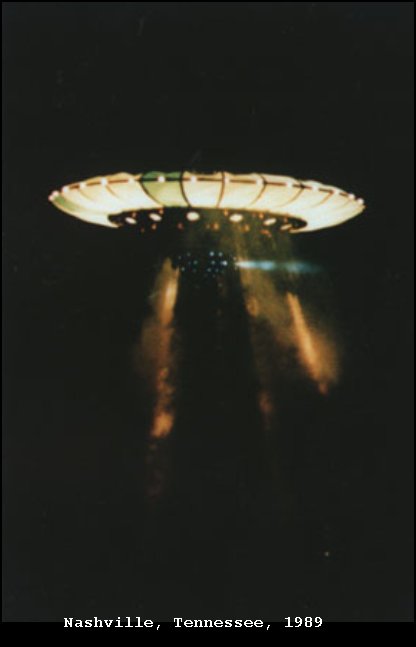
FILM ANALYSIS
Analysis of the film shows unusual colors not normally seen in any lighted object. The colors indicate a coronal discharge similar to the Aurora Borealis (Northern Lights.)
The photographs show a craft with approximately 32 red, white and blue perimeter lights. These lights are not used in normal aircraft configuration.
At times they appear all red. At other times they are all white. Sometimes outer perimeter lights appear mixed in color indicating they may have the ability to change color.
Inside the outer perimeter lights are panels of lights. These also appear to have the ability to change color. Although they are predominantly white they are sometimes seen as partially red or black. Assuming the craft is 100 feet in diameter these outer panels take up about 40 feet or 20 feet on each side.
Below the center of craft there appears to be a crystal or lights with crystal like appearance. Generally these lights appear blue. craft appears to rotate in the photos. Graham gave me his word that these were authentic photographs of an actual flying craft to the best knowledge.
He has known the photographer for 24 years and the man worked for him for ten years. He has always been know to tell the truth and was of high character.
The lights themselves have an unusual depth of color. When you look at a colored light it is normally a white light covered by a lens of red, yellow, green, blue etc. The lights on the craft appear as if the light contain the actual color. There is a vividness of color that is difficult to describe that appears to be in these photos.Editor’s Note: I have observed a UFO at close distance. The colors of the smoke probably are a coronal discharge similar to what I saw.
The fog or plasma is penetrated by the powerful lights shining downward. The lights extend down for an estimated seventy-five feet to one hundred plus feet and seem to stop abruptly. Duplication of this capability is exceptionally difficult to accomplish with any normal lights.
I have never seen lights that have these properties except on a UFO, nor have I seen comparable photography. I have over 5000 hours flying time and taken thousands of photographs. I would be very interested in any similar photographs or videos of a comparable craft.
source: http://www.nationalufocenter.com/features/bethune.htm
Researcher’s Notes
The photographic evidence from the Nashville 1989 case is distinguished by the high-caliber equipment utilized, specifically a Canon T-90 with a custom lens package exceeding 2000 mm. This setup, combined with Kodak 400 film that was push-processed to an effective speed of 3000, allowed for an unprecedented level of detail at a distance of approximately five miles. Technical analysis suggests the craft was approximately 100 feet in diameter and produced a coronal discharge similar to the Aurora Borealis, a phenomenon rarely captured with such clarity in civilian UFO photography.
The most anomalous feature documented is the behavior of the craft’s downward-shining light columns. Unlike standard terrestrial spotlights that dissipate gradually, these powerful beams appeared to truncate or stop abruptly in mid-air after roughly 75 to 100 feet. This “solid light” characteristic, coupled with the reported 32 multi-colored perimeter lights capable of shifting through the entire visible spectrum, suggests a propulsion or stabilization system far beyond the known aerospace technology of the late 1980s.
The Nashville encounter of 1989 remains a cornerstone of 1980s ufology due to the convergence of a highly skilled witness and professional-grade optical equipment. While many sightings of the era were dismissed as misidentified aircraft or weather phenomena, the FS-143 saucer report provides a detailed physical profile—from its 100-foot scale to its unique light-truncation properties—that continues to challenge conventional physics.
Ultimately, this case serves as a vital transition point in the historical archive, moving from the fuzzy “lights in the sky” of previous decades to structured, multi-sensor documentation. Backed by the testimony of Commander Graham Bethune, the Nashville photographs stand as compelling evidence of an intelligently controlled, non-conventional craft operating with impunity over the American South.