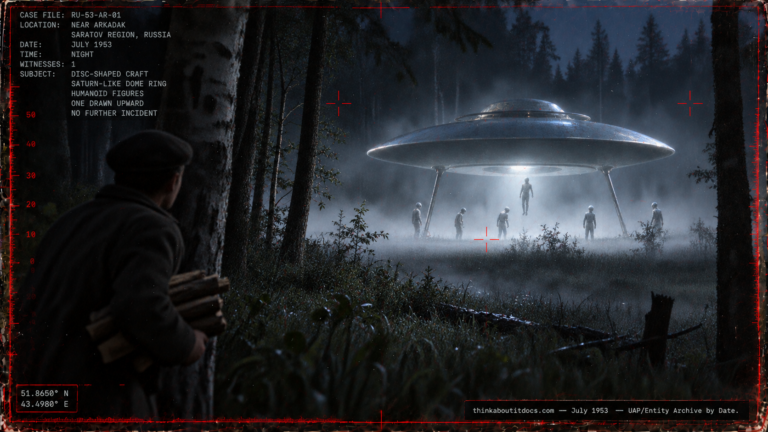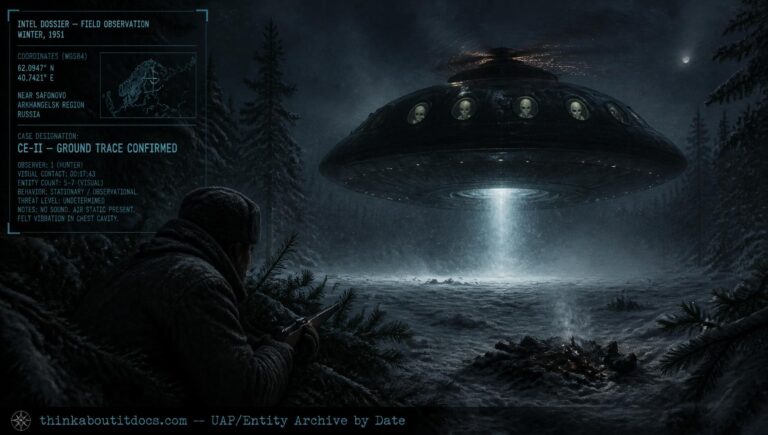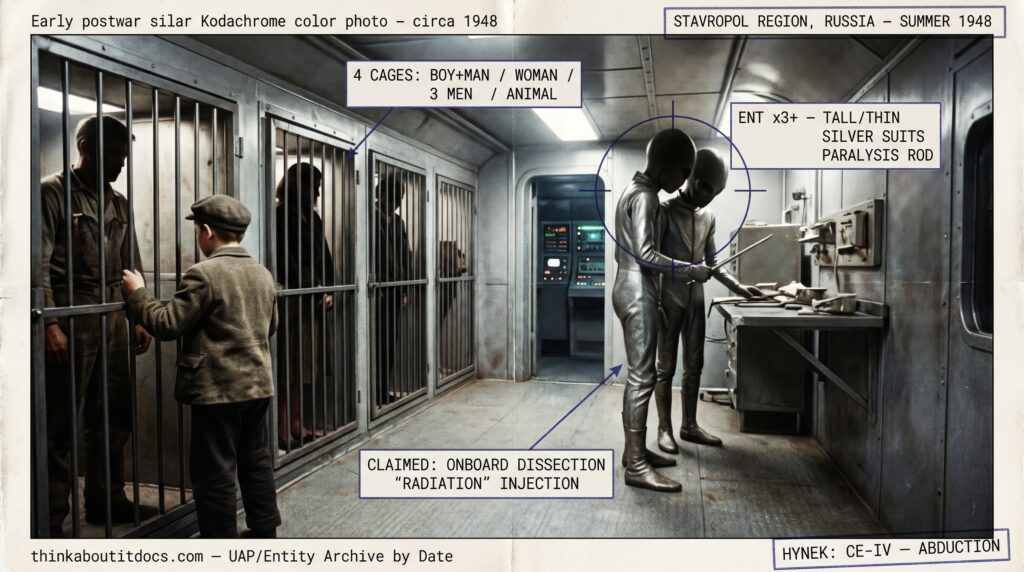
Four cages, two silver-suited captors, and a boy held with a stranger — the 1948 Stavropol abduction account, a vivid Soviet-era narrative held as Insufficient Data.
THINK ABOUTIT ABDUCTION REPORT
1948: Stavropol region, North Caucasus, Russia Abduction
A boy sent over a hill to nap while his sister and a neighbor girl sunned themselves woke to a soft, piercing whistle and saw a silver craft like a huge upturned plate settle onto three legs in the grass. Too scared to run, too curious to look away, he watched a door open and three tall, thin figures in silver suits walk out, take his hand, and lead him inside — into a corridor, then a room where four barred cages held a bear, a screaming naked woman, three praying men, and a Slavic stranger. They put the boy in with the stranger. What the boy would carry for the rest of his life was what came next: the aliens strapping one of the men to a table and dissecting him in the open, then washing away the blood; and “Uncle Sasha,” the mining engineer who freed himself by standing the boy on a bundle of his own clothes to reach a high button, who sabotaged the craft, was paralyzed by a metal rod, and bargained the boy’s release before agreeing to leave with them. The boy was dropped back in his field at dawn, sick with a metallic taste and a skin that could no longer bear sunlight — and three years later a man from the Secret Police came to a cow pasture to ask him what he remembered.
Date: Summer 1948
Sighting Time: Approximately noon–1:00 PM (abduction); released near dawn the following morning
Day/Night: Day (onset)
Location: Stavropol region, North Caucasus, Russia (rural collective-farm pasture near a small hutor/village)
Urban or Rural: Rural
No. of Entity(‘s): Three (plus at least one additional crew member seen at the controls; several seen sleeping)
Entity Type: Humanoid (tall, thin)
Entity Description: Very tall and very thin beings wearing silver suits. Capable of telepathic-style or spoken communication with the captive adult; used a hand-held metallic rod that instantly paralyzed on contact.
Hynek Classification: CE-IV (Close Encounter of the Fourth Kind) — abduction of the witness with onboard experience
Duration: Approximately half a day or more (midday capture to dawn release)
No. of Object(s): 1
Description of the Object(s): A large, silver-colored craft shaped like a huge upside-down plate, resting on three landing props. It emitted a soft but piercing whistle on arrival, then fell silent. Interior featured a narrow corridor with multiple sequential doors, a room with four barred metal cages, a wall-mounted fold-out “operating table,” control/cockpit area, and an engine/”reactor” room described as highly radioactive.
Shape of Object(s): Disc (huge upside-down plate)
Size of Object(s): Large (not precisely specified)
Color of Object(s): Silver
Distance to Object(s): Landed close to the witness (within yards)
Height & Speed: Vertical landing on three props; later departed on a “preliminary calculated route” toward a claimed mother ship; no speed given
Number of Witnesses: 1 primary on board (the boy, “V.Z.”); his sister and a neighbor girl were present in the area at the outset but are not described as witnessing the craft; multiple other captives described aboard (a woman, several men, and a bear)
Special Features/Characteristics: Onboard cages holding multiple humans and an animal; an in-view dissection of a captive; a sympathetic fellow-captive (“Uncle Sasha,” a Ural mining engineer) who freed himself, sabotaged the craft, and negotiated the captives’ release; a paralyzing hand-held rod; a stated alien motive of collecting radioactive material and studying humanity after the 1945 atomic tests; a “radiation” injection administered to the boy before release; subsequent prolonged illness, metallic taste, and photosensitivity; a Secret Police follow-up visit roughly three years later
Case Status: Insufficient Data
Source: Letter from the witness, published in “Cross of Centaurs” (Krest Kentavrov), Rostov-on-Don, No. 1, 2001; circulated through the Albert Rosales humanoid-encounter catalog
Summary/Description: In the summer of 1948, a boy (“V.Z.”) from a hutor in the Stavropol region was pasturing cows with his older sister and a neighbor girl. Sent to nap over a hill around midday, he was awakened by a soft whistle and saw a silver, plate-shaped craft land on three props. Three tall, thin beings in silver suits emerged, led him aboard, and placed him in one of four barred cages — others holding a bear, a hysterical naked woman, three praying Caucasian men, and a Slavic man. The boy witnessed the beings dissect one of the men on a fold-out table. The Slavic captive, a Ural mining engineer the boy called “Uncle Sasha,” freed himself (using the boy to reach a high control button), explored the craft as the crew slept, sabotaged it with a thrown metallic component, and was paralyzed by a rod-wielding alien. In subsequent dialogue the beings explained they sought radioactive material and had begun studying humanity after the 1945 atomic tests. Sasha negotiated the captives’ release and agreed to leave with the aliens on condition the others be freed; the boy was returned to his field by dawn, given a “radiation” injection, and left ill, with a metallic taste and lasting photosensitivity. Three years later a Secret Police officer questioned him about the encounter, which by then he could no longer recall.
Related Cases: 1947 Bahamut/Kokchetav, Kazakhstan encounter (adjacent Soviet contactee narrative) | 1948 Near Lazarevskoe, Sochi, Russia | 1989 Sochi, Caucasus close encounter | 1985 “Captured by Russian Forces” | broader Soviet/CIS abduction and contactee corpus
DETAILED REPORT
The account is a single-witness Soviet-era abduction narrative, preserved as a letter the witness — identified only by the initials V.Z. — sent to the Rostov-on-Don journal “Cross of Centaurs,” which published it in its first issue in 2001, more than half a century after the claimed event. By the account, in the summer of 1948 V.Z. was a boy living in a small hutor in the Stavropol region of the North Caucasus. It was his turn, along with his older sister and a neighbor girl, to take the collective farm’s cows out to pasture. Around midday, with the cows resting after grazing, the two girls decided to sunbathe and sent the boy over a hill to rest separately; he lay under a brush and fell asleep.
He was awakened by a soft but piercing whistle and saw a silver, plate-shaped craft descend onto three landing props nearby and fall silent. Frightened but transfixed, he did not flee. A door opened and three very tall, thin beings in silver suits emerged, took him by the hand, and led him through a narrow corridor — closing one door and then a second behind them — into a room where four barred metal cages stood. The cages held, respectively, a bear; a naked, hysterical, foaming woman; three men of Caucasian appearance; and a Slavic man, with whom the boy was caged. The boy describes himself as paralyzed by terror, unable to scream or resist. He then witnessed the encounter’s most disturbing element: the beings extracted a fold-out “operating table” from the wall, placed one of the unresisting Caucasian men upon it, and dissected him in full view, collecting the remains in a box and washing away the blood before leaving the room.
The narrative’s center of gravity is the Slavic captive — a self-described mining engineer from the Urals whom the boy came to call “Uncle Sasha.” Sasha calmed and protected the boy, then engineered an escape: he had the boy squeeze out through the cage bars and stand on a bundle of Sasha’s own clothing to reach and press a high wall button that released the cage lock. With the alien crew found sleeping in several rooms — including one dozing at the cockpit controls — Sasha searched the craft for a weapon, found none, and instead hurled a metallic component onto a bank of terminals, producing sparks, smoke, and alarms. Three woken beings overpowered him; one fetched a metallic rod whose touch instantly paralyzed him, and the captives were returned to the cage. In the dialogue that followed, the beings questioned Sasha about how he had resisted so effectively, expressed puzzlement at the low “development” of their other captives, and explained their purpose: they studied space and had taken interest in Earth after the 1945 atomic tests, regarding the explosive waste of radioactive material as madness when such material was scarce and valuable to them for energy and propulsion. Sasha negotiated the release of the human captives in exchange for agreeing to accompany the beings to their mother ship and home world, persuading them that no one would believe the witnesses anyway. The boy was returned to his own field by dawn, but not before the beings administered an injection they said he needed because he had been exposed to radiation in the engine room.
The aftermath is the most grounded portion of the account. V.Z. awoke to a search party of villagers calling for him; his mother found him feverish, trembling, thirsty, with a severe headache. He was ill for a long time, reported a persistent metallic taste, and could not tolerate bright sunlight — treated at home rather than in a hospital. When he tried to tell people, he was dismissed; his mother forbade him to write it down for fear of trouble with the militia. Three years later, while pasturing cows alone, he was approached by a military jeep carrying two militia men, a civilian, and a neighbor boy; the civilian — implied to be Secret Police — addressed him with false familiarity, claimed they had once “visited Leningrad” together, and pressed him about the alien encounter, offering education and respect if he would tell what he knew. By then V.Z. claimed he could remember nothing. The civilian proposed hypnotic interrogation; the militia men declined, and the group left after warning him to say nothing of their visit.
As evidence, the account is extraordinarily detailed but rests on the weakest possible chain: a single, anonymized witness, recounting a childhood event some fifty years after the fact, published in a regional ufology journal and circulated through a humanoid-encounter catalog. There is no corroborating witness to the craft (the sister and neighbor girl are not described as having seen it), no physical evidence, and no contemporaneous record. The narrative also carries the hallmark furniture of the Soviet atomic-age abduction genre — the cobalt/radioactive-material motive, the benevolent resourceful fellow-captive, the open dissection, the memory loss, and the menacing-but-thwarted state-security coda. These features make for a compelling story but cannot be verified, and several echo a recognizable template rather than reading as an independent observation.
RESEARCHER’S NOTES
The Cages and Uncle Sasha — Stavropol 1948 and the Soviet Atomic-Age Abduction Narrative
- Classification Basis: CE-IV (abduction) is the correct category and is well-supported by the narrative’s own content: the witness is physically taken aboard, held, and subjected to an onboard experience, with a claimed medical intervention (the injection). Unlike contactee accounts that center on voluntary, benevolent communion, this is an involuntary-capture narrative with horror elements, which fits CE-IV squarely. No reclassification is needed.
- Source Chain Assessment: This is the case’s defining weakness. The sole source is a letter from an anonymized single witness, published in the Rostov-on-Don journal “Cross of Centaurs” (No. 1, 2001) and propagated through the Rosales humanoid catalog — placing it, under the archive’s source hierarchy, in the problematic tier (regional self-published account, single uncorroborated witness, decades-delayed). There is no named witness, no contemporaneous documentation, and no second observer of the craft. The detail is rich, but richness of narrative is not provenance.
- Pattern Context: The account is a near-textbook example of the post-Soviet wave of atomic-age abduction stories that surfaced in Russian ufology publications in the 1990s and early 2000s. Its signature elements recur across that corpus: extraterrestrials drawn to Earth by the 1945 atomic tests; a stated alien interest in radioactive material as fuel; a resourceful, sympathetic fellow-captive who outwits the crew; an unflinching onboard dissection; deliberate memory suppression; and a sinister Secret Police follow-up. It is a genre cousin of the 1947 Kokchetav, Kazakhstan narrative elsewhere in this archive and shares the period’s preoccupation with state surveillance. These shared motifs suggest a narrative shaped by convention, whether at the witness’s or the publication’s stage.
- Physical Evidence and Evidentiary Weight: There is no physical evidence — no photograph, no trace, no medical record of the claimed illness, no recovered state-security file. The claimed aftereffects (fever, metallic taste, photosensitivity) are evocative and consistent with a radiation-exposure motif, but exist only within the testimony. With a single anonymized witness, a fifty-year delay, no corroboration of the craft itself, and a heavy load of genre-standard elements, the account cannot be elevated toward Unexplained. Insufficient Data is the accurate standing, retained for study as a representative specimen of the Soviet atomic-age abduction narrative rather than as a verified event.
The Stavropol abduction is one of the most cinematic entries in the Soviet-era record — the silver plate on three legs, the cages, the open dissection, “Uncle Sasha” and his sabotage, the radiation injection, and the Secret Police at the cow pasture three years on. It is also, by the plainest measure, unverifiable: a single anonymized witness, a letter to a regional journal published fifty years after the fact, no second observer of the craft, no physical trace, and a structure built from the recurring furniture of the Soviet atomic-age abduction genre. The record holds it as CE-IV by the nature of its claims and assigns Case Status: Insufficient Data — preserved in full for study as a vivid example of how these Cold-War-shadowed abduction narratives are told, and explicitly held apart from the verified record rather than advanced as fact.