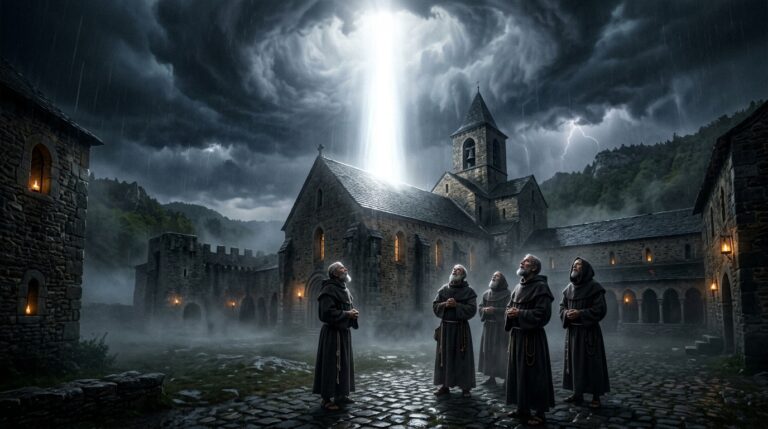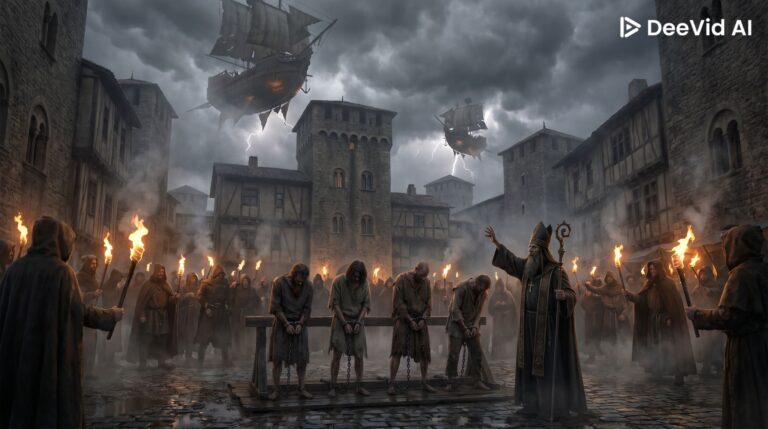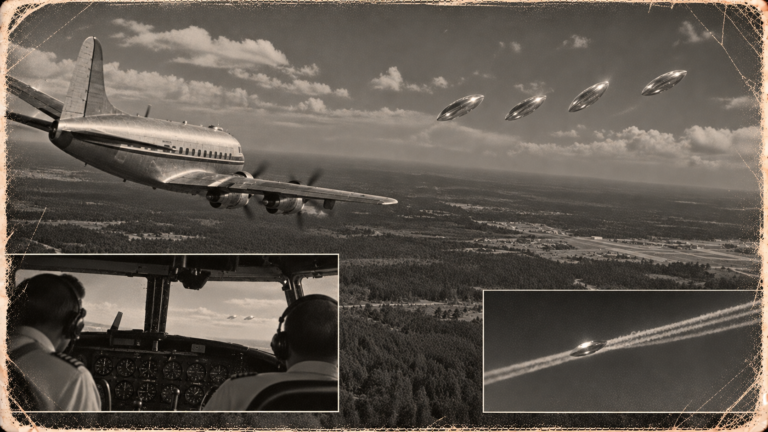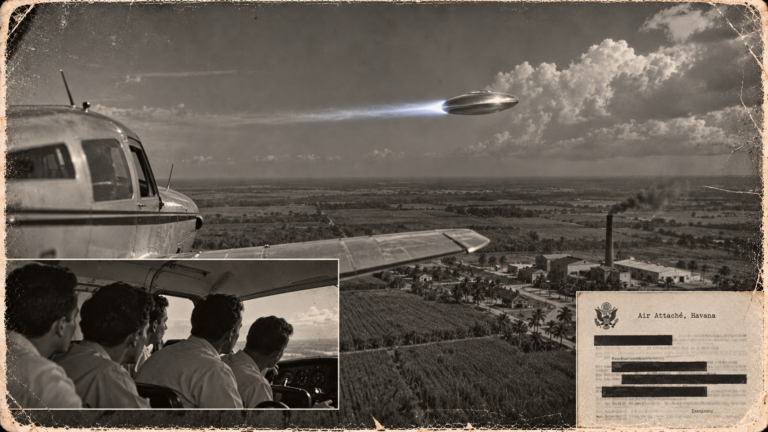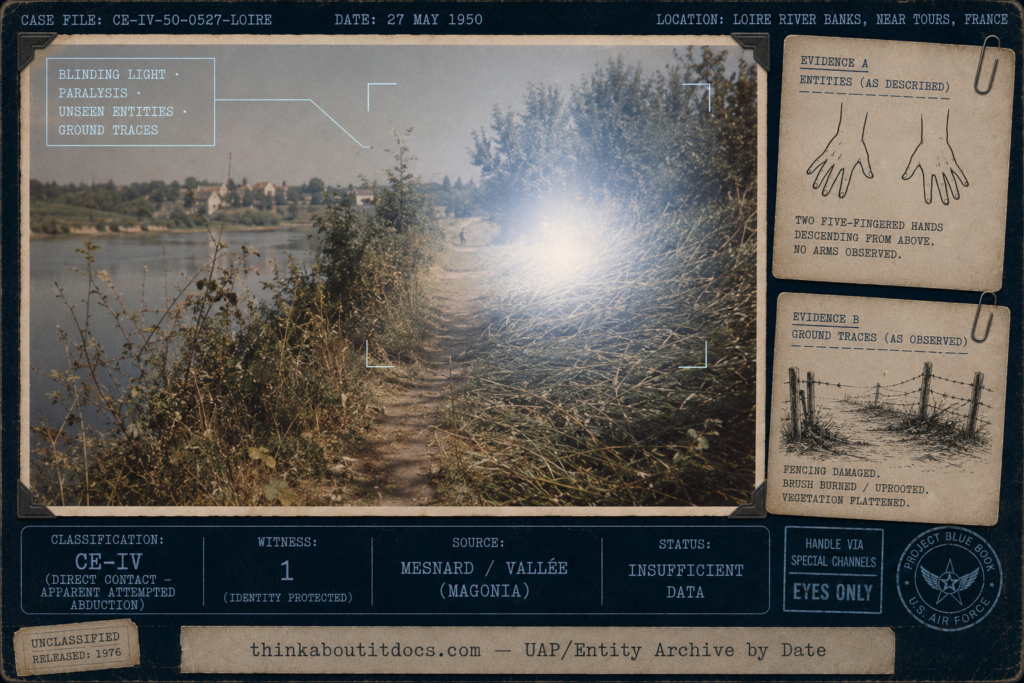
The Cours-les-Barres encounter, along the River Loire, France, May 20, 1950 — a lone woman seized in blinding light by unseen entities and dragged through brush, with physical traces reported afterward; classified CE-IV (direct contact), status Insufficient Data.
THINK ABOUTIT UFO | UAP | ENTITY ENCOUNTER REPORT
1950: The Cours-les-Barres Encounter — France
On the afternoon of May 20, 1950, a woman was walking a path along the steep banks of the River Loire near Cours-les-Barres, in central France, when she was suddenly engulfed in a brilliant, blinding light and felt herself go rigid, unable to move. Two enormous dark hands — five-fingered, black with a coppery yellow cast, attached to no visible arms — descended from above and clamped over her face and head. What followed, by her account, was a violent, several-minute ordeal at the grip of something she never saw: a presence that felt like cold iron, that pressed her against an armored chest, that delivered a shock like lightning, laughed a strange muffled laugh, and dragged her backward through brambles at impossible speed while a voice declared that they had her. Then, as abruptly as it began, it released her. She made it back toward the houses bleeding and exhausted, and behind her the trees bent under a sudden roaring whirlwind and a flash of white light as something unseen tore away. It is one of the most bizarre and difficult entries in the early French record — vivid, frightening, and resting entirely on the testimony of a single person.
Date: May 20, 1950
Sighting Time: 1600 hours (4:00 p.m.)
Day/Night: Day
Location: Cours-les-Barres (Cher department), central France — a path along the steep banks of the River Loire
Urban or Rural: Rural
No. of Entity(‘s): At least 2 (the unseen aggressor and an apparent unseen accomplice)
Entity Type: Unseen / invisible humanoid(s); perceived as metallic and hard-bodied
Entity Description: The entities themselves were never seen. The witness perceived only two huge hands — five-fingered, black with a yellowish, copper-like tint — descending from above with no visible arms. The presence felt cold, rigid, and hard, like iron or an armored carapace; she sensed invisible arms pressing on her shoulders and a steel-hard “knee.” She heard a strange, muffled laugh “as if through water” and a short, rough voice, seemingly addressing an unseen companion.
Hynek Classification: CE-IV (Close Encounter IV) — direct physical contact with the witness; in effect an apparent attempted abduction (the witness was seized and dragged but not taken aboard any craft, and ultimately escaped)
Duration: About a quarter of an hour to 20 minutes
No. of Object(s): 1 (a maneuvering luminous object seen the previous evening; an unseen object apparently departed at the end)
Description of Object(s): The night before, the witness had watched a “shooting star” that stopped abruptly, climbed and held among the stars, then enlarged and took on a swinging motion with its light pulsing on and off. During and after the assault she experienced a blinding white light; at the end, a roaring whirlwind bent the trees and a brilliant flash accompanied something that flew off at speed, seen by no one.
Shape: Not resolved (the previous night’s object appeared star-like, then enlarged)
Size: Not established
Color: Brilliant blinding white (the light); the perceived hands black with a coppery tint
Distance: Direct physical contact
Height & Speed: The prior-night object maneuvered and hovered among the stars; the departing object was unseen but accompanied by a violent displacement of air
No. of Witnesses: 1 (an unnamed woman)
Special Features/Characteristics: Engulfing blinding light and a sense of paralysis; an electric-shock sensation; physical seizing, squeezing, and dragging by unseen entities; a muffled laugh and a voice; a metallic taste, nervous exhaustion, and a burning sensation across the back afterward; lacerated, bleeding legs; claimed physical traces at the site — scorched and flattened brush, burned and uprooted fence posts, and broken barbed wire
Case Status: Insufficient Data
Source: Joël Mesnard, MUFON UFO Journal #309; Jacques Vallée, Passport to Magonia
Summary/Description: About 4:00 p.m. on May 20, 1950, a woman walking a path along the Loire near Cours-les-Barres was suddenly surrounded by a blinding light and felt paralyzed. Two large, dark, copper-tinted hands without visible arms seized her head from above and pressed her against a cold, hard, armored-feeling body. She described an electric-shock sensation, a strange muffled laugh, and a rough voice that seemed to tell an unseen accomplice that they had captured her. She was dragged backward through brambles at great speed before being released in a small pasture, where she heard movement in the bushes but saw no one. She made her way back toward the village, bleeding and exhausted, with a metallic taste in her mouth and a burning sensation on her back; behind her a sudden roaring whirlwind bent the trees and a blinding flash accompanied an unseen object departing at speed. Later examination of the site reportedly found scorched and flattened brush and damaged fencing. The witness had, the previous evening, observed a star-like light that stopped, climbed, and maneuvered with a pulsing glow.
Related Cases: 1954 — Quarouble, France (Marius Dewilde — paralysis, entities, ground traces) | 1954 — the French humanoid wave (occupant and direct-contact reports across France) | the Vallée Passport to Magonia corpus linking modern contact reports to older abduction folklore
Detailed Report
The Cours-les-Barres case is among the strangest in the entire early European record, and it must be approached with both seriousness and care: seriously, because the witness described a coherent, detailed, terrifying experience and there were claimed physical traces; carefully, because the entire event rests on one person’s testimony and its phenomenology is genuinely difficult to interpret.
The sequence, told plainly and without dwelling on its violence, runs as follows. Walking a riverside path in daylight, the woman was abruptly enveloped in a blinding light and felt her body lock up. Hands she could see — but arms she could not — took hold of her head from above. For something over a minute she was gripped, squeezed, and subjected to what she described as an electric jolt, while a presence that felt like cold metal held her against itself. She heard a muffled laugh and a short, rough voice that seemed to announce her capture to an unseen second party. She was then dragged backward through thorny brush at a speed she could not reconcile with anything human, and finally released in a small pasture. Around her the vegetation moved and rustled as though trodden by something she could not see. She struggled back toward the houses, her legs cut and bleeding, a metallic taste in her mouth, a burning sensation across her back, her muscles barely answering. As she reached the bend in the path, a violent rush of warm air and a roaring like a storm bent the trees, a white flash filled the air, and she sensed something race away unseen.
Two elements lift the account above pure subjectivity, and both deserve weighing. First, the witness reported that the previous evening she had seen a star-like light behave anomalously — stopping, climbing, hovering among the stars, enlarging, and swinging with a pulsing glow — which, if accurate, places an aerial component in the area before the encounter. Second, later examination of the site reportedly found physical disturbance: brush that was scorched in places and flattened in others, fence posts burned or pulled out, and barbed wire broken. If genuine and genuinely related, those traces are the case’s only tangible corroboration.
But the difficulties are equally real and must be stated. There was exactly one witness to the encounter, and the entities were never actually seen — only inferred from hands, voices, sensations, and movement in the brush. Several of the reported sensations — engulfing light, paralysis, electric-shock feelings, a buzzing or watery quality to sounds, a metallic taste, and the impression of an unseen presence — are sensations also documented in a range of ordinary neurological and altered-state experiences, which is a possibility that has to remain on the table without being asserted as fact, since no medical information about the witness is available and no diagnosis can responsibly be made from a narrative. The claimed physical traces, meanwhile, come through “later investigation” without a clear chain of documentation, and damaged fencing and scorched brush in rural country can have prosaic origins.
The case reaches us through respectable hands. Joël Mesnard was a serious French investigator and editor, and Jacques Vallée included the report in Passport to Magonia, his influential catalog arguing that modern encounter reports echo older folklore of abduction by unseen or otherworldly beings. That framing is itself instructive: the Cours-les-Barres narrative — seized from above, dragged by an invisible captor, a voice claiming the victim, a sudden release — reads as much like a folkloric abduction tale as a technological one, which is precisely the resonance Vallée was cataloging. Whether that points to a real anomalous phenomenon, a profound subjective experience, or some combination, the evidence as it survives does not allow a confident verdict.
RESEARCHER’S NOTES
The Cours-les-Barres Encounter — France 1950 and the Limits of a Single Account
- Classification. The live page’s CE-IV is defensible under the broad definition the category carries — direct physical contact with the witness — but it needs qualifying. This was not a classic abduction in which the witness is taken aboard a craft and later returned; it was a sustained, violent physical contact with unseen entities, in effect an attempted abduction that the witness survived and escaped. CE-IV (direct contact) is the closest fit, and it is more accurate than CE-III, since the entities were never actually observed — only their hands, voices, and effects. The label is retained with that clarification.
- Source chain. The provenance is reasonable for a single-witness continental case: investigation by Joël Mesnard, publication in the MUFON UFO Journal, and inclusion in Vallée’s Passport to Magonia. These are credible cataloging sources. What they cannot supply is independent corroboration of the core event — there is no second witness, no contemporaneous official report reproduced here, and the physical-trace findings are described only generally. The chain establishes that the account was collected and taken seriously, not that the events occurred as described.
- Pattern context. The case sits at the leading edge of France’s rich entity-encounter record, four years before the great 1954 humanoid wave that produced Quarouble and dozens of other occupant and contact reports. Its profile — a lone witness, paralysis, an electric or beam-like effect, unseen or barely-seen beings, and ground traces — recurs across that wave. Its deeper resonance, as Vallée emphasized, is with pre-modern abduction folklore: the invisible captor, the seizure from above, the spiriting-away through wild ground. That dual character makes it a frequently cited but rarely resolved case.
- Physical / evidentiary weight. Low to moderate, and bounded by its single-witness nature. The account is detailed, internally consistent, and was clearly a powerful experience for the witness; the prior-night light and the claimed site traces add intriguing but thinly documented support. Against confidence: no corroborating witness, entities that were never seen, a phenomenology that overlaps with ordinary altered states, and physical evidence reported without a firm investigative chain. This is neither demonstrably anomalous nor explained away — it is genuinely underdetermined. The honest disposition is Insufficient Data: a striking, sincerely reported experience that the surviving evidence cannot carry to any firm conclusion.
The Cours-les-Barres encounter is a case that resists every easy reading. Taken at face value it is one of the most frightening contact reports of its decade; taken critically it is a single uncorroborated account whose most dramatic features have no independent confirmation and whose sensations have more than one possible source. The respectable sourcing and the claimed physical traces keep it from being dismissed outright; the lone witness and the unseen assailants keep it from being affirmed. It belongs in the chronological record honestly catalogued — a vivid, disturbing, and ultimately undetermined direct-contact case, preserved for study rather than presented as established fact.