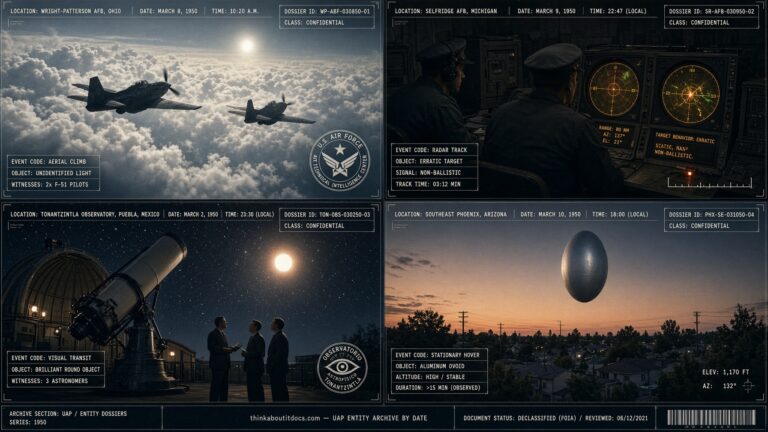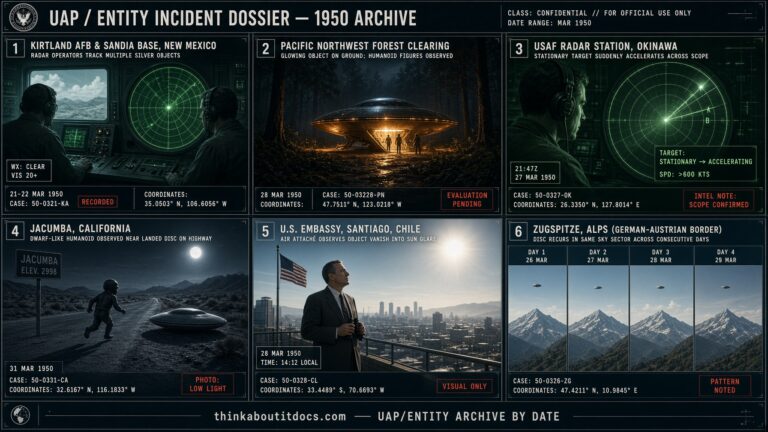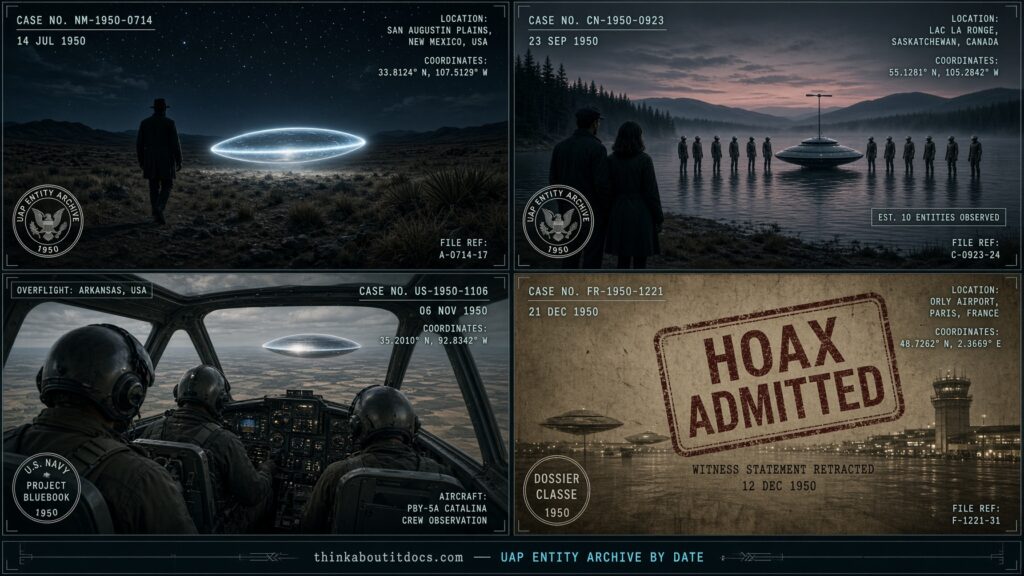
Four defining cases from July 1950, headlined by the Daniel Fry White Sands Incident.
1950: July UFO|UAP & Entity Sightings Archive
A quieter month numerically, July 1950 nonetheless produced one of the contactee movement’s founding narratives: Daniel Fry’s claimed thirty-minute round trip to New York City aboard a craft piloted by an entity called A-lan, documented in full via the standalone report linked below. The month also brought a detailed occupant sighting at Steep Rock Lake, Ontario, a Navy radar-visual case in Arkansas, and a French sighting later admitted by its own promoters to have been a hoax. A run of Army and Air Force paperwork rounds it out: a tumbling bow-tie object at Redstone Arsenal, a Jacksonville dawn roar and an Air Materiel Command memo urging intelligence officers to ask fewer questions, a red object that exploded over Ladd AFB, a drive-in saucer at Spartanburg, and a Pullman, Washington rumor of a recovered object.
Date: July 1950
Location: Mt. Washington, Cincinnati, Ohio
Time: 1:45 p.m.
Summary: A CAA flight engineer with 11 years of experience, sitting in his backyard, noticed an oddly shaped dark spot and described it as “wingless and fuselage shaped,” climbing at a 60-degree angle into a sunny sky filled with cumulus clouds. After a quick acceleration, the grayish metallic object reached 16,000 to 18,000 feet and stalled for about 10 seconds. While he called his wife, he watched it dive back to its original elevation, level off and race westward, disappearing in about 3 seconds with no sound or exhaust trail. He judged it the size of a DC-3 seen at 8,000 feet, at roughly 5,000 mph, and said it was “definitely solid and was controlled.” The Air Force later visited him at home. Witnesses asked not to be named.
Source: Stringfield, Leonard H., CRIFO bulletin, April 7, 1954; Hall, Richard H. The UFO Evidence NICAP, Washington, 1964 (Section V)
Source Status: The Blue Book July 1950 listing carries this case as information only, from the CRIFO bulletin, and marks it as not in the file. The exact day in July is not given.
Date: July 1, 1950
Location: Chicago, Illinois
Time: 01:09
Summary: Dr. L. Vatter reported a round, intensely bright, soundless object flying from the northern horizon to the southern horizon in two seconds on a horizontal course at high altitude, over the west side of the city. He said it was not a meteor and that he knew what meteors look like, calling it a ball of fire. Fifth Army headquarters forwarded the report to Air Materiel Command on July 14, 1950 and contemplated no further investigation; the Blue Book listing evaluates it as Astro (Meteor).
Source: Fifth Army letter to Air Materiel Command, July 14, 1950; Blue Book July 1950 sightings listing (Astro — Meteor)
Date: July 1, 1950
Location: Fairbanks, Alaska
Time: Saturday night
Summary: The Alaskan Air Command announced that a flaming object that flashed across the sky over Fairbanks on Saturday night was a meteor.
Source: UP wire story, July 4, 1950 (information only)
Source Status: Another Fairbanks-area report, from Ladd AFB, appears on July 22 below, and an earlier Ladd AFB entry on May 10.
Date: July 2, 1950
Location: Steep Rock Lake, Ontario, Canada
Time: Evening
Summary: After feeling a blast-like vibration, Mr. and Mrs. Gordon Edwards looked toward the lake and saw a large, shiny object on the water less than a quarter mile away, resembling “one saucer upside down on another” with round portholes around its edge. An open hatch on top revealed about ten “queer little figures,” each under four feet tall; a hoop-shaped antenna rotated slowly above them. The topmost figure wore a red skullcap, the others dark blue, all with a shiny metallic covering over the chest and no visible faces. Moving like automatons, they appeared to be drawing water through a bright green hose and discharging it through another. When the witnesses looked again, the figures were gone and the craft — about 48 feet wide and 15 feet thick — had risen to roughly 8 feet above the water; it tilted to 45 degrees and departed northward with a blast of wind.
Source: Gordon Edwards
Date: July 2, 1950
Location: Raleigh, North Carolina
Time: Night
Summary: Louis Polier, a local architectural engineer standing in his front yard on North Boylan Avenue, reported nine objects passing over Raleigh in a northwesterly direction in “ragged” formations of three. Each glowed rather brightly, but they did not look like planes with windows; in the dark he could not estimate altitude or speed, and there was no noise. Third Army forwarded the clipping to Air Materiel Command on July 11, 1950, and the Air Force card evaluates the case as A/C (aircraft).
Source: News and Observer (Raleigh), July 3, 1950; Project 10073 Record Card (A/C); Third Army letter, July 11, 1950
Date: July 4, 1950
Location: White Sands Proving Ground, New Mexico
Time: Evening, approximately 20:30
Summary: Technician Daniel Fry, walking in the desert after missing a bus to that evening’s fireworks, watched an oblate spheroid craft about 30 feet across settle to the ground 70 feet away. A voice warned him not to touch the still-hot hull, identified itself as “A-lan,” and explained he had been chosen for contact due to his scientific background. Fry was invited aboard and reported a roughly 8,000-mile round trip to New York City and back in about 30 minutes. A-lan identified himself as a descendant of the sunken continent of Lemuria. Fry reported further contacts with A-lan over subsequent years; he later revised the date of this first contact to 1949 in retellings. See the Full Report.
Source: Daniel Fry, The White Sands Incident
Date: July 5, 1950
Location: Los Angeles, California
Time: About midnight
Summary: William Grant, 26, a former Marine Corps aerial photographer, reported a brilliantly lighted circular object that he estimated at 50 feet in circumference. First seen about 1,000 feet overhead moving about 100 mph, it sped up to about 500 mph before disappearing behind the Hollywood hills. He said it was in sight about 45 seconds and left no exhaust trail and made no sound. A friend, Gilbert Magill, 35, president of a helicopter research firm, confirmed the story.
Source: AP wire story, July 6, 1950, as clipped in the New York Herald Tribune (information only)
Date: July 5, 1950
Location: Hill AFB, Utah
Time: Unknown
Summary: A military witness reported an unidentified object at Hill Air Force Base. The Blue Book listing evaluates the case as A/C (aircraft).
Source: Blue Book July 1950 sightings listing (A/C)
Source Status: No case file for this report is in the archive set; the entry rests on the Blue Book July 1950 sightings listing alone.
Date: July 7, 1950
Location: Richland, Kansas (near Topeka)
Time: 07:45
Summary: Civilians reported a slow-moving, platter-shaped object. The report reached the Air Force through an Office of Special Investigations report dated July 12, 1950, whose text is largely illegible in the archive scan; the Air Force card evaluates the case as Balloon.
Source: Project 10073 Record Card (Balloon); AFOSI report, July 12, 1950
Date: July 7, 1950
Location: Wiesbaden, Germany
Time: 10:20 p.m. local (2120Z)
Summary: A GCA radar operator directing the landing of a U.S. aircraft at Wiesbaden Air Base noticed an additional target alongside the aircraft under control; a second operator confirmed it. After several minutes, the target appeared to separate into two or three blurred individual targets spaced 90 to 100 degrees apart, which then moved at very high speed in a counterclockwise motion on the scope. The targets seemed 3 to 4 miles away and too high for good returns, and were lost about 2137Z as the operators concentrated on the aircraft. The operators thought the speed suggested jets, but the control tower knew of no jets in the area, and an airman quartered in town reported hearing low-flying jet sounds about 2200Z. The Air Force card evaluates the case as probably aircraft, with the comment “probable flt of jet ACFT.”
Source: Air Intelligence Information Report IR-262-50, Hq MATS (September 8, 1950); Project 10073 Record Card (probably aircraft); Dan Wilson
Date: July 8, 1950
Location: Peril Strait, Alaska
Time: Unknown
Summary: A witness listed as Juntunen, with others, reported an unidentified object over Peril Strait. The Blue Book listing evaluates the case as Balloon.
Source: Blue Book July 1950 sightings listing (Balloon)
Source Status: No case file for this report is in the archive set; the entry rests on the Blue Book July 1950 sightings listing alone.
Date: July 10, 1950
Location: Fort McPherson, Georgia
Time: 10:25
Summary: At least three personnel of the 111th CIC Detachment, including warrant officer Francis J. Riley, sighted a small, bright metallic object to the northwest, in plain view for about 15 minutes before low clouds obscured it. It was moving east at a slow rate of speed at an unpredictable height, “very high.” OSI at Marietta, Georgia was notified immediately, and the Air Force card evaluates the case as Balloon.
Source: Project 10073 Record Card (Balloon); CIC Summary of Information, 111th CIC Detachment, July 10, 1950; Third Army letter, July 11, 1950
Date: July 10, 1950
Location: Wilmington, Ohio
Time: Unknown
Summary: The Blue Book listing records a newspaper clipping about an unidentified object reported at Wilmington, Ohio, filed as information only and evaluated Others.
Source: Blue Book July 1950 sightings listing (information only; Others)
Source Status: No case file for this report is in the archive set; the entry rests on the Blue Book July 1950 sightings listing alone.
Date: About July 10, 1950
Location: Horse Heaven Hills, Washington (reported from Pullman)
Time: Unknown
Summary: A Navy lieutenant in Pullman, Washington wrote on July 26 to the 13th Naval District intelligence officer relaying what the Washington State College police chief had been told by a State Patrol officer: a citizen had found a saucer-shaped metal object about 6 inches thick and 20 inches across in the Horse Heaven Hills, and an Army officer from the Hanford Atomic Project quickly collected it, telling the patrolman that saucers come in three sizes up to 250 feet, that some are piloted, are atomic-powered, can reach 3,600 mph and are launched from Hanford. This is a fourth-hand account with no object produced, and the memo’s author mainly asked whether the officer had breached security. The Air Force card reads Insufficient Data. See the Full Report.
Source: Project 10073 Record Card (Insufficient Data); memorandum to the District Intelligence Officer, 13th Naval District, July 26, 1950
Source Status: This is a hearsay account. The date is estimated from “about two weeks ago” in a July 24 conversation.
Date: July 11, 1950
Location: Jacksonville, Florida
Time: About 5:00 a.m.
Summary: A tremendous roar, unlike that of bombers because it lacked a steady sound, woke Times-Union reporter Toni Veverka, who saw a great golden light come out of the southeast at about 500 feet with no running lights, glowing from beneath with violet flashes streaming into a short comet’s tail. Seen from the rear, it wavered up and down like a phonograph record on an uneven center, curved northwest, then made a sweeping curve and returned. About 15 minutes later a second came, much higher, and 15 minutes after that a third. A radio announcer at WMBR reported three objects at 4 a.m. flashing a red light and flying concentric circles at about 15,000 feet; the consensus size was 20 to 30 feet. The Air Force card evaluates the case as A/C (aircraft). See the Full Report.
Source: Florida Times-Union, July 11, 1950; Miami Herald (UP), July 13, 1950; Project 10073 Record Card (A/C)
Source Status: The Miami Herald says the roar came “early Wednesday” (July 12), while the Times-Union piece is dated July 11; the Air Force card and Blue Book listing use July 11.
Date: July 11, 1950
Location: Near Osceola, Arkansas
Time: Unknown
Summary: The crews of two Navy planes saw a disc-shaped object, its presence separately confirmed on airborne radar. Lt. (j.g.) J. W. Martin, enlisted pilot R. E. Moore, and electronics technician G. D. Wehner described the object as first appearing as a round ball ahead and to the left of their aircraft; as it crossed their flight path and receded to the right, it resembled “a World War I helmet seen from the side, or a shiny, shallow bowl turned upside down.” Wehner reported catching it on radar, with a closest-approach range estimated at about a mile.
Source: Weinstein, Dominique; Blue Book files (BBU)
Source Status: This case does not appear on the Blue Book July 1950 sightings listing in the archive file.
Date: July 13, 1950
Location: Saudi Arabia
Time: Unknown
Summary: A military air report from Saudi Arabia. The Blue Book listing evaluates the case as Astro (Meteor).
Source: Blue Book July 1950 sightings listing (Astro — Meteor)
Source Status: No case file for this report is in the archive set; the entry rests on the Blue Book July 1950 sightings listing alone.
Date: July 13, 1950
Location: Fort Peck, Montana
Time: 11:50 a.m.
Summary: A USAF weather reconnaissance flight crew saw four groups of round, metallic silver objects.
Source: Weinstein, Dominique
Source Status: The Blue Book July 1950 listing evaluates this report as Balloons.
Date: July 13, 1950
Location: Redstone Arsenal (Huntsville), Alabama
Time: 5:00 p.m.
Summary: Two men on the rear porch of the civilian bachelor’s quarters — a Chief Signal Office employee from Washington, and an engineer aide at the Ordnance Rocket Center, including a Mr. Washburn per Berliner — saw a polished aluminum object, shaped like a bow tie from two triangular sections and about the size of a standard door, flying level at about 1,000 feet and 100 to 125 mph. It was very bright even though the sky was heavily overcast with a black thunderhead behind it. Followed 5 to 8 miles to the quarry on Madkin Mountain, the two triangles appeared to flap, the leading one turning clockwise and the rear one counter-clockwise, about a quarter turn each, for about half a minute. The object then turned at a right angle and accelerated out of view in under 3 seconds. See the Full Report.
Source: Project 10073 Record Card (Unidentified); Report of Unusual Incident, Redstone Arsenal, July 13, 1950; Third Army letter, July 21, 1950; Berliner; FUFOR Index (BBU #758)
Date: July 13, 1950
Location: Jacksonville, Florida (county courthouse)
Time: 3:45 p.m.
Summary: About fifty courthouse employees and as many passersby gathered on the Forsyth Street side of the building to watch a shiny aluminum “pin-point” in the blue sky, too high to show features but apparently round. Two jets passed well beneath it, their wingspan seeming about twice the object’s diameter. Observers guessed a weather balloon; it appeared to hover laterally while drifting slowly upward until it vanished, with no jets and no noise. The Air Force card evaluates the case as Astro (Venus). See the Full Report.
Source: Florida Times-Union, July 14, 1950; Project 10073 Record Card (Astro — Venus)
Date: July 14, 1950
Location: Vandalia, Ohio
Time: 7:51 a.m. and about 8:30 a.m.
Summary: Two Air Materiel Command-linked witnesses reported objects on the same morning. A woman driving on Martindale Road about six miles west of Vandalia saw a grayish-white sphere “like a parachute” moving at high speed to the northeast, with no reflection from the bright sun, about 5,000 feet up for half a minute. An AMC employee entering the base at 7:51 a.m. saw a bright silver object climb from about 1,000 to 10,000 feet over Area C for several minutes, which she thought was a plane taking off from Patterson Field. AMC checked parachute drops, balloon releases and astronomy and found no explanation for the first; Operations said no aircraft took off from Area C at that time. The Air Force cards evaluate the case as A/C (aircraft). See the Full Report.
Source: Project 10073 Record Card (A/C); Air Materiel Command memorandum, July 14, 1950; Colonel Feiling memorandum, July 19, 1950
Date: July 15, 1950
Location: Los Alamos, New Mexico
Time: 2:15 p.m.
Summary: A bright, metallic aluminum-colored, flying-wing-shaped object, with no fuselage and a transparent section in the middle, was seen from the Gamma Building at Los Alamos heading east to west over the mountains. It was about 15 degrees above the horizon, at an estimated 15 miles away, about 35 feet in size and moving at about 300 mph with a yawing motion in straight flight; the window blocked the view of its disappearance. About one minute.
Source: Sparks; Blue Book microfilm, NARA Roll 91, pp. 489-492 (via NICAP 1950 chronology)
Source Status: The Blue Book July 1950 listing evaluates a July 15 Los Alamos report as A/C.
Date: July 20, 1950
Location: Detroit, Michigan (Southfield Township)
Time: 10:00 p.m.
Summary: Six Girl Scouts aged 12 to 14 and two adult leaders at a campfire at a Southfield Township camp saw an “awesome brilliance” shaped like a cigar or zeppelin that roared toward them, broke in two and rejoined. The girls ran for cover when it looked as if it would crash, and it vanished as suddenly as it came. Neither the girls nor the leaders thought it looked like what a flying saucer is supposed to look like. Neighbors in Franklin Village also reported the radiance but could not confirm its shape. Fifth Army forwarded the clipping on August 10, 1950 and contemplated no further investigation; the Air Force card evaluates the case as A/C (aircraft).
Source: Detroit Free Press, July 22, 1950; Project 10073 Record Card (A/C); Fifth Army letter, August 10, 1950
Source Status: An August 1, 1950 UP report quotes an Air Force spokesman at Selfridge Field attributing repeated Michigan reports of “huge bombers launching flying saucers” to F-86 Sabre jets making mock attacks on B-36 bombers. The clipping does not mention this camp sighting by name.
Date: July 22, 1950
Location: Ladd AFB (Fairbanks), Alaska
Time: 5:10 p.m. Alaska time (03:10Z, July 23)
Summary: Soldiers manning anti-aircraft gun positions beside the Ladd AFB airstrip watched a red, round object about three feet across by their estimate, with two white dots beneath it that seemed to revolve around it, drifting from east to west and slowly descending for 20 minutes in clear skies. A stream of smoke then appeared, and the object exploded and disappeared. The Alaskan Air Command called the witnesses very reliable but said the truth of the incident could not be evaluated with dependable objectivity, and floated a meteorological balloon drifting in from another station; the Air Force card evaluates it as Balloon (Exploding). See the Full Report.
Source: Project 10073 Record Card (Balloon — Exploding); Alaskan Air Command Intelligence Report 17-50, summarized by Hq USAF, September 1950
Source Status: Another Ladd AFB sighting is recorded on May 10, 1950, and a Fairbanks flash on July 1; no connection is established.
Date: July 22, 1950
Location: Spartanburg, South Carolina (Starlite Drive-In Theater)
Time: Between 23:00 and 24:00
Summary: A Spartanburg Journal reporter, his wife and two men in the next car watched a large luminous saucer-shaped form, rounded and fairly flat on the bottom and surrounded by mist or smoke, appear three times over about an hour at an estimated 2,000 feet and a bit under a mile away. The first two appearances were in the same spot, the third lower and to the right, with the bottom brightly lit as if by reflected forest fire; the stars shone clearly beyond it. The reporter estimated the underside at about 200 feet across and said all four agreed it was no aircraft or planet. The Counter Intelligence Corps interviewed him on July 24; the Air Force card evaluates the case as Astro (star or planet). See the Full Report.
Source: Spartanburg Herald-Journal, July 24, 1950; CIC report, July 24, 1950; Project 10073 Record Card (Astro — Star/Planet)
Date: July 23, 1950
Location: Guyancourt Airport, France
Time: 23:00
Summary: This case was later admitted by its own promoters to have been a hoax and is preserved here for the record rather than as a genuine sighting. As originally told: walking in the dark near the airport, Claude Blondeau came upon two round craft “resembling two enormous folded napkins, one upside down on the other,” 15 feet in diameter and 6.5 feet high, with square portholes around the rim, hovering just above the ground. A normal-sized man in a flying suit reportedly emerged from each craft; Blondeau approached and asked if they were in trouble, receiving the hesitant French reply “Yes, but not for long.” He described seeing an armchair and a control console with a large oval wheel inside one craft, and was told the controls ran on “energy.” The men re-entered, the portholes became luminescent, and the craft tilted vertical and departed upward; the whole incident reportedly lasted two minutes.
Source: Fernande Palatan & Jimmy Guieu (admitted hoax, per referenced source page 655)
Date: July 25, 1950
Location: Los Angeles (Venice), California
Time: 2:30 a.m.
Summary: Two Venice youths, aged 19 and 17, driving home saw a gray, disc-shaped object hovering about 1,000 feet above Washington and Lincoln Boulevards, about 200 feet around. They chased it, and it suddenly took off fast to the south, leaving a bluish-white vapor.
Source: Los Angeles Times, July 26, 1950 (information only)
Date: July 27, 1950
Location: Wiesbaden, Germany
Time: 18:50Z (about 19:50 local)
Summary: An airman on the porch of the MATS barracks at Wiesbaden Air Base saw an object to the northwest, about 45 degrees up and well above the low sun, resembling a tilted automobile headlight with its elliptical underside visible, motionless except for a slight oscillation. A second airman he called over exclaimed “It’s a flying saucer!” Three minutes after the first sighting, the object almost simultaneously accelerated and vanished. Neither airman saw any means of propulsion or could say which way it went, and the two control tower operators on duty saw nothing, one noting that the sun made it hard for them to see that bearing. The Air Force card reads Insufficient Data.
Source: Air Intelligence Information Report IR-248-50, Hq MATS (August 30, 1950); Project 10073 Record Card (Insufficient Data)
Date: July 29, 1950
Location: Williamsville, Illinois
Time: Night
Summary: Pilot Jim Graham, chief pilot for Capital Aviation Company, said a 10-foot, sausage-shaped blue streak trailing yellow fire dived into his propeller as he flew from Chicago to Springfield and “exploded like a bomb,” causing no damage; a thorough inspection found nothing amiss. Springfield residents also reported the “flying sausage,” one woman describing a popping noise. Weather Bureau observers said the only explanation they could offer was a meteor that exploded in front of the plane, but they did not see the object.
Source: UP wire story, July 30, 1950, as printed in the New York Times, July 31, 1950 (information only)
Date: July 30, 1950
Location: St. John’s, Newfoundland, Canada
Time: Unknown
Summary: Multiple witnesses reported an object at St. John’s, Newfoundland. The Blue Book listing evaluates the case as Astro (Meteor).
Source: Blue Book July 1950 sightings listing (Astro — Meteor)
Source Status: No case file for this report is in the archive set; the entry rests on the Blue Book July 1950 sightings listing alone. A second St. John’s report on July 31 appears below.
Date: July 31, 1950
Location: St. John’s, Newfoundland, Canada
Time: Unknown
Summary: Multiple witnesses again reported an object at St. John’s, Newfoundland, the day after the July 30 report. The Blue Book listing evaluates the case as Astro (Meteor).
Source: Blue Book July 1950 sightings listing (Astro — Meteor)
Source Status: No case file for this report is in the archive set; the entry rests on the Blue Book July 1950 sightings listing alone. See the July 30 report above.
EXECUTIVE SUMMARY
A Contactee Milestone Amid a Quieter Month
July 1950’s most historically significant entry is Daniel Fry’s claimed contact at White Sands Proving Ground — one of the earliest and most technically framed contactee narratives on record, now documented in full. The Steep Rock Lake, Ontario sighting stands out for its unusually detailed description of small, automaton-like occupants engaged in what appeared to be a mundane task (drawing water through a hose), a level of behavioral specificity uncommon among this era’s briefer reports. The month closes with a case — the Guyancourt Airport, France sighting — that its own original promoters later admitted was fabricated, preserved here transparently as a documented hoax rather than omitted from the record.
The Army and Air Force files add a different texture. At Redstone Arsenal, two men who worked around rockets watched a bow-tie object tumble its halves in opposite directions, a case the Air Force card calls Unidentified. In the Jacksonville and Vandalia files, an Air Materiel Command memo shows the intelligence department itself telling its officers that too much time had gone into looking into reports. At Ladd AFB and Spartanburg, credible witnesses described lights that Blue Book closed as an exploding balloon and a star or planet. And at Pullman, a Navy lieutenant relayed a fourth-hand story of a recovered saucer-shaped object that is documented here as hearsay and nothing more. Most of the month’s other entries were closed as aircraft, balloons or meteors, which is itself part of what the 1950 record shows.
“Tonight I joined the ranks of the F.S.B. — Flying Saucer Believers.”
— Daniel Fry, on the night of July 4, 1950, White Sands Proving Ground, New Mexico