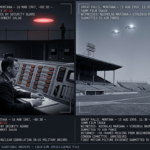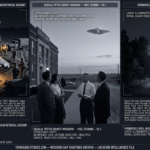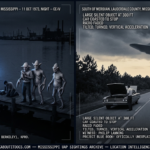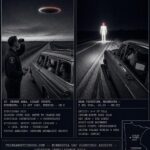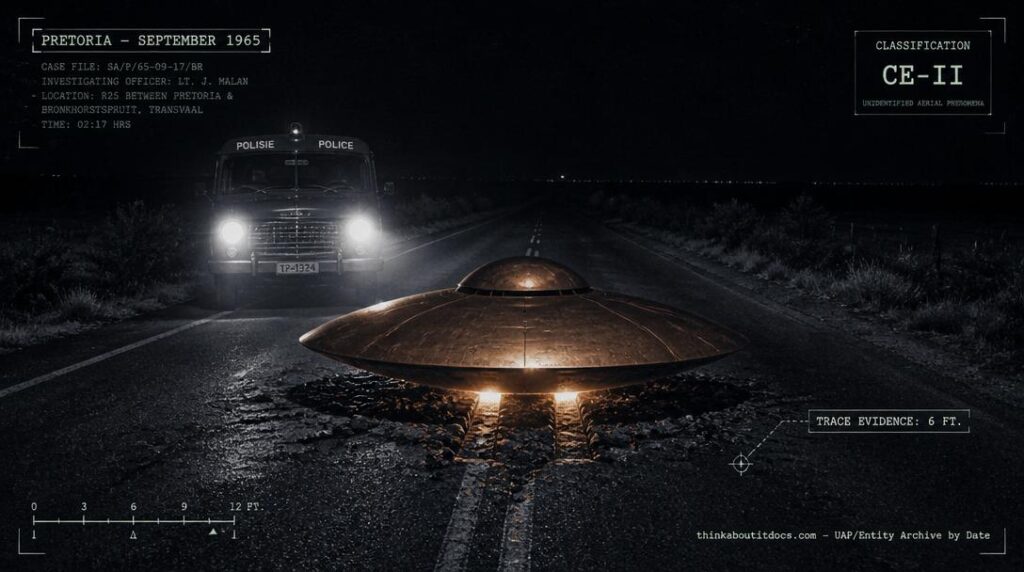
Dossier reconstruction of the UFO landing reported on the Pretoria–Bronkhorstspruit highway, South Africa, September 16, 1965.
THINK ABOUTIT UFO|UAP ENCOUNTER REPORT
1965 Pretoria Highway UFO Landing | Police Witness Case Archive
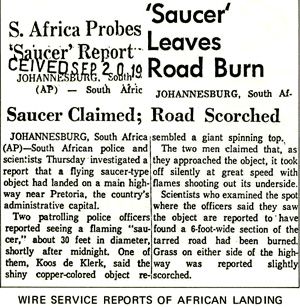
Just after midnight on September 16, 1965, two South African police constables patrolling the Pretoria–Bronkhorstspruit highway rounded a bend and drove almost straight up on a copper-colored, dome-topped disc sitting in the middle of the road. Their headlights barely had time to catch it before the object shot skyward, blasting flame from two tubes on its underside and scorching the tar. “Its lift-off was quicker than anything I have ever seen,” one of the officers said afterward. Investigators who examined the road the next day found it caved in, as if under enormous weight, with a six-foot patch of gravel burned and torn loose from the tar.
This is one of the better-documented landing cases in the archive — named police witnesses, a same-week Associated Press wire report, a district military commandant on record calling it a matter of top-level secrecy, and physical samples sent for laboratory analysis whose results were never released. Sixty years on, the case is still surfacing in South African news, most recently in mid-2026 alongside an unrelated new sighting near Middelburg.
Date: September 16, 1965 (the Associated Press wire report is dated September 17, describing “the night of September 16”)
Sighting Time: Just after midnight
Day/Night: Night
Location: Pretoria–Bronkhorstspruit highway, near Pretoria, South Africa
Urban or Rural: Rural — open highway between Pretoria and Bronkhorstspruit
Hynek Classification: CE-II (Close Encounter II) — corrected from NL. This case involves a landed, structured object observed at point-blank range and documented physical ground trace evidence, meeting Hynek’s definition of CE-II rather than an undifferentiated nocturnal light. See Researcher’s Notes.
Duration: A few seconds, from the object coming into the police van’s headlights to its departure
No. of Object(s): 1
Description of the Object(s): A copper-colored, disc-shaped craft with a small dome on top, resting on the highway; lifted off in seconds, emitting tongues of flame from two tubes or channels on its underside
Shape of Object(s): Disc, with a small dome on top
Size of Object(s): Approximately 30 feet in diameter
Color of Object(s): Copper-colored
Distance to Object(s): Undocumented precisely, but point-blank — the constables’ van headlights caught the object directly on the road ahead of them
Height & Speed: Landed/resting on the road, then lifted off vertically at extreme speed (“quicker than anything I have ever seen,” per Constable Lockem); no altitude or in-flight speed data given
Number of Witnesses: 2 — Constables John Lockem and Koos de Klerk, named in the source (corrected from “Multiple”)
Special Features/Characteristics: Flames from the object’s departure scorched the road surface roughly three feet into the air and continued burning after the object was out of sight; subsequent investigation found part of the road caved in, as if from a heavy weight, with gravel separated from the tar in a severely burned area about six feet in diameter; Constable Lockem sketched the object with the help of a staff artist from the newspaper Die Vaterland; road-surface samples were sent to a leading South African scientific agency for analysis, but the results were never made public; District Commandant Lt. Col. J.B. Brits told the press the matter was considered “of a highly secret nature” with an inquiry underway “in top circles”
Case Status: Unexplained
Source: Associated Press, Johannesburg, S. Africa, September 17, 1965; compiled by Richard Hall, NICAP, in “UFOs: A New Look” (1969)
Summary/Description: Just after midnight on September 16, 1965, South African police constables John Lockem and Koos de Klerk came upon a copper-colored, dome-topped disc resting on the Pretoria–Bronkhorstspruit highway. The 30-foot object lifted off within seconds, scorching the road and leaving a caved-in, burned section roughly six feet across. A district military commandant publicly acknowledged the incident as a serious, secretly investigated matter, and road samples sent for laboratory analysis were never publicly released.
Related Cases: The NICAP source notes that police officers in Exeter, New Hampshire and Damon, Texas had similar close-range encounters with structured, lighted UFOs on September 3, 1965, as part of the same broader wave of sightings that year. Not separately indexed in this archive.
Detailed Report
The case comes down to this archive through an unusually solid chain: an Associated Press wire report filed from Johannesburg on September 17, 1965, and later compiled by Richard Hall for NICAP’s 1969 report “UFOs: A New Look.” It arrived during what NICAP’s own account frames as an active wave of 1965 sightings that also included close-range police encounters with structured, lighted UFOs in Exeter, New Hampshire, and Damon, Texas, roughly two weeks earlier.
Just after midnight on September 16, Constables John Lockem and Koos de Klerk were patrolling the Pretoria–Bronkhorstspruit highway when their police van’s headlights suddenly caught a disc-shaped object resting directly on the road ahead of them. The craft was copper-colored, roughly 30 feet in diameter, and carried a small dome on top. Within seconds of coming into view, it shot upward off the road, flame pouring from two tubes or channels on its underside. “Its lift-off was quicker than anything I have ever seen,” Lockem said afterward. Flames from the road surface itself shot roughly three feet into the air as the object departed, and continued burning even after it had vanished from sight.
A follow-up investigation of the site found physical damage consistent with the officers’ account: part of the road had caved in, as though under enormous weight, and a roughly six-foot-diameter patch of gravel had been separated from the tar in a severely burned area. Lockem worked with a staff artist from the newspaper Die Vaterland to produce a sketch of the object. Lt. Col. J.B. Brits, the District Commandant of Pretoria North, went on record with the press describing the incident as being “of a highly secret nature,” with an inquiry underway “in top circles” — a striking degree of official engagement for a UFO report, and one that neither confirmed nor denied what the officers had seen. Samples of the damaged road surface were sent to a leading South African scientific agency for analysis; despite its efforts, NICAP was never able to obtain a copy of that analysis.
The case has not faded with time. As recently as mid-2026, South African outlets revisited the 1965 Pretoria incident in the context of a new, unrelated UFO report near Middelburg, treating the six-decade-old case as the country’s benchmark UFO landing story.
RESEARCHER’S NOTES
The Pretoria Highway Landing — South Africa 1965 and a Classification That Didn’t Fit
- Classification Correction: NL (Nocturnal Light) does not fit this case at all — a nocturnal light is, by definition, an undifferentiated point or extended light source with no discernible structure. This account describes a fully structured, landed, disc-shaped craft with a dome, observed at point-blank range, and — critically — documented physical trace evidence at the site (a caved-in road and a burned, gravel-separated area roughly six feet across). A landed object plus physical ground effects is the textbook definition of Hynek’s CE-II, and this entry is reclassified accordingly.
- Witness Count Correction: The source names both witnesses individually — Constables John Lockem and Koos de Klerk — rather than the vaguer “Multiple” in the original field data; this entry reflects the precise, sourced count of two.
- Source Chain Assessment: This is one of the better-sourced landing cases in the archive: a same-week Associated Press wire report, compiled by Richard Hall for NICAP’s “UFOs: A New Look” (1969), naming both officers and a district military commandant on record. That combination of wire-service reporting and a named official government source is stronger than most single-witness or anonymous cases here.
- Unresolved Physical Evidence: Road-surface samples from the burned, caved-in area were reportedly analyzed by “a leading scientific agency” in South Africa, but NICAP was never able to obtain copies of that analysis. The physical trace itself is well documented across contemporary reporting; what the specific lab results showed has never been made public.
- Official Acknowledgment: Lt. Col. J.B. Brits, District Commandant of Pretoria North, went on record describing the matter as “of a highly secret nature” with an inquiry underway “in top circles” — an unusual instance of a military official publicly confirming an active, serious investigation into a UFO landing rather than denying or dismissing the report.
- Continuing Resonance: As of mid-2026, this 60-year-old case has resurfaced in South African media coverage, prompted by a new, unrelated sighting reported near Middelburg — evidence that this remains one of South Africa’s most enduring UFO cases rather than a forgotten one.
The Pretoria highway case earns its place as Unexplained on the strength of what it actually has: two named police officers, a scorched and caved road surface examined the next day, a sketch made with professional help, and a military commandant who went on record rather than staying silent. What it doesn’t have is an ending — the lab results that might have settled the physical evidence one way or the other were never released, and sixty years later, they still haven’t been.
“Its lift-off was quicker than anything I have ever seen.”