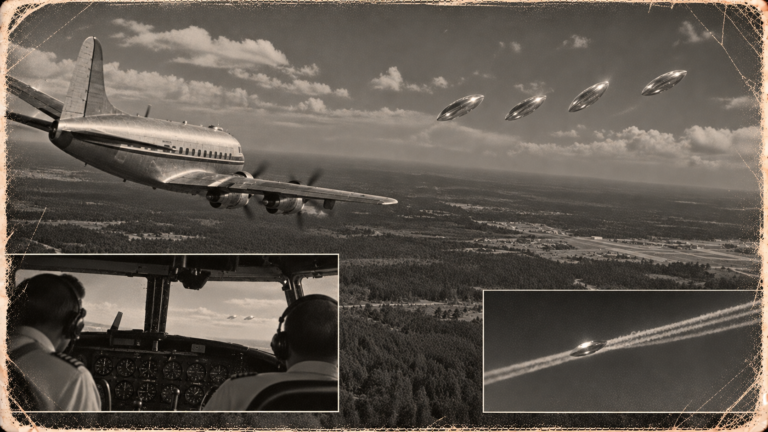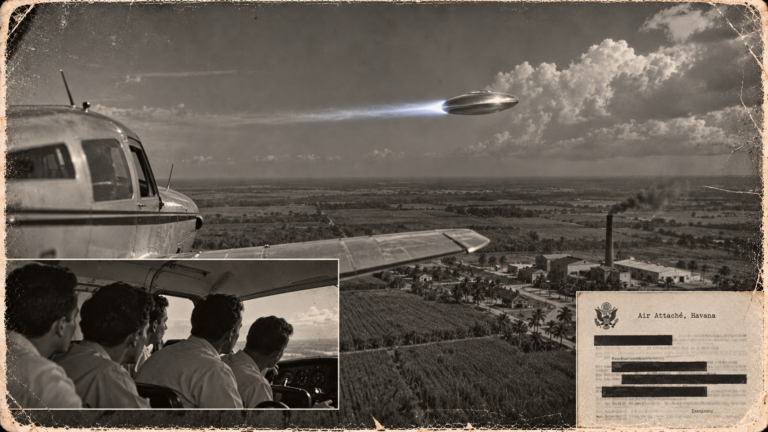
Aerial armies, a split moon, and a silver disc over Yorkshire — 12th-century high strangeness, 1100 to 1199 CE
Sighting by Date:
1100-1199 UFO|UAP & Entity Sightings Archive
Byland Abbey Disc, Woolpit Green Children & the Salamanca Astronaut Debunked
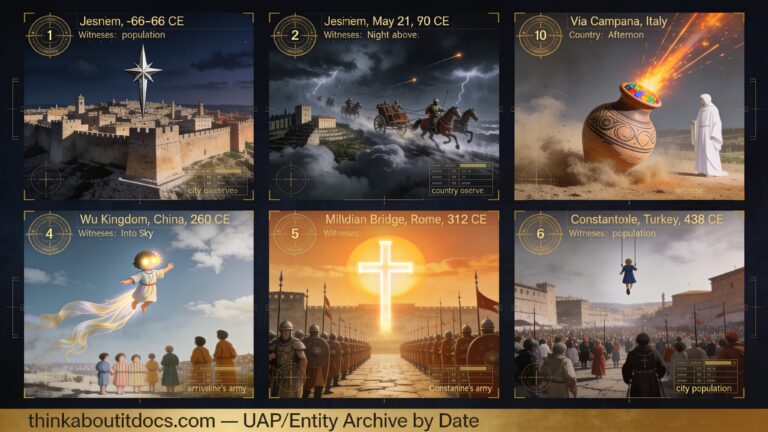
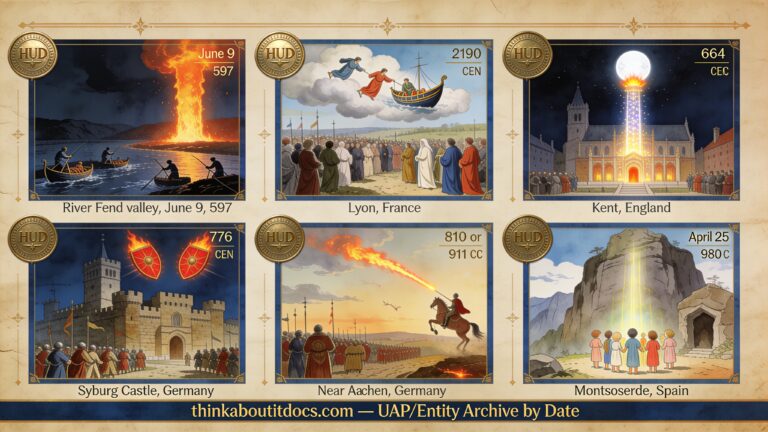
The 12th century CE was one of the most turbulent and consequential centuries in medieval European history — the Crusades reshaped the known world, the Catholic Church reached the height of its institutional power, and the great cathedrals of Europe began to rise from the earth. It was also a century in which the sky was unusually busy. From Germany to Japan, from England to China, from Spain to Russia, chroniclers, clergy, and common witnesses recorded aerial phenomena, entity encounters, and high strangeness events with a consistency and geographic breadth that no single cultural tradition can explain. The 1100–1199 CE archive documents dozens of recorded incidents across three continents — burning men running the hills of Germany, a captured dwarf escaping through a tunnel beneath a German monastery, sky ships observed over London, fiery dragons emerging from English seas, luminous objects over Japanese mountains, and armed troops witnessed fighting in the air over crusading Europe.
What makes the 12th century record particularly significant for serious researchers is the quality of its sources. Many of the events documented in this archive were recorded by named, credible witnesses — priests, chroniclers, military commanders, and monastic scholars who were operating within institutions that valued accurate record keeping. Ekkehard of Aurach, Nestor the chronicler of the Russian Primary Chronicle, Ralph Niger, Gervase of Canterbury, William of Newburgh, and Ralph of Coggeshall were not sensationalists. They recorded what was observed and what was reported to them because it was their job to preserve the historical record. This page also contains one claim that does not survive scrutiny — the so-called “Cosmonaut of Salamanca” — and it is corrected in place below rather than silently dropped, in keeping with the archive’s practice of flagging rather than erasing.
Date: 1100
Location: Germany
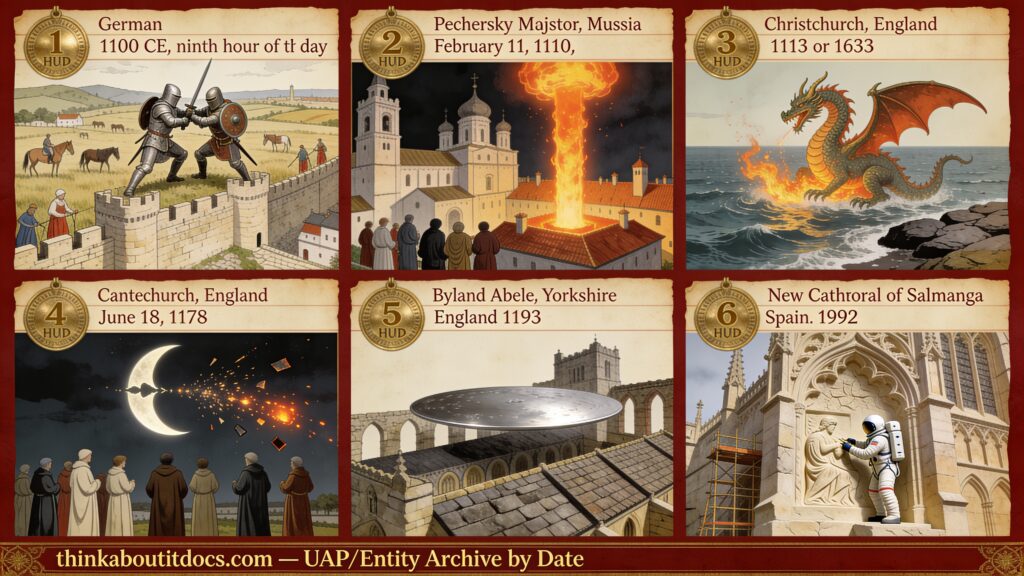
Summary: “The signs in the sun and the wonders which appeared, both in the air and on the earth, aroused many who had previously been indifferent… A few years ago a priest of honorable reputation, by the name of Suigger, about the ninth hour of the day beheld two knights, who met one another in the air and fought long, until one, who carried a great cross with which he struck the other, finally overcame his enemy… Some who were watching horses in the fields reported that they had seen the image of a city in the air and had observed how various troops from different directions, both on horseback and on foot, were hastening thither.” Many witnesses reported the sign of the cross divinely imprinted on their clothing or bodies, believing themselves marked for God’s service.
Source: Ekkehard of Aurach, On the Opening of the First Crusade (1101)
Date: Not 1102 — the carving dates to 1992 (see correction below)
Note — debunked claim, corrected in place: the “Cosmonaut of Salamanca” is not a medieval or Renaissance carving. The New Cathedral of Salamanca was built between 1513 and 1733, and the astronaut figure on its north facade (Puerta de Ramos) was added in 1992 during a documented restoration, by stonemason Jerónimo García’s team, as a modern “signature” — a well-established tradition among cathedral restorers of leaving a contemporary mark on their work. A companion figure of a dragon eating an ice cream cone sits nearby from the same restoration. This is confirmed across multiple independent sources, including the cathedral’s own visitor materials. It is retained here, corrected, because the claim circulates widely in ancient-astronaut literature and deserves an accurate record rather than silent removal.
Location: New Cathedral of Salamanca, Spain (Puerta de Ramos, north facade)
Summary: A relief carving of a figure in a modern-style spacesuit with helmet and boots, carved among the cathedral’s Gothic and Baroque decorative figures. Frequently cited in ancient-astronaut literature as medieval or Renaissance evidence of historical alien contact; in fact it is a documented 1992 addition with no connection to the 12th century or to ancient astronaut claims of any kind.
Source: Snopes.com fact-check; Atlas Obscura; multiple independent sources confirming 1992 restoration attribution to Jerónimo García
Date: 1104
Location: Switzerland (location uncertain in original source — possibly England)
Summary: Chronicler Wolffart notes “torches of fire, glowing lines and lights” often seen flying in the air, resembling swarms of butterflies or glowworms, flying through the air and obscuring sunlight as if they were clouds.
Source: Christian Piens, Les Ovni du Passé (Marabout, 1977), p. 46; “UFO Files,” ed. Marshall Cavendish (Paris, 1998), Special issue, p. 3
Date: February 16, 1105
Location: Unknown, likely France based on chronicle source
Summary: During the first week of Lent, a strange star appeared on the evening of Friday, February 16 in the southwest, small and dark but emitting a very bright light manifested as a beam projected northward. Some observers reported seeing other unidentified stars around the same time. On the eve of Maundy Thursday before Easter, two full moons were reportedly seen in the sky before daylight, one to the east and one to the west.
Source: Michel Bougard, La Chronique des OVNI (Delarge, 1977), p. 67
Date: February 11, 1110 (sometimes dated 1111)
Location: Pechersky Monastery, Russia
Summary: “There appeared a fiery pillar that reached from the ground to the sky, and lightning lit all earth, and thunder rattled at the first hour of night, and everyone saw it.” The pillar moved deliberately between locations — first over the monastery’s dining hall, then over Theodosius’s tomb, then to the top of the church, turning to face east before vanishing. The chronicle explicitly identifies it as “the apparition of an angel,” noting angels often appeared as a fiery column or flame.
Source: Nestor, Russian Primary Chronicle (Cambridge, MA: Harvard University Press, 1930), pp. 296–297
Date: 1113 (probable duplicate of the 1133 Christchurch entry below — see Researcher’s Notes)
Location: Christchurch, Wessex, England
Summary: A group of churchmen from Laon, France, touring Wessex with relics of the Virgin Mary used for healing miracles, reported seeing a dragon emerge from the sea at Christchurch, “breathing fire out of its nostrils.”
Source: Not recorded in original entry; corroborated in “UFO Files,” ed. Marshall Cavendish (1998)
Date: 1116
Location: China
Note — poor source translation: the surviving translation is fragmentary and does not resolve into coherent English. Retained for completeness pending better translation.
Summary: A Song Dynasty record describes a star resembling the moon moving slowly southward with a descending light, in the sixth year of the Huizong era (1116), with a related sighting the following December.
Source: Song Dynasty records, Continued Mirror chronicle
Date: 1123
Location: London, England
Summary: The chronicle of Geoffrey of Breuil records an observation over London of “ships that stopped over between the clouds.”
Source: Michel Bougard, La Chronique des OVNI (Delarge, 1977), p. 67
Date: 1125 CE: Railbach, Freienstein, Germany Burning Man? [Full case page — separate entry]
Date: 1130
Location: Bohemia
Summary: “A sign (or a monster) resembling a flying serpent” reportedly flew over Bohemia, recorded independently by two historians of the period.
Source: Canonici Wissegradensis Continuatio Cosmae, in Monumenta Germaniae Historica (MGH) SS 9, 136; Annales Gradicenses, MGH SS 17, 650; quoted in Vecerní Praha (Czech magazine) via The Washington Post, August 2, 1967
Date: 1133
Location: China
Note — poor source translation: fragmentary translation, retained pending improvement.
Summary: A Jin Dynasty record describes an object or light lost from view in the south during the tenth year of the Taizong era (1133).
Source: Jin Shi Tianwenzhi, Jin Dynasty records
Date: August 12, 1133
Location: Japan
Summary: A large silvery object was reported descending close to the ground.
Source: Morihiro Saito, Nihon Tenmon Shiryō, Ch. 7
Date: 1133 (probable duplicate of the 1113 Christchurch entry above — see Researcher’s Notes)
Location: Christchurch, Hampshire, England
Summary: A group of clergymen from Laon, touring Wessex with relics of the Virgin Mary, reported a dragon emerging from the sea at Christchurch, “throwing fire through his nostrils” — matching the 1113 entry above in every substantive detail.
Source: “UFO Files,” ed. Marshall Cavendish (Paris, 1998), pp. 3–4
Date: 1138: Dwarf Sighting in Germany [Full case page — separate entry]
Date: 1142
Location: Prague, Bohemia
Summary: Fiery dragons were reportedly seen flying above Prague in both 1130 and 1142, per period historians. The same source notes flying-object sightings became frequent enough by the 18th and 19th centuries to be discussed in Bohemian schools.
Source: Monachi Sazavensis, cont. Cosmae (a. 932–1162), MGH SS 9, 159; quoted in Vecerní Praha via The Washington Post, August 2, 1967
Date: 1148
Location: Trier, Germany
Time: Not recorded
Summary: A luminous object was reported over Trier by multiple witnesses, recorded in German monastic chronicles of the period.
Source: Referenced in Jacques Vallée, Passport to Magonia, supplementary records
Date: 1150
Location: Visoki Dečani Monastery, Serbia
Summary: Two hovering objects were observed near a building.
Source: Ion Hobana, UFOs from Behind the Iron Curtain (New York: Bantam Y8898, 1975)
Date: 1155
Location: Rome, Italy
Summary: During the coronation of Frederick Barbarossa by Pope Adrian IV, “there appeared in the sky three lights, and a cross formed by stars.” (The frequently cited source date of 1152 refers to Barbarossa’s declaration as king; the actual coronation, delayed by unrest and rivalry with Henry the Lion, took place in 1155.)
Source: B. Capone, “Luci dallo Spazio,” Il Giornale dei Misteri, Dec. 1972
Date: 1161
Location: Thann, Alsace, France
Summary: Three lights or luminous objects were observed by the Lord of Engelburg over Thann after a servant hid a stolen relic in his walking stick, planted beside a pine tree. The next morning the stick was found immobilized. A commemorative chapel was built, and the “cremation des trois sapins” (cremation of three fir trees) is still celebrated annually in Thann on June 30 in reference to the three lights.
Source: Johannes Andreas Schenck, Sanctus Theobaldus (Freiburg, 1628)
Date: 1166
Location: China
Note — poor source translation: fragmentary translation, retained pending improvement.
Summary: An account describes an official observing a bright light in a courtyard during a sleepless summer night in the second year of Xiaozong’s reign (1166), noted as an unexplained radiant phenomenon distinct from moonlight.
Source: Yi Jian, Vol. 19
Date: Christmas Eve, 1167 (probable location)
Location: England (not certain in original source)
Summary: “At the watch night of the Lord’s Nativity, two fiery stars appeared in the western sky. One was large, the other small. At first, they appeared joined together. Afterwards, they were for a long time separated distinctly.”
Source: Nicholas Trivetus (1258–1328), Annales Sex Regum Angliae — Trivetus was not contemporary with the event and drew from an earlier, unnamed chronicle
Date: 1169
Location: China
Summary: The Song Dynasty history records dragons battling in the sky during a thunderstorm in the fifth year of the Qiandao era (1169): “Two dragons fled and pearls like carriage wheels fell down on the ground, where herds’ boys found them.”
Source: Dr. M.W. De Visser, The Dragon in China and Japan (Amsterdam: Johannes Muller, 1913), p. 48, quoting the Wuki
Date: March 9, 1170
Location: St. Osyth, Sussex, England
Summary: Chronicler Ralph Niger records that an “incredibly large” dragon was observed leaving the earth to fly through the air, its passage setting the air aflame and burning a house and its outbuildings to ashes.
Source: “UFO Files,” ed. Marshall Cavendish (Paris, 1998), Special issue, p. 4
Date: 1171
Location: Teruel, Aragon, Spain
Summary: King Alfonso II and his men reportedly followed a wandering bull under a star-like luminous object during the Reconquista, taking it as a premonitory sign to establish a new town at the site — the founding legend of Teruel.
Source: Javier Sierra and Jesús Callejo, La España Extraña (Madrid: Ediciones EDAF, 1997), pp. 122–124
Date: 1173: Two Strange Children in Woolpit, Suffolk, England [Full case page — separate entry]
Date: June 18, 1178
Location: Canterbury, England
Summary: Gervase of Canterbury records five witnesses watching the upper horn of the new moon split in two about an hour after sunset, with a flaming torch springing from the division and spewing fire, coals, and sparks a dozen times or more, “turning the moon blackish along its whole length.” A 1976 theory linked this to the lunar crater Giordano Bruno; 2001 recalculations showed such an impact would have produced a week-long meteor storm on Earth that no records anywhere document, casting doubt on that explanation.
Source: University of Arizona news release, April 19, 2001
Date: October 27, 1180
Location: Kii Sanchi, Nara, Japan
Summary: Ancient documents describe a shining object seen the night of October 27, 1180, using a term equivalent to “flying saucer” some 700 years before the phrase entered Western use — described as a flying “earthenware vessel.” The object changed direction while heading northeast from a mountain in Kii province before vanishing below the horizon, leaving a luminous trail.
Source: Jacques Vallée, Passport to Magonia, pp. 4–5
Date: 1182
Location: Friesland, Holland
Summary: Chronicler Winsemius (1622), in Croniek van Vriesland, reports four suns and a company of armed men seen in the sky.
Source: Volksverhalen en Legenden van Vroegere Tijden (Groningen, 1843)
Date: 1185
Location: Mount Nyoigadake, Japan
Summary: Red beams appeared behind the mountain, followed by an object like a luminous wheel that flew over and entered the sea; the witnesses were fishermen.
Source: Brothers magazine (Japan), III, 1, 1964
Date: 1188
Location: Clonmacnoise, Ireland
Time: Not recorded
Summary: Gerald of Wales recorded an account of a ship’s anchor snagging on a church arch at Clonmacnoise — a variant of the aerial ship-and-anchor encounter type later seen at Gravesend in 1207. A crew member descended, was briefly seized by the congregation, then released, and the vessel departed.
Source: Gerald of Wales (Giraldus Cambrensis), Topographia Hibernica, 1188
Date: August 9, 1186 or 1189
Location: Dunstable, Bedfordshire, England
Summary: Benedict of Peterborough, in Gesta Regis Henrici Secundi, records that at the ninth hour the sky suddenly opened and both laity and Abbey clergy saw an enormous cross of astonishing dimensions, visible until midnight. Walter of Hemingford, canon at Guisborough, independently reported the same event dated to 1189, describing the cross as bright and white as silk. William of Newburgh also records the 1189 event, this time on the road to London, adding: “at one o’clock we saw the emblem of the Lord and the form of a crucified man.” Dunstable Abbey’s own archives separately record a similar giant cross crossing the sky east to west — but date that observation to 1217.
Source: Michel Bougard, La Chronique des OVNI (Delarge, 1977), pp. 68–69
Date: 1193
Location: Byland Abbey, Yorkshire, England
Time: Not recorded
Summary: A large, round, flat silver disc flew slowly over the abbey and the assembled monks, causing great consternation. Recorded by a monk in a marginal note in a manuscript now held at the British Museum.
Source: M.A. Hall, “UFOs in the Middle Ages,” citing the Byland Abbey manuscript
Date: June 7, 1193
Location: London, England
Time: About 6:00 p.m.
Summary: “A thick black cloud rose in the air, the sun shining clear all round about. In the middle of the cloud was an opening, out of which proceeded a bright whiteness, which hung in a ball under the black cloud over the side of the Thames, and the Bishop of Norwich’s Palace.”
Source: Thomas Short, A General Chronological History of the Air, Weather, Seasons, Meteors, &c. (1749)
RESEARCHER’S NOTES
The Century the Sky Would Not Be Still — and One Claim That Doesn’t Hold Up
- Salamanca “Cosmonaut” corrected: this claim is definitively debunked — the carving is a documented 1992 addition by stonemason Jerónimo García’s restoration team, confirmed by the cathedral itself, Snopes, and multiple independent sources. It has no connection to the 12th century, the Renaissance, or ancient-astronaut evidence of any kind, despite its wide circulation in fringe literature. The entry is corrected in place rather than removed.
- Probable duplicate flagged: the 1113 and 1133 Christchurch dragon entries describe the identical event — the same Laon clergy touring Wessex with the same relics, the same dragon breathing fire from the sea — under two different years and two slightly different place-names (Wessex vs. Hampshire, both correct for the same town). Both are retained per standing practice rather than merged.
- Fragmentary Chinese translations flagged: the 1116, 1133, and 1166 China entries rest on garbled or fragmentary translations from earlier compilations. They are retained for completeness with a note rather than silently improved or removed, pending access to better source translations.
The 12th century is notable for what its encounters reveal about the consistency of the phenomenon across cultures with no contact with one another — Japanese records of vessel-specific aerial objects, Chinese Song Dynasty dragon battles, English monastic accounts of sky ships and subterranean children, Russian chronicles of a deliberately moving fiery pillar, and Spanish founding legends built around a hovering star. None of these cultures shared an interpretive framework. The archive holds what each of them recorded — including, honestly, the one entry on this page that turned out not to belong here at all.
“Some who were watching horses in the fields reported that they had seen the image of a city in the air and had observed how various troops from different directions, both on horseback and on foot, were hastening thither.”
Ekkehard of Aurach, On the Opening of the First Crusade, 1101 CE