THINK ABOUTIT SIGHTING REPORT
Date: October 25 1582
Sighting Time:
Day/Night:
Location: Siberia, Russia
Urban or Rural: Rural
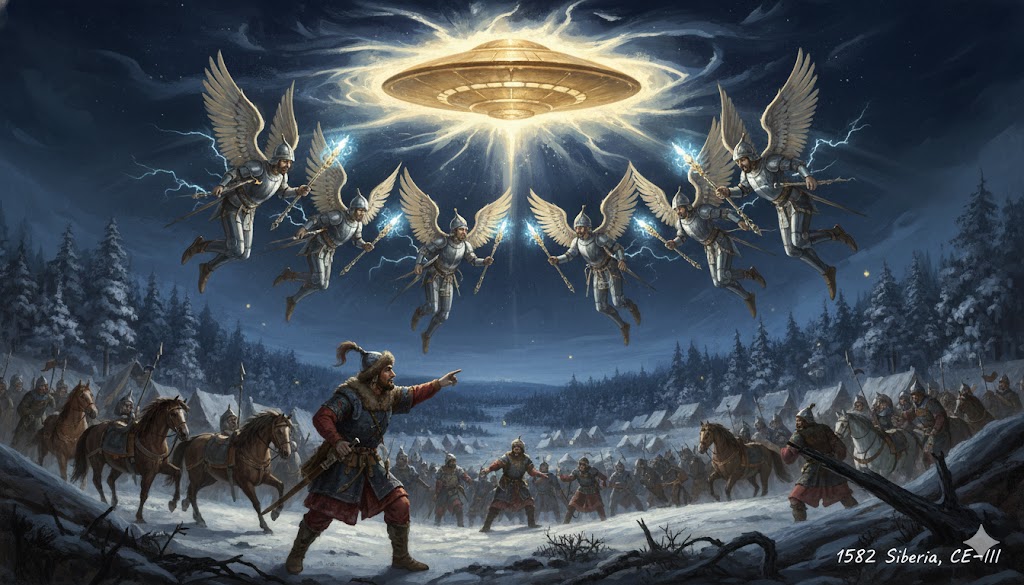
Entity Type: bright, armed, winged warriors
Entity Description:
Hynek Classification: CE-III (Close Encounter III) Close observation with animate beings associated with the object.
Duration:
No. of Object(s):
Size of Object(s):
Distance to Object(s):
Shape of Object(s):
Color of Object(s):
Number of Witnesses:
Source: Philip Mantle, Paul Stonehill “UFO-USSR”
Summary/Description: A local nomadic warrior Khan Kuchum observed a phenomenon he termed as a “znamenie”. He actually saw the sky open up in “the four corners of the Universe”, and exiting it were “bright, armed, winged warriors”. As they approached Kuchum’s camp, the “warriors” surrounded it, and ordered the Khan to flee. He was shaken, and ordered his camp to leave. They left in fear, and hid in the forest, and it seemed to the Khan he was chased by some “heavenly armies”.
Historical Context: Khan Kuchum and the Fall of the Siberian Khanate
The year 1582 was a pivotal moment in Russian history, marking the intense conflict between the Russian Empire and the Siberian Khanate. Khan Kuchum, the last ruler of the Khanate, was facing a decisive invasion by the Cossack leader Yermak Timofeyevich. It was during this period of high military stress and territorial loss that the “winged warriors” encounter reportedly took place.
Cultural Interpretations of “Heavenly Armies”
In the 16th century, atmospheric anomalies were often interpreted through a religious or supernatural lens.
-
Divine Omen: Khan Kuchum viewed the phenomenon as a “znamenie” (omen or sign), which likely influenced his strategic decision to retreat into the Siberian forest.
-
Psychological Impact: The report of “bright, armed, winged warriors” exiting the sky suggests a Close Encounter of the Third Kind (CE-III) that carried a distinct command: to flee.
-
Modern UFOlogy Link: Researchers Philip Mantle and Paul Stonehill note that these ancient Russian accounts frequently mirror modern UFO descriptions of luminous entities and abrupt behavioral shifts.
Research Insights: Mantle and Stonehill’s Investigation
The preservation of the 1582 Siberia account is largely due to the diligent work of researchers Philip Mantle and Paul Stonehill, authors of “UFO-USSR”. Their investigation highlights how Russia’s vast and often isolated geography has served as a repository for high-strangeness events that date back centuries.
By cross-referencing nomadic oral traditions with the military records of the Siberian Khanate, they have illustrated that Khan Kuchum’s experience was not merely a localized legend, but a documented historical anomaly. These findings suggest that the “winged warriors” may represent an early interpretation of what we now classify as extraterrestrial life or humanoids, demonstrating a consistent pattern of unidentified flying object interactions across different human eras.
Conclusion: The Enduring Mystery of the Winged Warriors
The 1582 encounter at the edge of the Siberian forest serves as a profound reminder that the unidentified flying object phenomenon is not a strictly modern invention. By examining Khan Kuchum’s forced retreat through the lens of both 16th-century omens and contemporary humanoid research, we gain a clearer picture of how “high-strangeness” events have shaped human history and migration. Whether interpreted as a divine intervention or a Close Encounter of the Third Kind (CE-III), the “winged warriors” remain a cornerstone of Russian anomaly research, proving that the skies over Siberia have been a theater for the unexplained for over four centuries. As researchers like Philip Mantle and Paul Stonehill continue to unearth these historical gems, they provide the necessary data to bridge the gap between ancient folklore and the modern extraterrestrial life hypothesis.