THINK ABOUTIT CLOSE ENCOUNTER REPORT
Date: about 1650
Sighting Time:
Day/Night: daytime
Location: Volga region, Russia
Urban or Rural: Rural
Entity Type: A very tall “man”
Entity Description: no less than 6 meters in height, (!) and by all signs, the humanoid seemed extremely upset. The giant emanated a powerful “energy wave” or feeling of melancholy.
Hynek Classification: CE-III (Close Encounter III) Close observation with animate beings associated with the object.
Duration:
No. of Object(s): 1
Size of Object(s): over 6 meters in height
Distance to Object(s):
Shape of Object(s):
Color of Object(s):
Number of Witnesses:
Source:
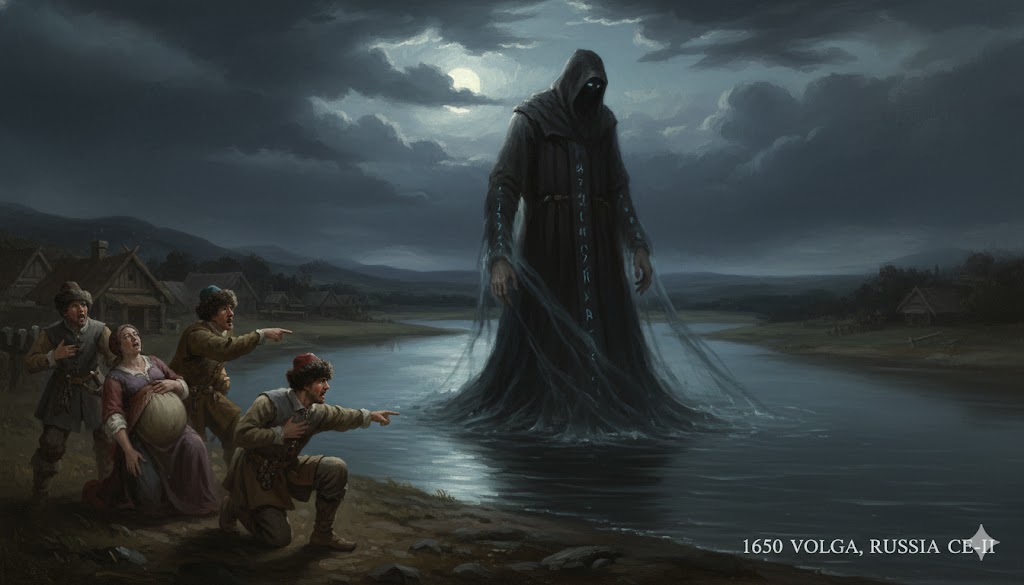
Summary/Description: One of the local legends from the area of the Great Russian River of Volga tells about the encounter with a huge entity and its horrible fate. A very tall “man” walked into the outskirts of a small Cossack settlement. It was absolutely incomprehensible to the Cossacks where this strange giant had come from.
The giant behaved quietly, he was said to be no less than 6 meters in height, (!) and by all signs, the humanoid seemed extremely upset. The giant emanated a powerful “energy wave” or feeling of melancholy. While close to the strange entity the locals felt uncomfortable and pregnant women in the settlement suffered miscarriages (this of course was blamed on the giant). The giant caused fear and hostility (enmity) by the local residents who eventually killed. (No other information on how this was done)
17th Century Russian Folklore vs. The Volga Giant
The 1650 sighting occurred at a time when the Volga River served as both a literal and spiritual frontier for the Russian state. For the Cossack settlements along the river, the landscape was alive with a mix of Orthodox piety and ancient Slavic paganism.
Mythical Strongmen and the Volga Bogatyrs
In traditional Russian folklore, the concept of a giant was not foreign. The Bogatyrs (epic knights) often possessed superhuman size and strength. Figures like Svyatogor were so massive that the Earth itself struggled to bear their weight. However, the Volga Giant of 1650 differs from these heroic legends in its eerie, non-human characteristics:
-
The “Melancholy Energy“: Unlike the boisterous strength of folklore heroes, this entity emitted a depressing or draining energy that paralyzed the witnesses. This mirrors modern reports of the “Oz Factor,” a phenomenon where witnesses of unidentified flying objects describe a sudden, unnatural silence and emotional heaviness.
-
Physical Proportions: While Russian folktales often exaggerate the height of giants to “reach the clouds,” the specific detail of a 6-meter tall humanoid provides a level of descriptive restraint more typical of CE-III reports than oral fairy tales.
-
Cossack Realism: The 17th-century Cossacks were hardened frontiersmen, less prone to flights of fancy than the general peasantry. Their reporting of such an entity suggests a physical encounter that defied their deep practical knowledge of the Volga’s natural wildlife and bandits.