THINK ABOUTIT MERMAID SIGHTING REPORT
Date: January 12 1809
Sighting Time:
Day/Night: morning
Location: Sandside, Caithness, Scotland
Urban or Rural: –
Entity Type: face of a young woman “round and plump and of a bright pink hue
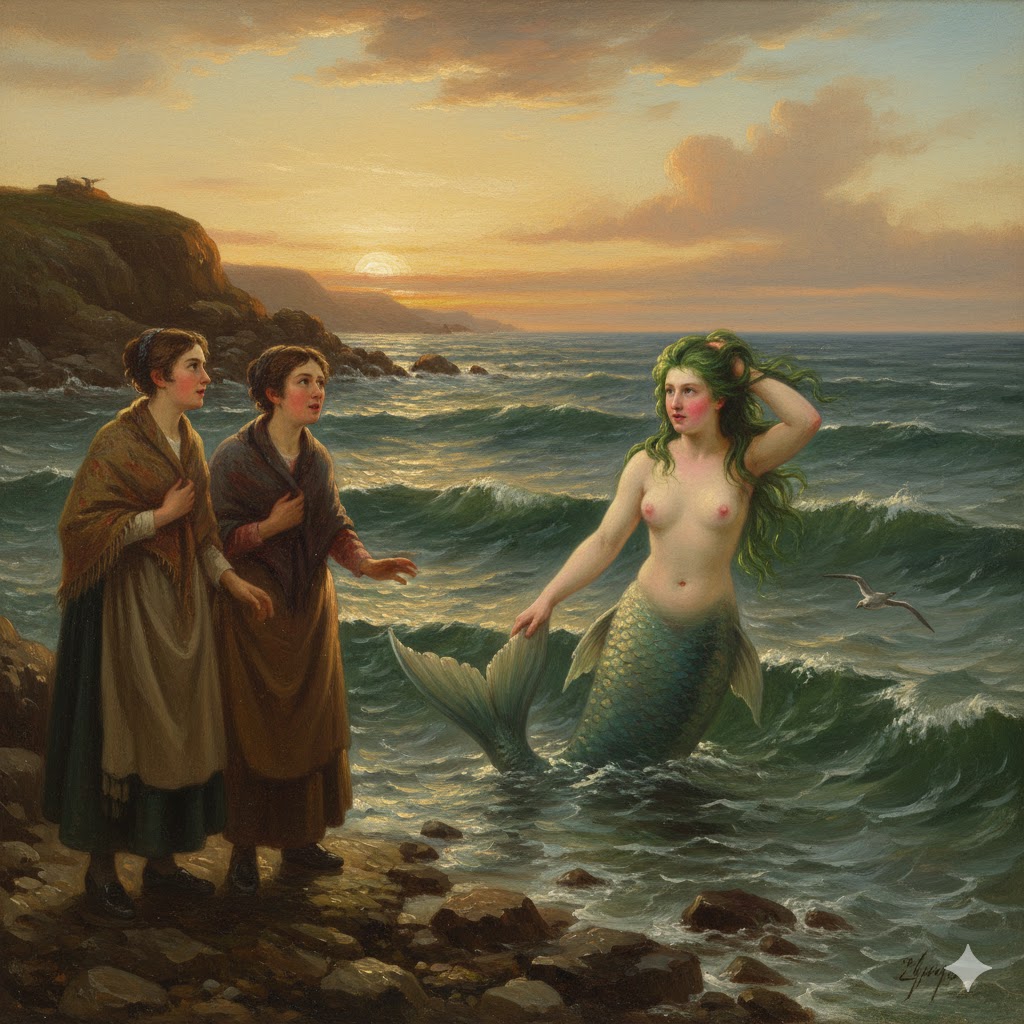
Entity Description: When they were able to observe more of the top part of its body, they could see that it had well-formed human breasts. From time to time it lifted a long, thin white arm above the waves to toss back its long green hair.
Hynek Classification: CE-III (Close Encounter III) Close observation with animate beings associated with the object.
Duration:
No. of Object(s): 1
Size of Object(s):
Distance to Object(s):
Shape of Object(s):
Color of Object(s):
Number of Witnesses: Two
Source: Jerome Clark, Unexplained!
Summary/Description: Two women standing on a beach in a remote area of northeastern Scotland saw what looked like the face of a young woman “round and plump and of a bright pink hue” in the sea. It then disappeared into the water, to reappear a short time later. When they were able to observe more of the top part of its body, they could see that it had well-formed human breasts. From time to time it lifted a long, thin white arm above the waves to toss back its long green hair.
Investigative Analysis: The Sandside Bay Phenomenon
The 1809 mermaid sighting near Sandside is one of the most vividly described maritime anomalies in Scottish history. Unlike vague folklore, this account from Caithness provides specific anatomical details that align with modern CE-III encounter characteristics, specifically regarding the entity’s interaction with its environment.
Physical Characteristics and Behavioral Observations
-
Anatomical Anomalies: The witnesses notably described a “bright pink hue” and “long green hair,” colors that are frequently associated with biological bioluminescence or unusual aquatic flora in modern cryptozoology.
-
Intelligent Interaction: The report of the creature using a “long, thin white arm” to move its hair suggests a level of manual dexterity and self-awareness beyond that of known local marine life, such as seals or porpoises.
-
Witness Credibility: The sighting occurred in broad daylight (“morning”) at a time when the witnesses were in a clear state of mind, which significantly bolsters the case’s standing in historical anomalous research.
Cultural and Historical Context
Located in the remote northeastern corner of Scotland, Sandside Bay has long been a site of maritime mystery. This 1809 report is unique because it was documented with enough precision to be later analyzed by researchers like Jerome Clark, moving the narrative from simple seaside “tall tales” into the realm of structured historical reporting.
Witness Profile: The Testimony of Miss Mackay
The primary documentation for this 1809 encounter stems from a detailed letter written by Miss Eliza Mackay, daughter of the Reay minister, who observed the creature alongside a companion. Her testimony is considered highly credible due to the level of anatomical detail provided and her insistence on describing only what was physically visible, rather than relying on existing sea-creature myths.
Corroborating Evidence
-
Duration of Sighting: The witnesses watched the entity for over an hour, noting its rhythmic behavior of diving and reappearing to “toss back” its green hair.
-
Proximity: The creature was reportedly close enough to the shore for Mackay to clearly distinguish its “pinkish” skin tone and “human-like” facial features.
-
Local Impact: Following Mackay’s report, other local residents, including a schoolmaster from Reay, came forward with similar sightings from the same stretch of Caithness coastline, suggesting a resident population of unidentified biological entities in the area during that period.