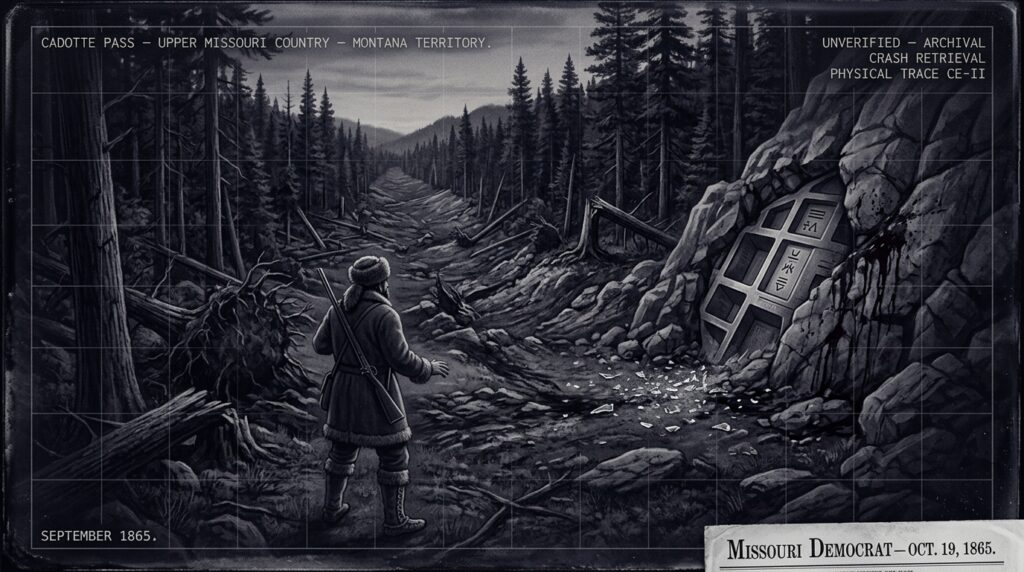
September 1865, Cadotte Pass, Montana Territory — trapper James Lumley discovers a compartmented object with strange hieroglyphic markings embedded in a mountainside, surrounded by miles of uprooted forest and glass-like fragments. Reported in the Missouri Democrat, October 19, 1865. The object is believed to remain in the Bob Marshall Wilderness Area northwest of Great Falls, Montana.
THINK ABOUTIT CRASH REPORT
1865: Montana Trapper Reports Crash of ‘Compartmented Craft With Strange Hieroglyphics’
In September 1865, while the United States was still absorbing the end of its Civil War, a Rocky Mountain trapper named James Lumley was working his lines seventy-five miles above the Great Falls of the Upper Missouri — in what is now Montana — when the sky above him fractured. A bright luminous body moved rapidly eastward, separated into particles like a sky-rocket burst, and seconds later the earth jarred beneath his feet from a heavy explosion followed by a wind like a tornado through the pines. What Lumley found the next morning was not a meteorite. It was a corridor of devastation stretching as far as he could see in either direction — giant trees snapped at the base, hilltops shaved off, earth plowed in long furrows — ending at a large object driven into the face of a mountain. The object was divided into geometric compartments. It was inscribed with hieroglyphics. It was surrounded by fragments of glass-like material and dark dried stains. The Missouri Democrat published his account on October 19, 1865, and speculated — in the voice of its era — that perhaps meteors were being used as conveyances by inhabitants of other planets. The object, by all accounts, is still there.
Date: September 1865
Sighting Time: Just after sunset
Day/Night: Night
Location: Cadotte Pass (Rogers Pass), Montana Territory — approximately 75–100 miles above the Great Falls of the Upper Missouri
Urban or Rural: Rural
No. of Entity(‘s): 0
Entity Type: None observed
Entity Description: None observed
Hynek Classification: CE-II (Close Encounter II) — object at close range with physical traces
Duration: Aerial phase approximately 5 seconds visible; ground site discovered the following morning
No. of Object(s): 1
Description of the Object(s): Large body divided into regular geometric compartments; inscribed with hieroglyphic symbols described as the work of human hands; surrounded by glass-like fragments and dark dried liquid stains; driven deep into the face of a mountain at the end of a mile-wide forest devastation corridor
Shape of Object(s): Compartmented — geometric segmented form; not meteoritic in appearance
Size of Object(s): Large — described as a fragment of an immense body; exact dimensions not recorded
Color of Object(s): Bright luminous body in flight; surface color at impact site not recorded
Distance to Object(s): Approximately 2 miles from witness’s camp
Height & Speed: Moved with great rapidity eastward at altitude before descent and ground impact
Number of Witnesses: 1 primary (James Lumley); multiple corroborating witnesses in Leavenworth, Galena, and St. Louis observed the aerial body separate and explode
Special Features/Characteristics: Hieroglyphic inscriptions on compartmented hull surface; glass-like debris field at impact site; dark dried liquid stains on surrounding rock face; sulphurous odor in air following event; mile-wide corridor of devastation — giant trees uprooted or snapped at base, hilltops shaved, earth plowed in long furrows; heavy explosion felt as ground vibration; tornado-like wind rush through forest following impact; object still partially embedded and visible at mountain face when discovered
Case Status: Unexplained
Source: Missouri Democrat, October 19, 1865
Summary/Description: Rocky Mountain trapper James Lumley, camped near Cadotte Pass in Montana Territory, observes a bright luminous body moving rapidly eastward just after sunset; it separates into particles and seconds later a heavy explosion jars the ground, followed by a tornado-like wind and sulphurous air. The following morning Lumley follows a mile-wide corridor of uprooted and broken old-growth trees to a mountain face where a large compartmented object — inscribed with hieroglyphics and surrounded by glass-like debris and dark liquid stains — has been driven into the rock. Lumley concludes the object was used by animated beings. The account was corroborated by multiple independent witnesses who observed the aerial separation event in Leavenworth, Galena, and St. Louis. The object is believed to remain embedded in the Bob Marshall Wilderness Area northwest of Great Falls, Montana.
Related Cases: 1884 Dundy County Nebraska crash retrieval | 1897 Aurora Texas crash | 1891 Dublin Texas crash — Missouri Democrat front page
DETAILED REPORT
James Lumley was not the kind of man given to invention. The Missouri Democrat described him as “an old Rocky Mountain trapper” staying at the Everett House — a man whose credibility rested on decades of solitary competence in some of the most remote terrain on the continent. When he told his story, the paper noted that “he relates it with so much sincerity that we are forced to accept it as true.” That assessment has not been improved upon in the 160 years since.
The event began just after sunset in mid-September 1865. Lumley, camped approximately 75 to 100 miles above the Great Falls of the Upper Missouri in the neighborhood of Cadotte Pass — now called Rogers Pass on modern Montana maps — observed a bright luminous body moving rapidly eastward across the heavens. It was visible for at least five seconds before it suddenly separated into particles, resembling in his description the burst of a sky-rocket. Minutes later came a heavy explosion that jarred the earth perceptibly. Shortly after that, a rushing sound like a tornado swept through the forest. A strong wind sprang up and then just as suddenly subsided. The air filled with a sulphurous odor.
The following day Lumley followed the evidence. Two miles from his camping place he found it: a corridor of devastation cutting through the old-growth forest in a perfectly linear path, several rods wide, stretching as far as the eye could see in either direction. Giant trees had been uprooted or broken off near the ground. The tops of hills along the path had been shaved clean. The earth had been plowed in long furrows as if by an enormous blade traveling at ground level. This was not the work of a meteorite skipping through the atmosphere and leaving a scattered debris field. This was a single object following a controlled trajectory at near-ground level through one of the densest wilderness regions in North America.
At the end of the corridor, driven into the face of a mountain, Lumley found the object. What was visible of it showed a surface divided into regular geometric compartments — not geological crystalline structure, not random fragmentation, but deliberate organized segmentation. The compartments were inscribed in various places with what Lumley described as curious hieroglyphics — symbols he was confident were the work of human hands, though of no human language he recognized. Around the impact site he found fragments of a substance resembling glass, and here and there dark stains on the rock as though caused by a liquid. Lumley was clear: whatever he was looking at, “although but a fragment of an immense body, must have been used for some purpose by animated beings.”
The Missouri Democrat corroborated the aerial component independently. The bright body that separated into particles had been observed in Leavenworth, in Galena, and in St. Louis — where Colonel Bonneville himself had watched it. At Leavenworth it was seen to explode. The aerial event was real and multi-witnessed. Only Lumley, however, was in the wilderness the next morning to follow the corridor to its terminus.
The object has never been recovered. Cadotte Pass — now Rogers Pass — lies in the remote mountains northwest of Great Falls, Montana. The area in question falls within or adjacent to the Bob Marshall Wilderness, one of the largest roadless wilderness areas in the contiguous United States. A Montana resident who contributed contextual notes to this page has lived in the state his entire life and is certain the object remains where Lumley found it — embedded in a mountain face, in country that has seen remarkably few visitors in the century and a half since. Notably, Great Falls is also the home of Malmstrom Air Force Base, where anomalous aerial encounters and documented UFO interference with nuclear missile systems occurred repeatedly in the 1950s and 1960s. The geography of the record has a long memory.
RESEARCHER’S NOTES
Title: The Hieroglyph in the Mountain — James Lumley’s 1865 Montana Crash
- Geographic Misattribution: This case has been widely misidentified as occurring in the state of Missouri due to the newspaper name. The Missouri Democrat was a St. Louis publication. Lumley’s account explicitly locates the event “about seventy-five or one hundred miles above the Great Falls of the Upper Missouri” — meaning the Missouri River in Montana, not the state. Cadotte Pass is a documented Montana location, now called Rogers Pass, situated in the remote mountains northwest of present-day Great Falls.
- Earliest American Crash-Retrieval Record: The Lumley case predates the 1884 Nebraska crash by nineteen years and the 1897 Aurora, Texas crash by thirty-two years, making it the earliest documented American crash-retrieval report in which the recovered object showed evidence of deliberate construction and non-human inscription. The Missouri Democrat editorial speculation about “inhabitants of other planets” using meteors as conveyances is among the earliest published extraterrestrial hypothesis statements in American journalism.
- Physical Evidence Profile: The combination of a mile-wide forest devastation corridor, shaved hilltops, plowed earth furrows, glass-like debris, dried liquid stains, sulphurous atmospheric effect, and ground-jarring explosion gives this case one of the most substantial physical trace profiles in the entire pre-aviation archive. The compartmentalization and hieroglyphic inscription of the hull surface place it in a separate analytical category from any known meteorite impact.
- Recovery Status: No documented recovery expedition has ever been conducted. The Bob Marshall Wilderness northwest of Great Falls remains one of the largest roadless wilderness areas in the contiguous United States. Malmstrom Air Force Base — home of repeated documented UFO encounters and nuclear missile interference events in the 1950s and 1960s — sits in the same geographic region. The object, by all reasonable analysis, has not moved since September 1865.
Eighty-two years before Roswell, a trapper in the Montana wilderness walked two miles through a corridor of uprooted giants to stand in front of an object that had no business being there — compartmented, inscribed, embedded in a mountain face, surrounded by glass and dried liquid, still radiating the sulphur of its arrival. The Missouri Democrat ran the story on page one and speculated about planetary conveyances. The U.S. Army filed no report. No expedition was mounted. The Civil War had just ended and the continent had other concerns. The object, by every reasonable analysis, has not moved since September 1865. Somewhere northwest of Great Falls, in country that has resisted easy access for a century and a half, the record is still waiting to be read in person.
A STRANGE STORY-REMARKABLE DISCOVERY
10-19-1865
Mr. James Lumley, an old Rocky Mountain trapper, who has been stopping at the Everett House for several days, makes a most remarkable statement to us, and one which, if authenticated, will produce the greatest excitement in the scientific world.
Mr. Lumley states that about the middle of last September, he was engaged in trapping in the mountains about seventy-five or one hundred miles above the Great Falls of the Upper Missouri, and in the neighborhood of what is known as Cadotte Pass. Just after sunset one evening, he beheld a bright luminous body in the heavens, which moved with great rapidity in an easterly direction. It was plainly visible for at least five seconds, when it suddenly separated into particles, resembling, as Mr. Lumley describes it, the bursting of a sky-rocket in the air. A few minutes later, he heard a heavy explosion, which jarred the earth very perceptibly, and this was shortly after followed by a rushing sound, like a tornado sweeping through the forest. A strong wind sprang up about the same time, but suddenly subsided. The air was also filled with a peculiar odor of a sulphurous character.
These incidents would have made a slight impression on the mind of Mr. Lumley, but for the fact that on the ensuing day he discovered, at the distance of about two miles from his camping place, that, as far as he could see in either direction a path had been cut through the forest, several rods wide-giant trees uprooted or broken off near the ground- the tops of hills shaved off and the earth plowed up in many places. Great and widespread havoc was everywhere visible. Following up this track of desolation, he soon ascertained the cause of it in the shape of an immense stone driven into the side of a mountain. An examination of this stone, or so much of it as was visible, showed that it was divided into compartments that in various places it was carved with curious hieroglyphics. More than this, Mr. Lumley also discovered fragments of a substance resembling glass, and here and there dark stains, as though caused by a liquid. He is confident that the hieroglyphics are the work of human hands, and that the stone itself, although but a fragment of an immense body, must have been used for some purpose by animated beings.
Strange as this story appears, Mr. Lumley relates it with so much sincerity that we are forced to accept it as true. It is evident that the stone which he discovered, was a fragment of the meteor which was visible in this section in September last. It will be remembered that it was seen in Leavenworth, Galena and in this city by Col. Bonneville. At Leavenworth it was seen to separate into particles or explode.
Astronomers have long held that it is probable that the heavenly bodies are inhabited — even the comets — and it may be that the meteors are also. Possibly, meteors could be used as a means of conveyance by the inhabitants of other planets, in exploring space, and it may be that hereafter some future Columbus, from Mercury or Uranus, may land on this planet by means of a meteoric conveyance, and take full possession thereof — as did the Spanish navigators of the New World in 1492, and eventually drive what is known as the “human race” into a condition of the most abject servitude. It has always been a favorite theory with many that there must be a race superior to us, and this may at some future time be demonstrated in the manner we have indicated.


I think the artifact or ship or whatever it was is still lying or sitting up in the mountains NW of present day Great Falls, Montana near Rogers Pass which used to be called Cadotte Pass on old maps of Montana. The area in question is very remote and much of it is still unexplored. It would be somewhere in the Bob Marshall Wilderness Area. I’m quite surprised that people think “the Upper Missouri River Country” means the state of Missouri. Wrong.
It actually means what is now the state of Montana as the Missouri River starts in Montana near Three Forks, Montana where the Gallatin, Jefferson and Madison rivers come together to form the Missouri River. Great Falls, Montana is also the home of Malmstrom AFB where many UFO sightings have happened and where the UFO’s actually shut down the missiles in the 50’s and 60’s. I have lived here in Montana my whole life and have always been confused as to how people would think this story is about something happening in Missouri.
Perhaps if more UFO websites and UFO hunters corrected this story, the artifact or ship might very well be found. If you think I’m wrong, just do the research on Cadotte Pass and “The Upper Missouri River Country” and you’ll see very quickly that it’s in Montana not Missouri. Happy hunting!