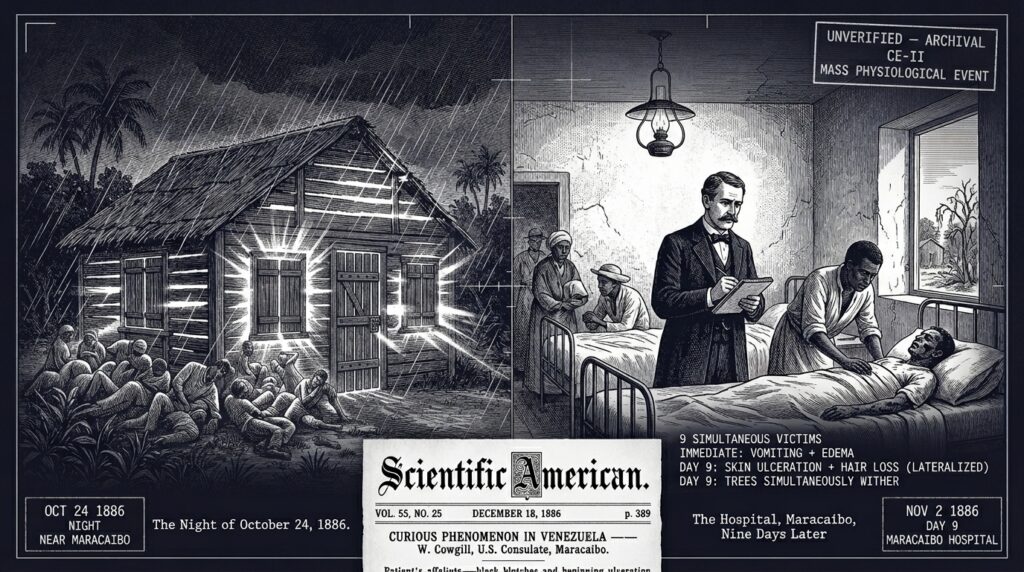
Near Maracaibo, Venezuela — night of October 24, 1886. A luminous humming object illuminates a closed hut through its sealed walls, simultaneously affecting all nine sleeping family members with immediate vomiting, facial swelling, and progressive skin discoloration developing into open ulcers on day nine — the same day all surrounding trees simultaneously withered. Hair loss lateralized to the side that was face-down during the event. House undamaged; no lightning trace found. US Consul Warner Cowgill visited the nine survivors in hospital and reported to Scientific American, December 18, 1886.
THINK ABOUTIT UFO|UAP SIGHTING REPORT
1886: Maracaibo, Venezuela Incident
On the night of October 24, 1886, during a rainy and tempestuous night near Maracaibo, Venezuela, nine members of a family sleeping in their hut were awakened by a loud humming noise and a vivid, dazzling light that brilliantly illuminated the interior. All nine people in the house — without exception — were simultaneously struck by violent vomiting. Extensive swellings appeared on the upper parts of their bodies, particularly noticeable about the face and lips. The light had produced no sensation of heat, though there was a smoky appearance and a peculiar smell. By morning the swellings had subsided, leaving large black blotches across their faces and bodies. On the ninth day the skin peeled off and the blotches became open, virulent sores. On the same ninth day, the trees surrounding the house simultaneously withered. The house itself was undamaged — all doors and windows had been closed. No lightning trace was found anywhere on the building. No detonation had been heard, only the humming. US Consul Warner Cowgill visited the nine survivors in a Maracaibo hospital, described their appearance as truly horrible, and wrote it all up in a letter to Scientific American, which published it on December 18, 1886, on page 389. It is among the most medically specific and institutionally credentialed CE-II case reports in the 19th-century archive, and the symptom profile — simultaneous hair loss on the down-facing side, nine-day delayed skin ulceration, tree death at the same nine-day interval — has never been explained by any conventional meteorological hypothesis.
Date: October 24, 1886
Sighting Time: Night — family was asleep; exact time not recorded
Day/Night: Night
Location: A hut a few leagues from Maracaibo, Zulia State, Venezuela
Urban or Rural: Rural — hut several leagues outside Maracaibo
No. of Entity(‘s): 0
Entity Type: None observed
Entity Description: None observed
Hynek Classification: CE-II (Close Encounter II) — object in close proximity to witnesses with major documented physiological effects on nine people and environmental effects (simultaneous tree death) over a nine-day period
Duration: Initial event — duration of light/humming not precisely recorded; physiological effects developed over nine days; tree death also on day nine
No. of Object(s): 1
Description of the Object(s): Luminous object accompanied by loud humming noise; appeared during a rainy and tempestuous night; produced vivid, dazzling light sufficient to brilliantly illuminate the interior of a closed hut; no sensation of heat despite extreme brightness; smoky appearance; peculiar smell; no detonation; no lightning trace found on any part of the building; all doors and windows closed — object apparently exterior to the structure
Shape of Object(s): Not recorded
Size of Object(s): Not recorded
Color of Object(s): Bright — vivid, dazzling white light
Distance to Object(s): Close enough to illuminate the hut interior through closed doors and windows and produce simultaneous physiological effects on all nine occupants
Height & Speed: Not recorded
Number of Witnesses: 9 — all members of the family; all affected simultaneously; Cowgill subsequently visited all nine in a Maracaibo hospital
Special Features/Characteristics: All nine occupants affected simultaneously — no individual variation in the triggering event; violent vomiting immediate; swellings on upper body, face, and lips immediate; no heat sensation despite extreme luminosity; smoky appearance; peculiar smell; black blotches on skin by morning; skin peeled off on day nine; blotches became open virulent sores on day nine; hair fell off on the side that was face-down when the phenomenon occurred — lateralized radiation effect consistent with directed rather than omnidirectional exposure; trees surrounding the house showed no damage until day nine, then simultaneously withered — same nine-day delayed biological response in both animal and vegetable organisms noted by Cowgill; house completely undamaged — all doors and windows closed; no lightning trace anywhere in the building; US Consul Warner Cowgill personally visited the nine survivors in hospital and described their appearance as truly horrible; Cowgill’s letter published in Scientific American, December 18, 1886, page 389; nine-day delayed onset of both human skin ulceration and tree death is consistent with delayed radiation syndrome in the absence of immediate thermal burns
Case Status: Unexplained
Source: Warner Cowgill, US Consul, Maracaibo, Venezuela; Scientific American, Vol. 55, No. 25, December 18, 1886, p. 389
Summary/Description: Nine members of a Venezuelan family sleeping in a closed hut near Maracaibo are simultaneously awakened by a humming noise and blinding light, then experience immediate vomiting and facial swelling. Over nine days they develop black skin blotches that become open sores, with lateralized hair loss on the body side that was face-down during the event. On the same ninth day, all surrounding trees simultaneously wither. The house is undamaged and no lightning trace is found. US Consul Warner Cowgill visits the nine survivors in hospital and reports to Scientific American. The symptom profile — simultaneous onset in nine people, nine-day delayed ulceration, lateralized hair loss, synchronized tree death — is consistent with directed radiation exposure and has no conventional meteorological explanation.
Related Cases: 1993 Central Park NSW Australia CE-II — directed beam, paralysis, subsequent death | 1967 Falcon Lake Manitoba Canada CE-II — chest burns, radiation symptoms | 1980 Cash-Landrum Texas CE-II — radiation symptoms in three witnesses | 1968 Ellsworth AFB South Dakota — physiological effects | 1993 Guarapiranga Brazil — tissue damage
DETAILED REPORT
Warner Cowgill was the United States Consul at Maracaibo, Venezuela. His letter to Scientific American — dated November 17, 1886, published December 18 — was submitted not as a UFO report but as a contribution to the journal’s ongoing coverage of unusual meteorological phenomena. He presented it to the editor as an addition to the list of electrical eccentricities. This framing is important: Cowgill was a trained diplomatic observer making a formal institutional submission to a peer-reviewed scientific publication. He was not sensationalizing. He was reporting.
The event occurred on the night of October 24, during a rainy and tempestuous night — thunderstorm conditions, which Cowgill noted because the electrical hypothesis was on his mind throughout his account. A family of nine people were sleeping in their hut a few leagues from Maracaibo when they were awakened by two simultaneous stimuli: a loud humming noise, and a vivid, dazzling light that brilliantly illuminated the interior of the house. The nine people were terror-stricken. They fell to their knees to pray. They were almost immediately interrupted by violent vomiting.
The physiological sequence that followed over nine days is the most analytically significant feature of the case. Cowgill documented it in precise medical language:
Immediate: violent vomiting; extensive swellings on the upper parts of the bodies, particularly about the face and lips. The light had produced no sensation of heat — an explicit negative observation from Cowgill, who was specifically looking for thermal effects given the electrical hypothesis. There was a smoky appearance and a peculiar smell.
Day one morning: swellings had subsided; large black blotches on faces and bodies.
Day nine: skin peeled off; blotches transformed into virulent raw sores. Hair fell from the side of the head that had been face-down when the phenomenon occurred. In all nine cases, the same side of the body was the more seriously injured.
The lateralization of the hair loss is the most diagnostically specific element of the entire medical record. All nine people lost hair from the same anatomical side — the side that had been facing down, away from the apparent direction of the light source. This is consistent with directed radiation exposure in which the affected side was the side most exposed to the source — but here it is the shielded side rather than the exposed side, which is analytically unusual and suggests a mechanism more complex than simple line-of-sight radiation.
The house itself was completely undamaged. All doors and windows had been closed throughout. No lightning trace was found anywhere on the building. No detonation was heard — only the humming. The object, whatever it was, had illuminated the interior of a closed wooden hut through its walls with sufficient intensity to cause simultaneous physiological effects on all nine occupants, without producing any heat or acoustic shock, and without leaving any electrical damage trace on the structure.
On the ninth day — the same day the human skin sores developed — the trees surrounding the house simultaneously withered. Cowgill noted this explicitly and with characteristic scientific caution: “This is perhaps a mere coincidence, but it is remarkable that the same susceptibility to electrical effects, with the same lapse of time, should be observed in both animal and vegetable organisms.” The synchronized nine-day delayed biological response in both human tissue and plant tissue is not a meteorological phenomenon. Lightning does not produce nine-day delayed tree death with simultaneous human skin ulceration. Ball lightning — the most commonly proposed conventional explanation — is a transient atmospheric phenomenon lasting seconds to minutes and does not produce nine-day delayed biological responses in surrounding vegetation.
Cowgill visited the nine survivors personally in a Maracaibo hospital before writing his letter. He described their appearance as truly horrible. He expressed hope that none of the injuries would prove fatal. His letter to Scientific American constitutes a formal diplomatic-medical report on a physiological mass-casualty event with no conventional explanation — published in the most widely circulated scientific periodical in the United States.
RESEARCHER’S NOTES
Cowgill’s Letter — The 1886 Maracaibo Incident and the Nine-Day Radiation Profile
Symptom Profile Analysis: The medical sequence documented in the Maracaibo case — immediate vomiting, immediate edema (swelling), progressive skin discoloration transitioning to ulceration at nine days, lateralized hair loss — is consistent with what is now called acute radiation syndrome (ARS) following exposure to a directed ionizing radiation source, specifically at a dosage level that produces delayed rather than immediate skin damage. The nine-day interval between exposure and ulceration onset is consistent with the dermal phase of ARS at moderate-to-high radiation doses. This clinical parallel does not prove radiation exposure but it represents the closest available conventional medical framework for the symptom profile.
Lateralized Hair Loss — Analytical Problem: The hair fell from the side that was face-down during the exposure — the side away from the apparent light source. In standard radiation exposure scenarios, the side most exposed (toward the source) sustains the most damage. The Maracaibo cases show the reverse: maximum damage on the shielded side. Cowgill noted this detail consistently across all nine cases. No standard radiation or electrical model predicts this lateralization pattern, and it remains the most analytically unexplained specific detail in the case.
Synchronized Tree Death — Day Nine: The simultaneous withering of all surrounding trees on the same ninth day as the human skin ulceration onset is perhaps the single most extraordinary detail in the case because it implies a common biological mechanism operating simultaneously in fundamentally different organisms. Trees and humans have entirely different biological systems; a single agent causing synchronized nine-day delayed tissue death in both requires a mechanism that operates at the cellular level across species boundaries. Cowgill correctly identified this as remarkable.
Ball Lightning Hypothesis: Ball lightning has been proposed as a conventional explanation for the Maracaibo case. Ball lightning is a real atmospheric phenomenon — it produces luminosity, hum, sometimes sulfurous smell, and can cause burn injuries at close range. However, it is a transient phenomenon lasting seconds to minutes, it does not penetrate closed structures without leaving physical damage traces, and it does not produce nine-day delayed biological responses in surrounding vegetation. The ball lightning hypothesis accounts for the initial event characteristics but fails on every delayed-response element.
Warner Cowgill went to the hospital and looked at nine people whose appearance he described as truly horrible, and then he went back to the consulate and wrote a careful, measured letter to Scientific American about electrical eccentricities. He noted that the trees had died on the same day the sores appeared. He noted the hair had fallen from the wrong side. He expressed hope that none of the nine would die, which suggests that on the day he wrote the letter he was not certain they would survive. Scientific American published his letter on December 18, 1886. The nine-day delayed synchronized death of both human skin and surrounding trees has never been conventionally explained. The archive holds the letter exactly as Cowgill wrote it — which is the most respectful thing that can be done for a document of this quality.