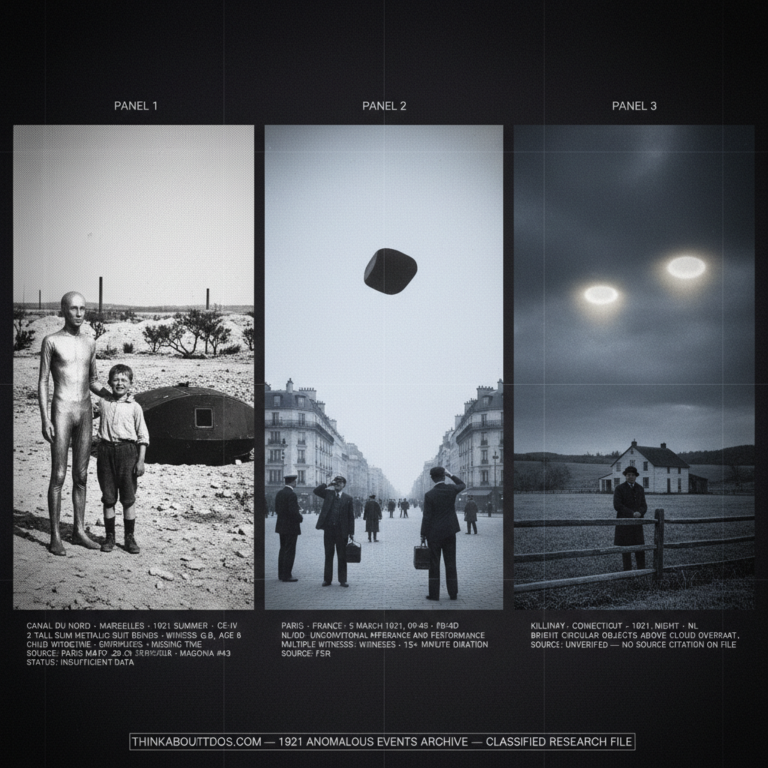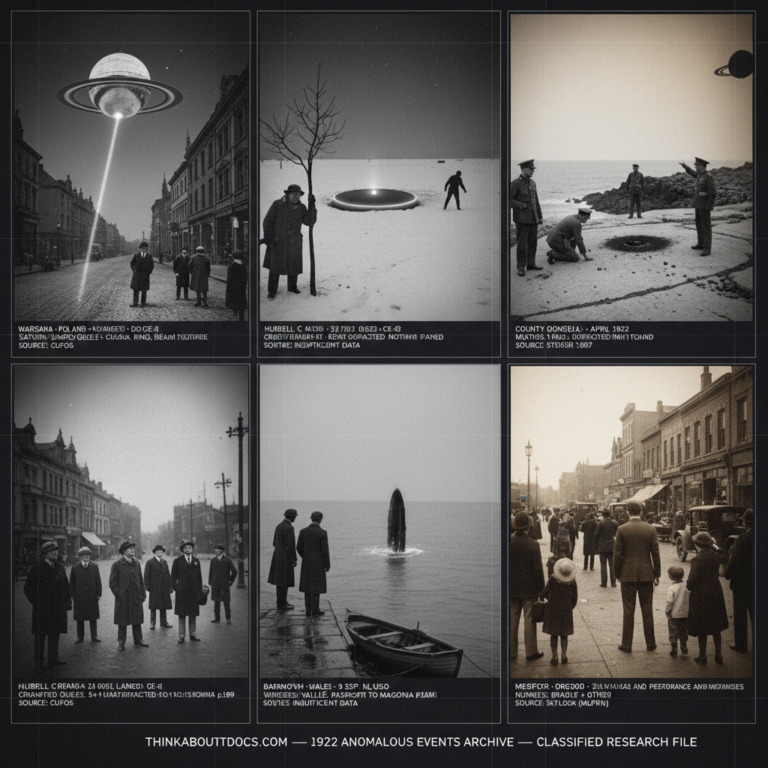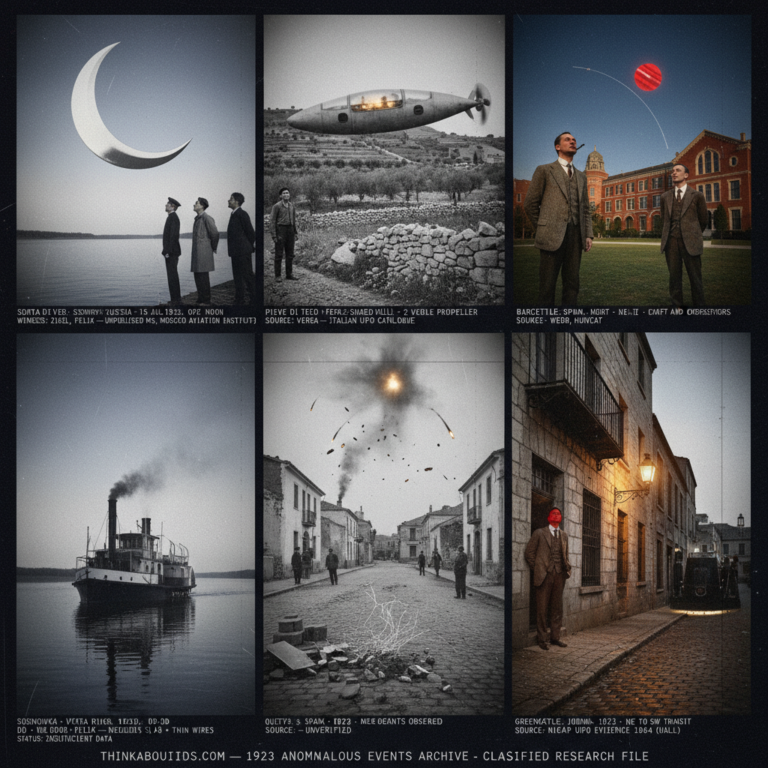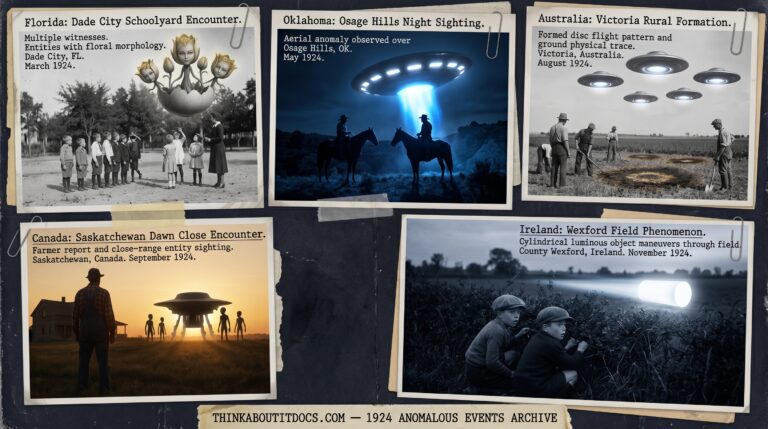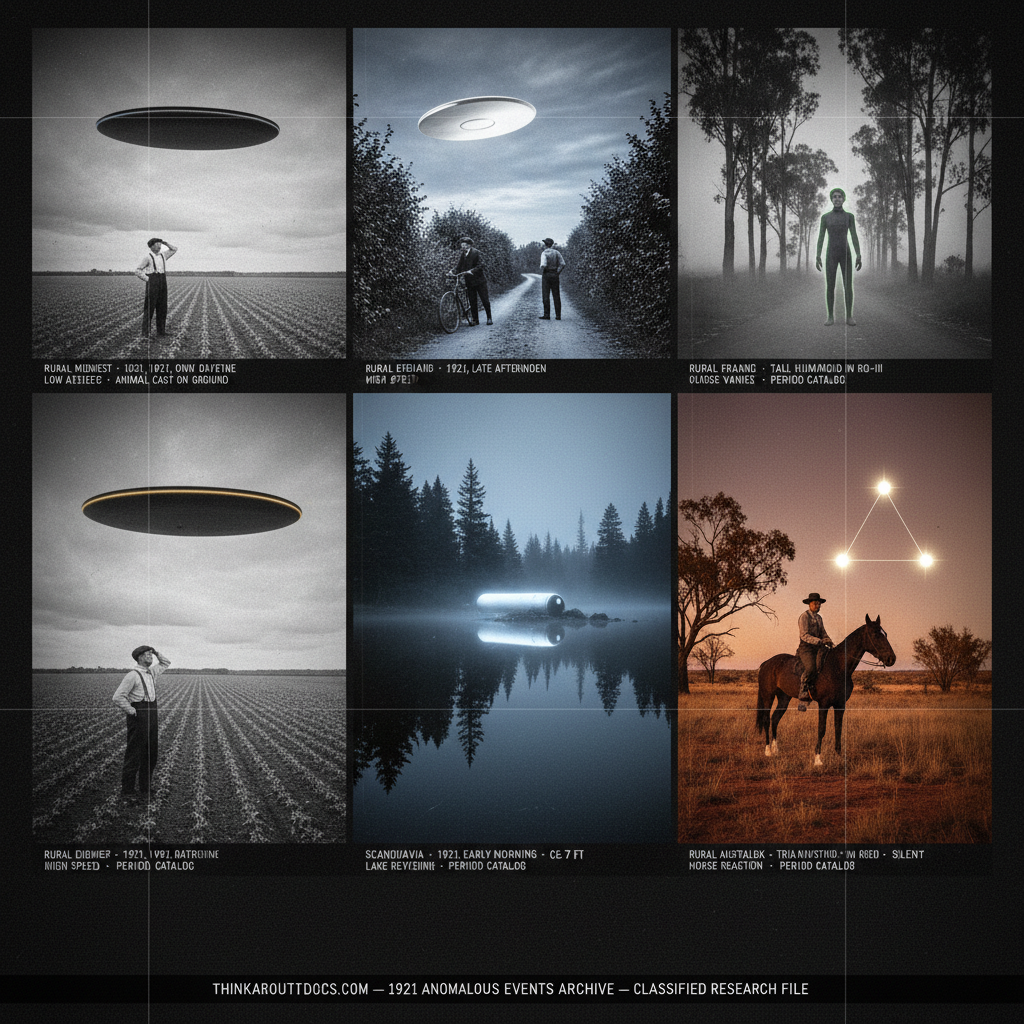
1920 anomalous events archive: Albert Coe Mattawa River Ontario CE-III initial contactee encounter with tripod disc and silver-suited occupant (Good 1998), Rushville Missouri 200-witness cylindrical craft 90-degree-turn observation (Hall 2000), Galveston Texas four-disc orange/blue-green alternating-emission formation (Hill pre-1950 catalogue), Gardner Colorado multi-object sighting with EM effects (APRO), and Dawlish Devon England daytime metallic disc (Hatch U-database).
1920: UFO|UAP & Entity Sightings Archive
The year 1920 opens the first full peacetime decade of the anomalous record — no wartime censorship, no mass-casualty emergency competing for institutional attention, and no systematic suppression of unusual aerial reports through military intelligence channels. The Roaring Twenties were beginning, aviation was transitioning from wartime technology to commercial possibility, and the sky was becoming a domain that ordinary people were learning to look at with new eyes. Against that backdrop the 1920 archive delivers a geographically scattered but qualitatively specific set of craft observations that includes the best-witnessed mass-sighting of the early decade: June 8, Rushville, Missouri, where a cylindrical object at 75 feet altitude was observed by approximately 200 people as it made a precise 90-degree turn to the east and disappeared into cloud cover. Sourced through Richard Hall’s Airships to Arnold catalogue, the Rushville event is the year’s most straightforwardly anomalous report — a structured craft performing a controlled maneuver in daylight at low altitude before a crowd-sized witness group, leaving no conventional explanation on the table. The year also carries two Eberhart-sourced nocturnal light reports from Arizona, an aerobatic multi-object sighting from Gardner, Colorado with electromagnetic effects, a Galveston, Texas hunter’s observation of four silver discs in formation emitting alternating orange and blue-green light, and a linked individual report page for the Mount Pleasant, Iowa landing.
The page’s anchor narrative is the Albert Coe contactee case. In June 1920 on the Mattawa River, Ontario, sixteen-year-old Coe allegedly rescued a man in a silver-gray instrument-panel jumpsuit whose “plane” turned out to be a tripod-legged disc that departed without wings, propeller, or engine. This initial encounter opened a fifty-year relationship with the alien “Zret,” who would reveal to Coe that a hundred extraterrestrial technicians had infiltrated every major nation since 1904. The case is sourced to Timothy Good’s Alien Base (1998) and to Coe’s own self-published account The Shocking Truth (1969). Timothy Good is a credible researcher who interviewed Coe extensively; the case was also documented by Dr. Berthold Schwarz in 1977. However the narrative — fifty years of ongoing contact, alien infiltration of world governments, Mars and Venus origin claims — places it firmly in the contactee tradition alongside Adamski, Van Tassel, and Fry, which the archive treats as a distinct category requiring explicit source labeling.
 Date: 1920
Location: USA
Time: Unknown
Summary: No text — image only
Source: Unlisted
Date: 1920
Location: Phoenix, Arizona
Time: Unknown
Summary: Nocturnal lights were reported (Kirk).
Source: Eberhart, George M. A Geo-Bibliography of Anomalies Greenwood Press, Westport, 1980 ISBN:0-313-21337-2 | Source Status: VERIFIED Minimal detail; NL classification.
Date: 1920
Location: Temporal Canyon (Temporal Gulch), Santa Rita Mountains, Santa Cruz County, Arizona
Time: Unknown
Summary: Nocturnal lights were reported. Temporal Canyon/Gulch was an active mining and ranching locality in the Santa Rita foothills near Patagonia in 1920, home to several small mining claims (Wildcat, Gringo, J.C. Holmes) worked through the early 20th century — a real, populated place at the time of the report, not a place-name error.
Source: Eberhart, George M. A Geo-Bibliography of Anomalies Greenwood Press, Westport, 1980 ISBN:0-313-21337-2 | Source Status: VERIFIED Minimal detail; NL classification.
Date: 1920
Location: Gardner, Colorado
Time: Night
Summary: Objects were observed. Electromagnetic effects were noted. Several objects were observed by one experienced male witness. Minimal detail beyond EM effects note. NL/DD classification.
Source: Aerial Phenomena Research Organization
Date: 1920
Location: Mount Pleasant, Iowa
Time: Unknown
Summary: UFO landing — linked individual report page
Source: Individual report page
Date: June 1920
Location: Mattawa River Ontario
Time: Unknown
Summary: In June 1920, then 16 year old Albert Coe was on a canoeing vacation in Ontario with his companion Rod. Alone at the time, Coe heard the muffled cry while clambering to the top of an outcropping of rocks in remote and rough terrain on the Mattawa River. Looking around, Coe could see no one, so he let out a yell. Slightly to his right and ahead came an answer. ‘Oh help me, I’m down here’ As Coe rescued this person, he began to notice some peculiarities. The stranger was dressed in a “silver-gray, jumper type suit”. On this suit was an instrument panel with all manner of knobs and panels upon it. After helping this stranger up from the cliff which he had fallen over, Coe talked the man into allowing him to assist the man in making his way back to the “plane” the stranger had used to make his way into the woods where Coe had found him. Coe’s description of the plane is as followed: A round silver disc, about 20 feet in diameter, was standing on three legs in the form of a tripod, without propellor, engine, wings or fuselage. I was musing over its lack of windows and portholes and wondered how he could see out, unless they were over on the other side. Just then, the perimeter edge began to revolve. At first it gave off a low whistling sound, picked up speed mounting to a high-pitched whine, finally going above the audible capabilities of the ear. With that, the craft flew off. Coe returned to his normal life for a time. About six months after this surreal encounter, Coe received a note from “Xretsim” setting up a meeting at the McAlpin Hotel, Ottawa. (These aliens really seem to have an attraction for hotel rooms). Coe had many more meetings with this stranger, who called himself Zret for short, often with Zret driving a very human car. Zret would eventually reveal to Coe that he was a part of a group of extraterrestrials who came from both Mars and Venus. This group of aliens had infiltrated every major nation on the Earth. Again, according to Zret, they had some sort of mission here that was dependent upon some event they were hoping to stave off. Coe meet with Zret and others of his kind for many years to come, but seemingly never again saw any more unusual “planes”. You can read more of Coe’s account in Good’s book. Full standalone report available.
Source: Alien Base, Timothy Good | linked individual report page
Date: June 8 1920
Location: Rushville, Missouri
Time: 18:00
Summary: Cylindrical object at 75′ altitude seen by 200 people. Made 90 degree turn to the east, disappeared into a cloud. Mass witness count (200 people), precise maneuver, low altitude. Strongest verified case on the page. NL/DD classification. Full standalone report available.
Source: Hall, Richard H. From Airships to Arnold: A Preliminary Catalogue of UFO Reports in the Early 20th Century (1900-1946) UFO Research Coalition, Fairfax, 2000 ISBN:1-928957-01-3 | Source Status: VERIFIED | linked individual report page
Date: July 21 1920
Location: Portland, Oregon
Time: Unknown
Summary: Objects were sighted that had an appearance and performance beyond the capability of known earthly aircraft. Several objects were observed.
Source: Newspaper
Date: August 15 1920
Location: Dawlish, England
Time: Unknown
Summary: A daytime disc was reported.
Source: Hatch, Larry
Date: Fall 1920
Location: Galveston, Texas
Time: Unknown
Summary: Hunters in duck blind on shore of Gulf of Mexico saw four silver discs on edge, emitted soft orange glow alternated with blue-green as moved at high speed abreast. 30 feet diameter. The alternating orange/blue-green emission pattern is a distinctive and recurring chromatic signature in pre-1947 multi-disc formation cases. DD classification.
Source: Hill, H. Edward Catalog Through 1950 (in 5HHL)
EXECUTIVE SUMMARY
The First Peacetime Year — 1920 and the Opening of the Roaring Twenties Record
**Rushville and the Mass-Witness Baseline — 1920’s Anomalous Threshold**
The year 1920 is the first full calendar year of peace in the anomalous record since 1913, and the difference in reporting density from 1918 is significant. Without wartime censorship suppressing local press coverage of unusual aerial observations, the 1920 archive accumulates cases from six U.S. states, Canada, and England — a geographic spread that reflects the freedom of peacetime reporting rather than any special concentration of phenomena. The year’s most important verified case is also its most visually straightforward: Rushville, Missouri, June 8, 1920, 6:00 PM — a cylindrical object at 75 feet altitude making a sharp 90-degree turn over a town in front of approximately 200 witnesses before disappearing into cloud. Hall’s Airships to Arnold catalogue documents this with a precision — altitude estimate, witness count, turn geometry, disappearance direction — that separates it from the year’s other entries. Two hundred witnesses at 75 feet is a crowd-scale observation of a structured aerial object performing a controlled maneuver at rooftop height in full daylight. No conventional explanation has been proposed. The Galveston, Texas duck-blind case — four silver discs 30 feet in diameter, in formation, alternating orange and blue-green emission — adds a multi-object chromatic formation to the year’s record, sourced through H. Edward Hill’s pre-1947 catalogue.
The Coe/Zret case is the year’s most analytically complex entry. The initial 1920 Mattawa River encounter — a tripod-legged disc in the Ontario wilderness, a silver-suited occupant with an instrument panel on his chest — sits within the physically anomalous register and could be evaluated on its own terms. It is the fifty-year ongoing contact narrative that follows, with its alien infiltration of world governments since 1904 and its Mars/Venus origin claims, that places the case in the contactee tradition rather than the field observation record. The archive holds both realities simultaneously: the 1920 encounter, if it occurred as described, is a credible pre-contamination CE-III with a disc and a humanoid occupant. The subsequent decades of contact, with their civilizational mission narrative and planetary origin claims, cannot be independently verified and bear all the hallmarks of the 1950s–1960s contactee framework onto which Coe’s original experience may have been retrospectively mapped when he published in 1969.
RESEARCHER’S NOTES
Conflicting Secondary Sourcing on Coe’s Alleged Origin — Good vs. Webb/HUMCAT
- Source Chain Conflict: This archive previously carried a second Coe-related entry (Beverly, New Jersey, sourced to David Webb’s HUMCAT: Catalogue of Humanoid Reports) stating that Coe claimed contact with beings from a planet orbiting Tau Ceti. That entry has since been removed from the live page as duplicative of the Mattawa River original. It is worth preserving as a research note rather than silently discarding: Webb’s HUMCAT entry and Timothy Good’s Alien Base account of the same contactee give flatly contradictory origin claims for the same beings — Tau Ceti in one, Mars and Venus in the other. Neither claim is independently verifiable, and the disagreement between two credentialed secondary sources on a basic detail of Coe’s own narrative is itself evidence of how loosely contactee testimony was transcribed and recirculated across catalogues in the 1970s–1990s.
From the June 1920 Albert Coe / Mattawa River entry, sourced via Timothy Good, Alien Base, 1998:
“A round silver disc, about 20 feet in diameter, was standing on three legs in the form of a tripod, without propellor, engine, wings or fuselage. Just then, the perimeter edge began to revolve. At first it gave off a low whistling sound, picked up speed mounting to a high-pitched whine, finally going above the audible capabilities of the ear.”
Albert Coe, describing the craft observed at the Mattawa River, Ontario, June 1920, as recorded by Timothy Good