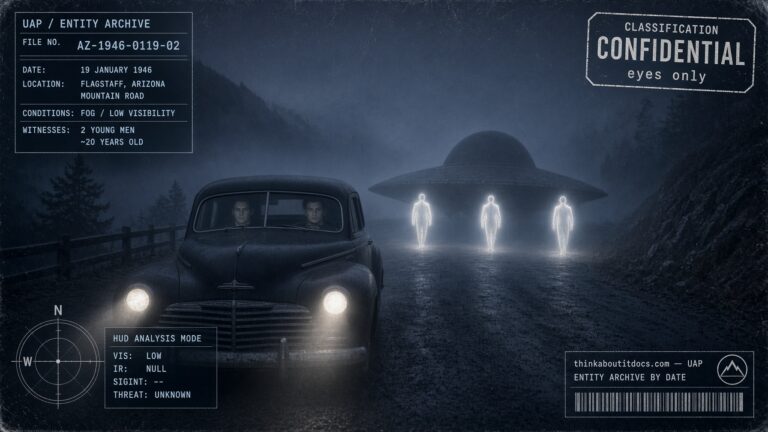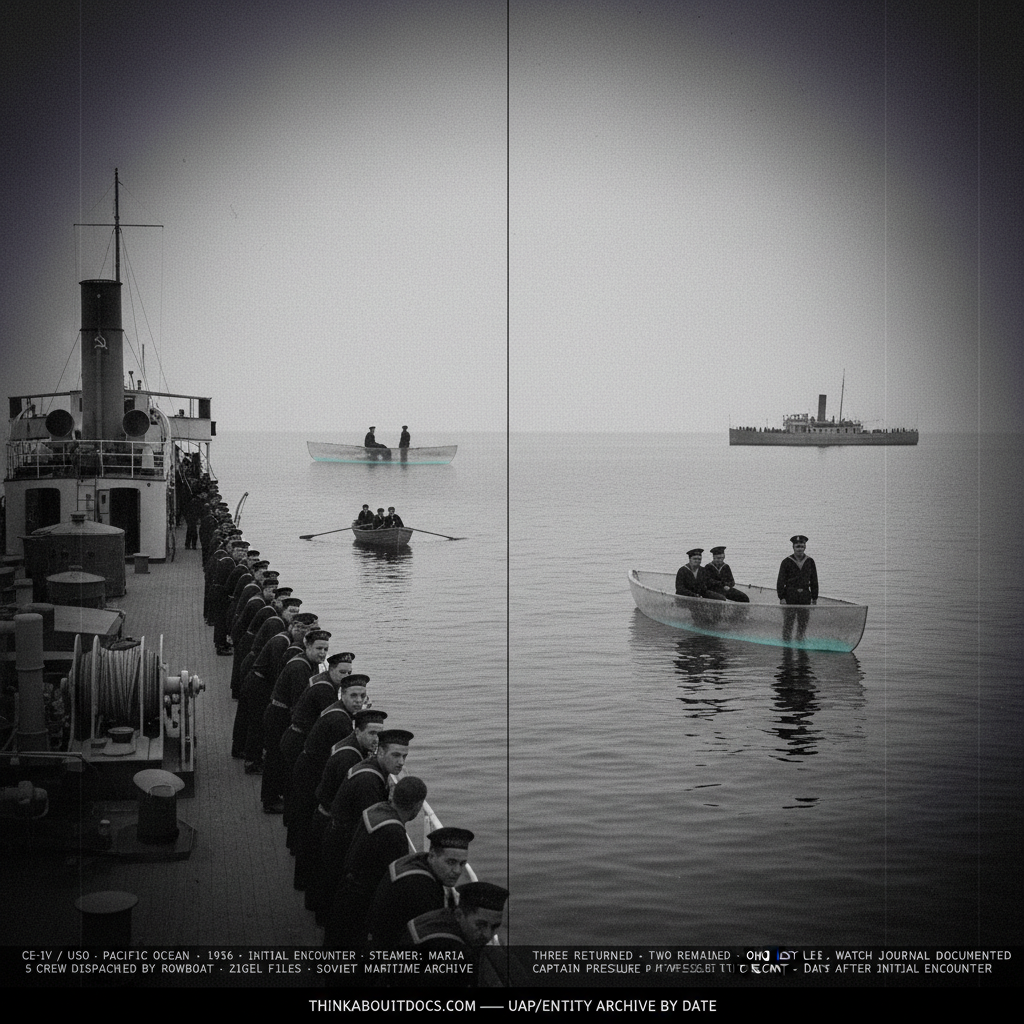
Pacific Ocean, 1936 — the Soviet steamer Maria encounters a vessel that ascended from the ocean, launches five sailors to investigate, and watches it accelerate away with them aboard. Days later three are found in a small transparent boat; one jumps into the sea and is lost. The two survivors describe webbed-fingered telepathic beings who offered a choice — two sailors chose to remain and were never seen again. The captain's watch journal documented the encounter; he was subsequently interrogated by the Soviet Ministry, pressured to recant, and transferred. Source: Engineer Lev A. Popov, quoting the files of Felix U. Zigel and Anton Anfalov. thinkaboutitdocs.com.
THINK ABOUTIT UFO | UAP | ENTITY ENCOUNTER REPORT
1936: Pacific Ocean Sightings
Somewhere in the Pacific Ocean in 1936, the Soviet civilian transport steamer Maria out of Leningrad encountered a vessel unlike anything in the ship’s registry. It sat motionless on the flat water ahead — no flag, no markings, no response to radio signals, no visible crew. The Maria’s captain ordered a rowboat launched. Five sailors rowed over and boarded it. The crew watched from the rail. Then the anomalous vessel accelerated away at very high speed and disappeared into a cloud or fog bank, with all five sailors aboard. The Maria searched for hours and found nothing. Days later, on the same return route, the officer of the watch spotted something on the water — a small boat made entirely of transparent material. Inside were three of the five sailors. As the Maria approached, one of the three screamed and jumped into the sea. His body was never found. The other two were brought aboard. They appeared, by the account, to be happy to see their crewmates. Then they explained what had happened. The vessel they had boarded was crewed by webbed-fingered beings in dark shiny suits who communicated by apparent telepathy. The beings told all five that there was no return. Two of the sailors agreed to stay. The three who wanted to leave were eventually placed in the transparent boat with a supply of tablet-form food. When the Maria departed, the transparent boat sank back into the ocean. Back in Leningrad, the captain filed a report with the Ministry. He was called in, interrogated, pressured to recant, and transferred to another ship. The watch journal — the contemporaneous ship’s log — documented everything.
Date: 1936
Sighting Time: Daytime (initial encounter); unspecified for the return of the survivors
Day/Night: Day (initial encounter)
Location: Pacific Ocean (en route from Leningrad; specific coordinates not recorded)
Urban or Rural: Open ocean
No. of Entity(‘s): Multiple (exact number not recorded)
Entity Type: Aquatic humanoids (“frogmen”)
Entity Description: Dressed in dark, shiny, form-fitting suits resembling diving/frogman gear; extremities similar to human hands but with small webbed membranes between the fingers; communicated by apparent telepathy and exchanged glances rather than speech
Hynek Classification: CE-IV (Close Encounter of the Fourth Kind — abduction/detention). Classification correction: an earlier version of this page listed CE-III; two sailors were held involuntarily for roughly two days and one was lost during recovery, which meets the CE-IV threshold rather than a simple occupant-observation CE-III.
Duration: Initial encounter — vessel departed rapidly, subsequent search lasted several hours; detention aboard the anomalous vessel — approximately two days by survivor estimate; total event span — several days
No. of Object(s): 2 (the primary anomalous vessel; a small transparent boat used to return the three survivors)
Description of the Object(s): Primary vessel — appeared to have ascended from the ocean, no conventional markings, no radio response, capable of very high speed departure; secondary vessel — a small boat made entirely of transparent material with no visible attachment points, which sank back into the ocean on its own once the Maria departed
Shape of Object(s): Vessel-like (primary); small open boat (secondary, transparent)
Size of Object(s): Primary vessel large enough to board by rowboat and accommodate five sailors plus crew; secondary vessel small-boat sized
Color of Object(s): Transparent (secondary vessel); primary vessel color not recorded
Distance to Object(s): Close enough for rowboat approach and boarding
Height & Speed: Departed the initial encounter at very high speed, disappearing into a cloud or fog bank
Number of Witnesses: Full crew of the steamer Maria (multiple, observing from the rail); five sailors directly involved (two voluntarily remained, two recovered, one lost at sea)
Special Features/Characteristics: USO (Unidentified Submerged Object) profile — vessel appeared to ascend from the ocean; telepathic communication; tablet-form food offered to detained sailors; two sailors voluntarily chose to remain; one sailor became erratic upon recovery and jumped into the sea; captain’s watch journal documented events contemporaneously; Soviet Ministry interrogation followed; captain pressured to recant and subsequently transferred; transparent secondary vessel sank unaided after the Maria’s departure
Case Status: Unexplained.
Source: Engineer Lev A. Popov, quoting the files of Felix U. Zigel and Anton Anfalov. ⚠ SOURCE CAVEAT: per this archive’s standing policy, Anton Anfalov is flagged as a problematic source on Soviet/CIS-territory cases. This entry’s retention rests primarily on the Zigel manuscript chain and Popov’s direct citation of it, with the Anfalov link noted as a caveat rather than relied upon independently.
Summary/Description: In 1936, the Soviet civilian transport steamer Maria encountered an anomalous vessel in the Pacific Ocean that appeared to have ascended from the water. Five sailors launched to investigate and boarded it; the vessel departed at high speed with them aboard. Days later, three sailors were found in a small transparent boat on the same route; one jumped into the sea and was lost. The two survivors described being held by webbed-fingered, telepathic beings who told all five there was no return — two accepted and voluntarily remained; the other three were eventually released with tablet-form food in the transparent boat, which sank on its own once the Maria departed. The captain’s contemporaneous watch journal documented the encounter; he was subsequently interrogated by the Soviet Ministry, pressured to recant, and transferred to another vessel.
Related Cases: 1936: UFO|UAP & Entity Sightings Archive | 1982 Trans-Baikal/Issyk Kul, USSR — Soviet frogmen vs. underwater humanoids (same aquatic-entity morphology, decades later)
Detailed Report
The 1936 Pacific Ocean Maria encounter is the most elaborate pre-modern maritime USO/CE-IV case in the compiled Soviet literature, and its source chain — Engineer Lev Popov citing the files of Felix Zigel — places it within the most credentialed body of Soviet anomalous research available to the Western record. Zigel was a Soviet aerospace engineer and UFO researcher whose manuscript files, compiled between the 1950s and his death in 1988, represent the most systematic pre-glasnost documentation of Soviet UAP cases. He worked within the Soviet scientific establishment, taught at the Moscow Aviation Institute, and collected case files with the methodological rigor of an aerospace professional constrained by state censorship. His manuscripts circulated in samizdat form and were transmitted to Western researchers after 1991 through intermediaries including Anton Anfalov and Lev Popov.
The event unfolds in two distinct phases. The initial encounter — a large vessel ascended from the ocean, unresponsive to radio, approached by rowboat, departed at high speed with five sailors — is a multi-witness event observed by the entire crew of the Maria, documented contemporaneously in the captain’s watch journal. This is the evidentiary backbone of the case: an official ship’s log entry describing an anomalous vessel encounter in real time, not a retrospective report. The captain’s subsequent refusal, under Ministry interrogation, to abandon his testimony — insisting on the watch journal as documentation before finally being forced to recant — speaks to the conviction with which he held his account.
The sailors’ testimony from inside the anomalous vessel adds the case’s most structurally significant elements. The beings communicated by exchanging glances — apparent telepathy without vocalization. The proposition delivered to all five sailors — that there was no return — was apparently non-coercive in tone; two accepted it immediately and voluntarily remained. This is one of the most unusual features in the pre-modern CE literature: not an abduction in the standard coercive sense but an offer, and two individuals accepting it. The three who did not accept were held for approximately two days, provided with tablet food, and eventually returned in a small transparent boat whose construction appears nowhere else in the 1930s maritime UAP record.
The Soviet institutional response is the case’s final analytical layer. The Ministry’s interrogation of the captain and surviving sailors, and the captain’s eventual forced recantation followed by transfer to another vessel, is a documented pattern of Soviet UAP suppression that Zigel’s files record across multiple cases. It does not prove the event occurred, but it is consistent with how the Soviet state handled anomalous reports from professional witnesses throughout the pre- and post-war period.
RESEARCHER’S NOTES
The Maria Encounter — 1936 Pacific Ocean and the Zigel File Standard
- Correction note: This section was previously corrupted on the live page with unrelated content — an image-generation prompt fragment describing a different, circa-1937 Polo, Missouri case. That text has been removed and replaced with genuine analysis of this case.
- Source Chain Assessment: Zigel’s manuscript files are among the more credible available sources for Soviet-territory pre-glasnost cases, given his professional standing and documented decades-long compilation effort. The Anfalov transmission link is flagged per standing policy, but Popov’s direct citation of the Zigel files provides an independent chain that does not rest on Anfalov alone.
- Classification Rationale: CE-IV is assigned because two sailors were involuntarily detained for an extended period and one was lost — this exceeds a simple CE-III occupant-observation case and meets the abduction/detention threshold.
- Pattern Context: The “webbed-fingered, telepathic aquatic humanoid” entity type recurs in this archive’s much later 1982 Trans-Baikal/Issyk Kul Soviet frogman case, suggesting either a persistent strand within Soviet-territory anomalous reporting or a recurring narrative template within that specific research tradition. The transparent-vessel motif and the “voluntary retention” offer are otherwise unparalleled in this archive’s pre-1947 maritime record.
- Evidentiary Weight: The captain’s contemporaneous watch journal is a genuine strength — official maritime logs carry legal and professional weight for the officer maintaining them. Set against that is the extraordinary content of the claim itself (telepathic aquatic beings, voluntary human retention, a self-sinking transparent boat) and the absence of any independently surfaced corroborating Soviet archival record. The case is logged as Unexplained on the strength of the documented captain’s-log chain, while acknowledging the claim’s extraordinary character.
The Maria encounter stands as the most elaborate — and most institutionally consequential — pre-modern Soviet maritime USO case in this archive. A captain who kept his log, held to his testimony under Ministry pressure, and was transferred rather than simply dismissed is a genuinely unusual evidentiary profile, set against a claim extraordinary enough that this archive logs it as Unexplained rather than Unverified, while being honest about how far outside the ordinary record it sits.