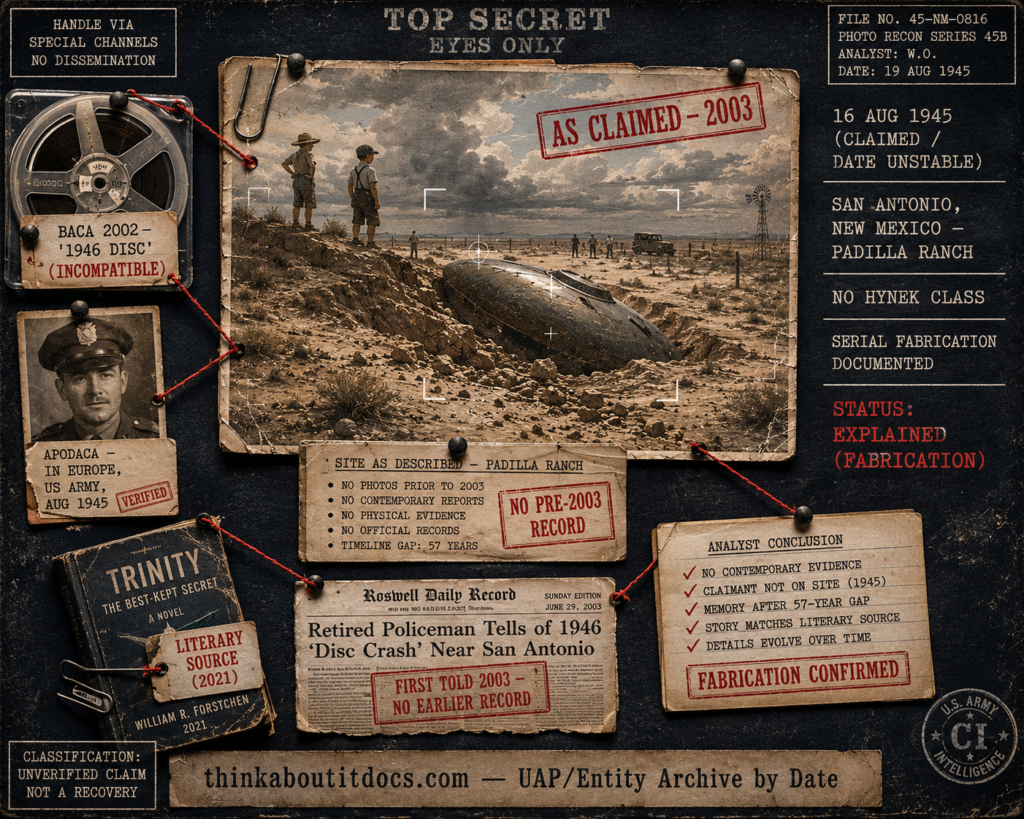
The "Trinity" crash, framed honestly: a story with no record before 2003, a witness who told an incompatible version a year earlier, and a "participant" who was in Europe with the Army in 1945. Logged Explained — fabrication.
THINK ABOUTIT UFO | UAP SIGHTING REPORT
1945: New Mexico UFO Crash Encounter
For nearly two decades this was sold as the oldest crash-retrieval case in the canon — two ranch boys near San Antonio, New Mexico, finding a downed “avocado-shaped” craft with small living creatures inside it just weeks after the Trinity atomic test, the wreckage hauled off by soldiers under a cover story about a manganese mine. Jacques Vallée and Paola Harris built it into a 2021 book, Trinity: The Best-Kept Secret, and the New York Times treated it gently. The trouble is that none of it survives investigation. There is no record of the story existing before 2003, when the two “boys” were men in their sixties; one of them had been tape-recorded a year earlier telling a completely different and incompatible crash tale; and the state policeman written into the recovery was provably in Europe with the Army in 1945 and would not become a policeman for another six years. This is not the archive’s oldest crash case. It is a late-built fabrication, and the honest record says so.
Date: Claimed August 16, 1945 (date unstable across tellings — also given as August 18; recovery variously placed Aug. 20–25). The “one month after Trinity” alignment appears constructed.
Sighting Time: Claimed daytime (mid-morning into dusk); not fixed
Day/Night: Day (as claimed)
Location: Padilla Ranch on leased federal land west of San Antonio, New Mexico (near present I-25 Milepost 139)
Urban or Rural: Rural (remote desert ranchland)
No. of Entity(‘s): Claimed multiple — small “hombrecitos” (as claimed; fabricated)
Entity Type: Claimed humanoid (fabricated)
Entity Description (as claimed, not credible): Small, hairless, “childlike,” shadowy and expressionless figures said to be moving rapidly inside the craft, as if able to shift position instantly. No physical description survives scrutiny; the account originates with self-contradicting witnesses.
Hynek Classification: None — documented fabrication (hoaxes/fabrications carry no Hynek classification). [Page previously listed CE-III; stripped — see notes.]
Duration: Claimed observation over minutes on the first day, with claimed return visits over subsequent days; durations vary by telling
No. of Object(s): 1 (claimed)
Description of the Object(s) (as claimed): An oblong/circular “avocado-shaped” craft, dull metallic (“the color of an old pot”), partly buried at the end of a gouge said to be the length of a football field; associated thin foil-like material claimed to unfold by itself when crumpled (a motif borrowed from Roswell “memory-metal” lore)
Shape of Object(s): Claimed avocado/oblong-circular (the depicted shape shifted across illustrations and later media)
Size of Object(s): Large enough, as claimed, to require a flatbed truck and an L-shaped frame; not consistently specified
Color of Object(s): Dull metallic (as claimed)
Distance to Object(s): Claimed close approach (within yards)
Height & Speed: N/A (claimed crashed/grounded object)
Number of Witnesses: 2 primary claimants — the late Remigio “Reme” Baca and Jose Padilla — who first told the story publicly in 2003 as men in their mid-60s; supporting figures named in the tale (Faustino Padilla; officer Eddie Apodaca) are deceased and/or demonstrably not present in 1945
Special Features/Characteristics: Crash/retrieval claim; claimed occupants; child witnesses (as later framed); a claimed surviving metallic “artifact”; a claimed military cover story; self-unfolding “memory” foil; narrative anchored rhetorically to the Trinity atomic test
Case Status: Explained — fabrication (serial, documented; no credible evidence of a real 1945 event — see notes)
Source: Original publication: Ben Moffett, The Mountain Mail (Socorro, NM), two articles, late 2003. Subsequent promotion: Reme Baca, Born on the Edge of Ground Zero (2011); Paola Harris interviews and MUFON UFO Journal (2016); Jacques Vallée & Paola Harris, Trinity: The Best-Kept Secret (1st ed. 2021; 2nd ed. 2023; 3rd ed. 2024); sympathetic coverage in the New York Times. Critical investigation: Douglas Dean Johnson, “Crash Story Files” (2023–2025); David Halperin; researcher Tom Carey (holder of the 2002 Baca recording)
Summary/Description: A claim, first made public in 2003 by two New Mexico men, that as boys in August 1945 they found a crashed craft with living non-human occupants on the Padilla family’s leased ranchland near San Antonio, later recovered by the military under a cover story. Promoted in 2021 as the book Trinity: The Best-Kept Secret. Detailed investigation has since established that no version of the story predates 2003, that one witness had earlier told an incompatible crash tale, and that a key named participant could not have been present — findings that collectively identify the account as a fabrication.
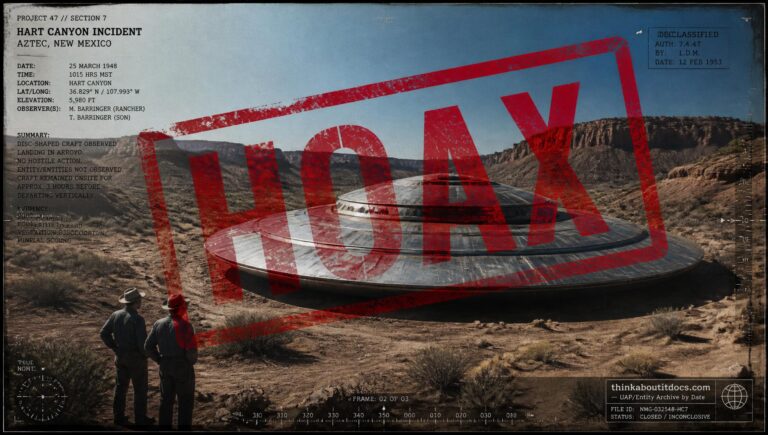
Related Cases: 1947 Roswell (the “memory-foil” motif echoed here) |; 1948 Aztec crash (documented hoax) | 1947 Socorro “alien autopsy” film (documented hoax) | 1964 Lonnie Zamora Socorro landing (a genuinely unexplained case the Trinity tale attempts to associate itself with by proximity)
Full Report
As told from 2003 onward, the story runs like this: on an August morning in 1945, Jose Padilla, then a boy, and his younger friend Reme Baca rode out on the Padilla family’s leased ranchland near San Antonio to find a stray cow, heard a violent crash during a passing thunderstorm, and discovered a partly buried metallic craft at the end of a long gouge in the earth. Inside, they said, small hairless “childlike” creatures moved frantically. They reported it to Jose’s father, Faustino; a family friend, state policeman Eddie Apodaca, was brought in; and over the following days the Army removed the wreckage on a flatbed truck, masking the operation with a cover story about working a manganese mine. The boys, they said, kept a piece of the craft and were told to say nothing. That narrative, written up by local feature writer Ben Moffett in The Mountain Mail in late 2003, is the entire basis of the page as it previously stood — and it is the only part of the file most readers ever saw.
What the page omitted is everything that has happened since, and it is decisive. The 2003 account was elaborated over the next two decades — through Baca’s 2011 self-published book, through Paola Harris’s interviews from 2010 onward, and finally through Jacques Vallée and Harris’s 2021 book Trinity: The Best-Kept Secret, which gave the case international visibility and even drew sympathetic notice from the New York Times. Throughout, the story was framed as the testimony of two children, sincere and unrehearsed. That framing is itself misleading: the tale was first told publicly not by children but by two men in their mid-sixties, and no record of any kind has ever been produced showing that either man told anyone this story before 2003.
Beginning in 2023, researcher Douglas Dean Johnson published a meticulous series of investigative reports that dismantled the case. Three findings are individually serious and jointly fatal. First, provenance: in nearly sixty years, not one contemporaneous or even mid-century document, letter, or recorded recollection places this crash in the historical record before 2003. The man who first interested Vallée in the case conceded that “nobody spoke about it for many years” — which, absent any real event, is exactly what one would expect.
Second, and most damaging, is a recording. Less than a year before the 2003 avocado-craft story appeared, Reme Baca was tape-recorded by veteran Roswell researcher Tom Carey describing a thoroughly different boyhood adventure: a crashed disc encountered in 1946, not an avocado-shaped craft in 1945. The two accounts share only the two boys and a single aluminum bracket presented as an “artifact” — and even there, the two stories give flatly incompatible explanations of how that bracket was obtained. A witness does not misremember a disc as an avocado, or 1946 as 1945, or one method of acquiring an object as another; the divergence is the signature of invention, not memory. Carey, who did not believe Baca at the time, confirmed in 2025 that Baca had presented the story to him as straight truth.
Third is what Johnson aptly likened to identity theft. The recovery narrative leans on a named, real New Mexico State Police officer, Eddie Apodaca, as a corroborating adult presence in August 1945. But Apodaca was serving with the U.S. Army in Europe in August 1945 and was not commissioned as a New Mexico State Police officer until 1951. The boys would have known him only years later, as teenagers, after he joined the force; inserting him into a 1945 scene is an anachronism that cannot be reconciled with the claim. That neither Harris across some twenty years nor Vallée across six caught this is, in Johnson’s assessment, evidence that no genuine credibility investigation was ever conducted.
Around these load-bearing problems sit numerous smaller ones, all pointing the same direction: the crash date drifts between tellings (August 16, August 18, recovery dates ranging across late August); the witnesses’ stated ages do not match their validated birth records; and the depicted craft mutated over the years, in later renderings drifting toward the shape of “Jumbo,” the famous steel containment vessel associated with the Trinity test — a visual nudge tying the tale ever more tightly to the Manhattan Project and, latterly, to the cultural moment of the Oppenheimer film. The lone surviving “artifact,” a small metallic bracket, has never been shown to possess any anomalous property and featured, as noted, in the earlier and incompatible version of the story.
To their partial credit, in the wake of Johnson’s reporting Jacques Vallée acknowledged serious credibility problems with Baca, and Harris to a lesser degree. Both, however, have continued to defend a version of the case. The archive records that ongoing defense for completeness, but it does not change the evidentiary picture: a story with no existence before 2003, contradicted by its own teller’s earlier recorded account, and populated by a participant who was on another continent at the time, is not a historical event. It is a fabrication assembled decades later.
Researcher’s Notes
The Avocado Craft — San Antonio 1945 and the Hoax Built Backward from Trinity
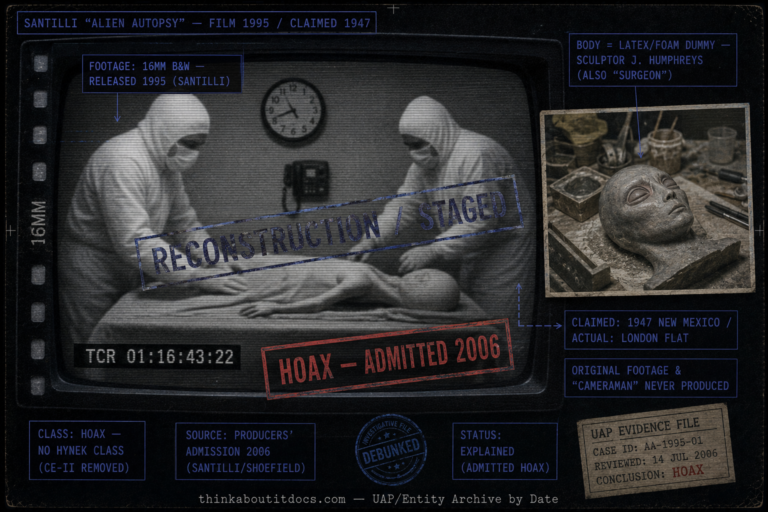
- Classification — strip the CE-III: The page’s CE-III rested entirely on the claim that the boys saw living occupants. Because the underlying account is a documented fabrication rather than a witnessed event, no Hynek classification applies, and the CE-III is removed rather than reassigned. This follows the archive’s standing rule — hoaxes and fabrications carry no Hynek class — and the same treatment already applied to the Aztec and Santilli “autopsy” entries. The Case Status moves to Explained, the explanation being deliberate invention.
- Source chain — a story with no roots before 2003: The single most important source fact is a negative one: there is no pre-2003 record of this crash, anywhere, despite sixty years and a region saturated with UFO interest. The chain runs Moffett/Mountain Mail (2003) → Baca’s self-published book (2011) → Harris interviews and MUFON UFO Journal (2016) → Vallée & Harris, Trinity (2021/2023/2024) → New York Times notice → Douglas Dean Johnson’s investigation (2023–2025), with David Halperin and Tom Carey corroborating. The previous version of this page cited only the first link in that chain and none of the rest, which is precisely how a discredited claim keeps its shine — by freezing the record at the origin story and never showing the reader what investigation later found.
- Pattern context — a hoax marketed onto a real landmark: The case is a study in how crash-retrieval lore is assembled from familiar parts and then anchored to something real for credibility. The self-unfolding “memory foil” is lifted straight from Roswell; the military-cover-story beat is standard genre furniture; and the whole tale is welded to the Trinity atomic test by date (“one month after”) and, increasingly, by imagery (the craft reshaped toward “Jumbo”). The sympathetic New York Times coverage of the 2021 book is itself a cultural datum worth noting: institutional endorsement substituted for verification, and a baseless claim acquired borrowed authority it never earned. The archive places this beside Aztec and the Santilli film as a marketed fabrication, distinct from genuinely unresolved nearby cases like Zamora’s 1964 Socorro landing, which the Trinity promoters invoke by mere geographic proximity.
- Evidentiary weight — the fabrication is demonstrated, not merely suspected: This is not a thin case logged for caution; it is a discredited one logged on evidence. The 2002 Carey recording establishes conscious fiction-making (an incompatible prior story from the same witness); the Apodaca anachronism establishes a fabricated participant (a real man provably elsewhere); the absence of any pre-2003 record removes any independent footing. The surviving “artifact” proves nothing and appeared in the contradictory earlier tale. Even the case’s principal promoter has conceded credibility problems with the lead witness. Weighed honestly, the evidence does not merely fail to support a 1945 crash — it affirmatively demonstrates the account was constructed later. Status: Explained — fabrication.
The record’s honest final position is that the “Trinity” crash never happened. What happened instead is documented and almost as instructive: two men in their sixties assembled, in 2003, a crash-retrieval story that one of them had told incompatibly just a year before; they furnished it with a real policeman who was an ocean away at the time; and over two decades it was polished, published, and welded to the most famous event in New Mexico’s history until a national newspaper repeated it without checking. Careful investigators then took it apart. The archive keeps the page not as a crash report but as a worked example of how a modern legend is built backward from a landmark — CE-III stripped, status Explained, the 2003 origin tale preserved only as the artifact it is. The oldest crash in the canon turns out to be one of the youngest, and naming that plainly is the whole point of keeping the record honest.