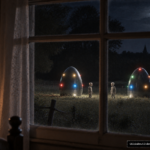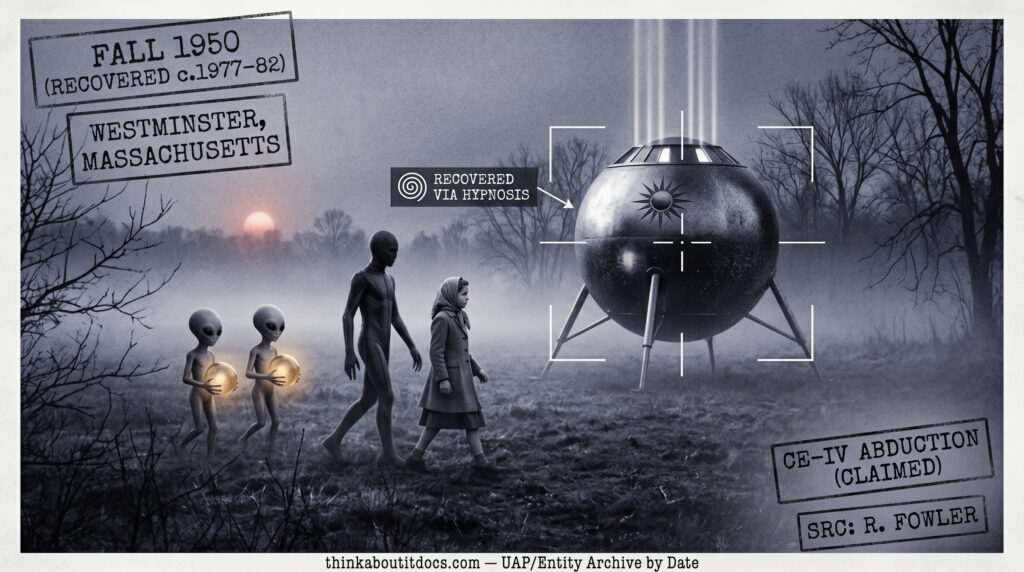
The account's return scene — the three-legged sphere, the sunburst emblem, the escort of grey beings. Recorded not in 1950 but recovered under hypnosis three decades later, as part of the Andreasson Affair. Logged Insufficient Data.
THINK ABOUTIT ABDUCTION REPORT
1950: Westminster Massachusetts Abduction
The “1950 Westminster abduction” is not an isolated case at all — it is a childhood chapter in the most exhaustively documented abduction narrative in the literature, and the page as it stood never said so. The thirteen-year-old “Betty Aho” of this account is Betty Andreasson, later Luca, the Massachusetts woman whose 1967 encounter became Raymond Fowler’s five-book Andreasson Affair. This particular journey — the white misty room, the small grey beings, the underwater tunnel lined with costumed humans in crystal, the meeting with “The One,” the implant behind the eye — was not reported in 1950 by a child to her parents. It was recovered under hypnosis some three decades later, in the course of an investigation into the adult Betty’s experiences, and published in 1982. Everything about how to read it follows from that single fact.
Date: Fall 1950 (as dated within the narrative; the episode itself was recovered via hypnotic regression c. 1977–1982, not reported contemporaneously)
Sighting Time: Morning (as recounted)
Day/Night: Day (morning)
Location: Westminster, Massachusetts (Betty Andreasson’s childhood home area; she was raised in Westminster and Gardner)
Urban or Rural: Rural/semi-rural (as recounted — outdoors near the home, then claimed off-site/otherworldly settings)
No. of Entity(‘s): 5+ (as recounted) — three small beings initially, two taller beings later, plus a tall white-haired humanoid (“The One”) and others
Entity Type: Humanoid (two types: small “Grey”-type and taller escort-type)
Entity Description (as recounted): Small beings 2½ to 3 feet tall with grey skin, large oval heads, and huge black oval eyes, in silvery-white coveralls that seemed to blend with the room’s mist and light; and taller beings about 5 feet tall in grey coveralls. A tall, white-haired human-like figure in a luminous white robe also appears. The small-being description matches the now-canonical “Grey.”
Hynek Classification: CE-IV (Close Encounter of the Fourth Kind — abduction). Appropriate to the claim type; note the account is a hypnotically recovered subjective experience (see notes).
Duration: Not fixed (a single extended experience as recounted)
No. of Object(s): 1+ (an orb-like object initially; later a landed craft, plus many craft-like objects described at an otherworldly location)
Description of the Object(s) (as recounted): An object “like a moon” that grew larger and immobilized her; later, a landed craft shaped like a sphere of reflective metal standing on three legs, with a door, a sunburst emblem, and beams of “solid light” projecting from the top that stopped abruptly “as if chopped off”
Shape of Object(s): Spherical (the landed craft); orb (the initial object)
Size of Object(s): Not specified
Color of Object(s): Reflective metallic; recurring reddish-orange orb motif
Distance to Object(s): Close (claimed boarding and transport)
Height & Speed: N/A (claimed transport, including a described submersion into water and travel through tunnels)
Number of Witnesses: 1 (Betty Andreasson alone for the 1950 episode; her later, best-known 1967 encounter had family witnesses, but this childhood event does not)
Special Features/Characteristics: Paralysis; floating/levitation; medical-style examination over a table; light-globes and framing light-beams; an underwater “Museum of Time” tunnel holding humans in period costume preserved in crystal; a “Great Door” in a glass wall and a meeting with “The One”; out-of-body experience; clamshell transports; a mine of blue stones; removal of the right eye and implantation of a tiny device; instruction to forget. Strong religious/visionary character throughout.
Case Status: Insufficient Data (sincere single-witness subjective account recovered via hypnosis decades later; unverifiable, not a hoax — see notes)
Source: Raymond E. Fowler, The Andreasson Affair series — specifically the childhood episodes detailed in The Andreasson Affair: Phase Two (1982); chapters including “The Museum of Time,” “The Great Door,” and “The Implant” correspond directly to this narrative. The broader case was the subject of a roughly twelve-month MUFON investigation (begun 1977) involving hypnosis (Harold Edelstein, Fred Max), lie-detector testing, and psychiatric evaluation, with Fowler as lead investigator.
Summary/Description: A childhood abduction experience attributed to the thirteen-year-old Betty Andreasson (née Aho) at Westminster, Massachusetts, in the fall of 1950: immobilized by an orb-like object, taken into a misty white room, examined by small grey beings and taller escorts, transported through an underwater tunnel “museum” of preserved humans to meet a luminous white-robed figure called “The One,” subjected to an eye-removal and implant, and returned to a field by a landed three-legged spherical craft bearing a sunburst emblem, with instruction to forget. The account was recovered under hypnosis in the course of Raymond Fowler’s investigation of the adult Betty’s experiences and published in 1982.
Related Cases: The 1967 South Ashburnham, Massachusetts Andreasson abduction (the main, multi-witness case, entity “Quazgaa”) | Betty’s earlier recovered childhood episodes (1944, age 7; 1949, age 12, also at Westminster) | the Hill abduction (1961, the template hypnosis-recovered case Fowler expressly compared) | 1950s contactee narratives (Adamski; Howard Menger — contactee) with which the “messenger to humanity” and divine-encounter themes share DNA
Full Report
To read this entry correctly, the reader first has to know who the witness is. “Betty Aho” is Betty Andreasson, later Betty Luca, born in 1937 to Waino and Eva Aho and raised in Westminster and Gardner, Massachusetts. In 1967 she reported a UFO encounter at her South Ashburnham home witnessed in part by her father and several of her children; a decade later, after answering a newspaper appeal connected to J. Allen Hynek and MUFON, she became the subject of an intensive investigation led by Raymond E. Fowler. That investigation — roughly twelve months of hypnotic-regression sessions, lie-detector testing, and psychiatric interview — produced the 1979 book The Andreasson Affair and, ultimately, four more volumes. The case is routinely described as the most thoroughly documented abduction account on record.
The 1950 Westminster episode belongs to a second layer of that investigation. As the sessions continued, Betty (and to some extent her daughter) recovered what were presented as a lifelong series of contacts beginning in early childhood: a red orb in a playhouse at age seven (1944), a grey being encountered in the Westminster woods at age twelve (1949), and then, in the fall of 1950, the elaborate journey recorded on this page. These childhood materials were published primarily in The Andreasson Affair: Phase Two (1982), whose chapter titles — “The Museum of Time,” “The Great Door,” “The Implant” — track the present narrative point for point. This is the essential context the page omitted: the 1950 account is not a contemporaneous report but a memory retrieved under hypnosis roughly thirty years after the fact.
The experience as recounted is among the most baroque in the abduction literature. Betty described being immobilized outdoors by an object “like a moon,” then finding herself in a white, misty room where three small grey beings — large oval heads, great black eyes, silvery coveralls — reassured her before an examination involving light-globes and framing beams. Taller beings escorted her onward; she was given a mouthpiece, laid on a cushion, and felt acceleration and a descent into water. Beyond it lay a tunnel of ice or crystal holding humans dressed in the costumes of many eras and places, like a museum; then a “Great Door” in a glass wall and an out-of-body meeting with a luminous white-robed figure she called “The One,” the content of which she described as secret. There followed a passage through a mine of blue stones, the removal of her right eye and the implantation of a tiny device, further examination, and finally a return to a field near her home beside a three-legged reflective sphere marked with a sunburst emblem, with the instruction that she must forget.
Two analytical points govern the case, and they pull in opposite directions. The first is that Betty Andreasson is, by essentially all accounts including skeptical ones, sincere. She and her daughter passed lie-detector examinations and a psychiatric interview; investigators across the long inquiry found no indication of fraud, and her devout, gentle character impressed even critics. This is not a Steep Rock or a Trinity — there is no evidence whatever of deliberate invention, and the archive does not treat it as a hoax.
The second point is that sincerity is not the same as historical accuracy, and the method by which this account was obtained is precisely the method least able to establish it. Hypnotic regression does not reliably recover buried fact; it is well documented to generate vivid, confidently held, internally detailed narratives that are nonetheless shaped by suggestion, expectation, and the subject’s own imaginative and cultural materials. In Betty’s case those materials are unusually legible: a fundamentalist Christian frame suffuses the whole, the encounter with “The One” reads as overtly religious vision, and the recurring motif of being made a “messenger” echoes the 1950s contactee narratives of figures like Adamski and Menger. The 1950 episode also stands alone evidentially — unlike the 1967 event with its family witnesses, this childhood journey rests on Betty’s recovered testimony only, with no second observer and no physical trace. The implant, the most checkable claim, never yielded verifiable physical evidence.
The result is a case that is neither fraudulent nor confirmable. It is a sincere, richly detailed, hypnotically recovered subjective experience — historically important as part of the Andreasson record and as a wellspring of the now-standard “Grey” imagery, but not a documented physical event of 1950.
Researcher’s Notes
The Museum of Time — Westminster 1950 and the Hypnosis Question
- Classification — CE-IV stands, with a caveat rather than a correction: Unlike the hoax entries in this run, the CE-IV here is not stripped. Abduction is the correct claim-type label for the account, and the case shows no evidence of fabrication, so removing the classification would misrepresent it. The necessary annotation is methodological, not categorical: the CE-IV describes a subjective experience recovered through hypnotic regression decades after the dated event, not a contemporaneously reported or externally witnessed one. The classification is retained; the epistemic weight attached to it is the point of the notes below.
- Source chain — identify the witness and name the method: The page’s source line, “Raymond Fowler,” is correct but seriously under-specified, and its silence on two facts is what made the entry misleading. First, the witness is Betty Andreasson (Luca), not an anonymous “Betty Aho” — the most studied abductee in the field, and that identification reframes the entire entry. Second, the 1950 material comes specifically from the childhood-recovery layer of Fowler’s series, principally The Andreasson Affair: Phase Two (1982), and was obtained under hypnosis. A reader given only “Fall 1950 / Raymond Fowler” would reasonably assume a contemporaneous account; the corrected source line removes that false impression.
- Pattern context — the Andreasson Affair and the making of the Grey: This episode sits inside a lifelong-contact series (1944, 1949, 1950, 1967) and shares the case’s defining features: the heavily religious-visionary content (the “Museum of Time,” “The Great Door,” “The One”), the messenger-to-humanity motif that links it to 1950s contactee lore, and small beings whose description — grey skin, oval head, large black eyes — is now the culturally canonical “Grey.” The Andreasson Affair, published 1979–1990s, was one of the major vehicles by which that image became standardized, which is itself worth flagging when an entry dated 1950 already describes the fully-formed modern Grey: the image we read here belongs to the era of the account’s recovery, not necessarily to 1950.
- Evidentiary weight — sincere, detailed, and unverifiable: The honest balance sheet has real entries on both sides. In favor of taking it seriously as experience: a sincere witness, lie-detector and psychiatric screening passed, an enormous and consistent body of testimony. Against taking it as history: a single witness for this episode, no physical evidence (the implant never materialized as a verifiable object), no contemporaneous report, and — decisively — a recovery method, hypnotic regression, that is known to manufacture confident false memories as readily as it retrieves real ones. These do not net out to “hoax” or to “unexplained craft.” They net out to Insufficient Data: an account that cannot be confirmed or refuted, logged honestly as a hypnosis-derived subjective experience rather than a documented 1950 event.
The record’s honest final position is that this is a sincere experience of uncertain origin, not a verifiable abduction of 1950. Betty Andreasson appears to have believed every word, and the people who tested her could find no fraud; that is worth stating plainly and respectfully. But belief and detail are not evidence, and a deeply religious narrative recovered under hypnosis three decades after the fact — single-witness, trace-free, and saturated with imagery from the era of its recovery — cannot be filed as something that demonstrably happened in a Westminster field when she was thirteen. The archive keeps it as what it is: a key childhood chapter of the most documented abduction case on record, valuable for understanding Betty Andreasson and the cultural shaping of the abduction narrative, and logged Insufficient Data because the method that produced it can never tell us whether it was memory or vision. Naming that distinction is the kindest and the most accurate thing the record can do.
Source
13-year old Betty Aho had left the house to play when she saw an object like a moon grow larger; she was then unable to move. Suddenly she found herself inside a white room, feeling relaxed. Then three small beings glided toward her. The beings were humanoid 2 ½ to 3-feet tall, gray skin, large oval shaped heads and huge black oval shaped eyes. They wore silvery white coveralls, which seemed to blend with the mist and bright light in the room. They reassured her and one raised his hand and she felt sleepy. She floated with the beings into a cold misty room where she was suspended in midair over a box-like table. The beings placed globes of light by her head & feet, and then beams of light closed in a square around her. The beings escorted her to a dark room where two more beings met her. These were 5-feet tall and wore gray coveralls. She was greeted by name and told she was going to take a ride.
They laid her on a large round cushion and fitted a mouthpiece device around her tongue. A being relieved her discomfort by laying a hand on her forehead. She began spinning and felt acceleration, a mist fell on her, and lights flashed through a glass dome above her. Her craft crashed into a body of water and came out. She saw a great tunnel, apparently made of ice, where crystals held a collection of humans dressed in various ethnic and historical costumes, much like a museum. She left the craft and entered a dark misty region filled with objects resembling UFOs. A taller being escorted her to a clam shaped through a subterranean conduit as she approached her destination, which was a great door in a glass wall where she was to meet “The One,” she had an out of body experience and entered through the door. The events inside remained a secret. Soon a tall human with white hair & dressed in a white luminous robe directed her to another clamshell transport. When she emerged, a tall humanoid being escorted her to a mine tunnel where several small beings cut blue stones from a wall. She re-entered a craft and a being had her operate a console. She was then floated onto a table.
The beings then apparently removed her right eye and implanted a tiny device deep within her head. She was then extensively examined & scanned. Following other procedures she was promised that she could go home. Her next memory was of being on a field near her home near a landed craft that was shaped like a sphere of reflective metal and was standing on 3 legs, beams of “solid light” were coming from the top and stopped as if chopped off. A door and a sunburst emblem were also visible. She crossed the field with a taller being in front and two smaller beings behind carrying luminous globes. The taller being told her that they were watching over her & that she had to forget the experience.