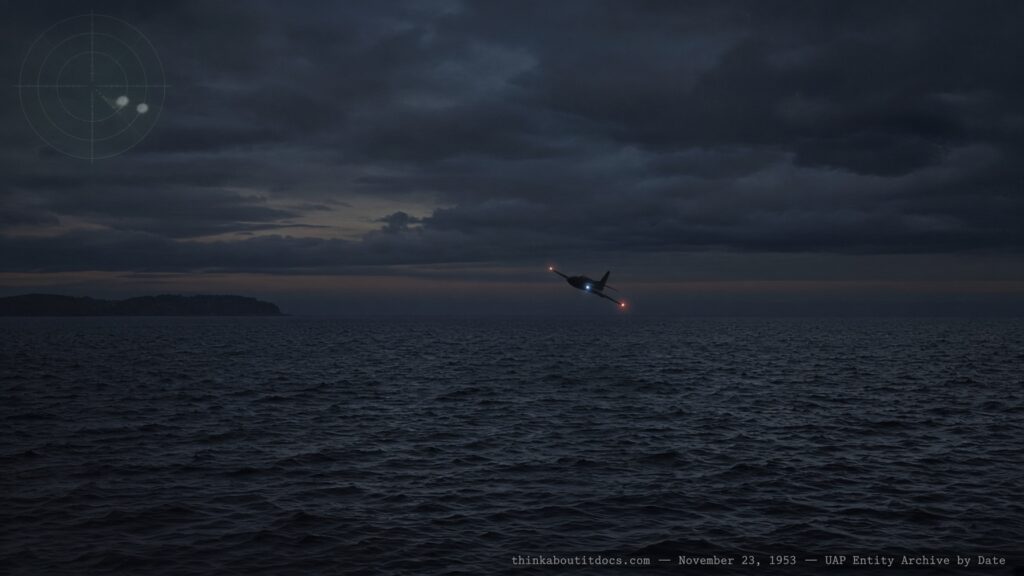
The last known position of 1st Lt. Felix Moncla's F-89, over Lake Superior, November 23, 1953.
THINK ABOUTIT UFO|UAP SIGHTINGS REPORT
1953: The Kinross Air Force Base Incident — Felix Moncla & Robert Wilson
Ground radar watched two blips converge over Lake Superior on the night of November 23, 1953 — an unidentified target, and the F-89C Scorpion jet sent to intercept it. Controllers waited for the blips to separate as the jet passed over its target. They never did. First Lieutenant Felix Moncla and his radar operator, Second Lieutenant Robert Wilson, vanished along with their aircraft, and neither man nor a single piece of wreckage was ever recovered. It remains one of the U.S. Air Force’s most genuinely unresolved Cold War-era mysteries.
Date: November 23, 1953 BBU
Sighting Time: Aircraft scrambled at 2322 Zulu (approximately 6:22 p.m. EST); last radar contact at approximately 2355 Zulu
Day/Night: Night
Location: Airspace over Lake Superior, approximately 70 miles off Keweenaw Point and 150-160 miles northwest of Kinross Air Force Base, Michigan (near the U.S.-Canada border by the Soo Locks)
Urban or Rural: Air (restricted border airspace)
No. of Entity(‘s): 0
Entity Type: Not Applicable
Entity Description: Not Applicable
Hynek Classification: RV (Radar-Visual) — the unidentified target was tracked exclusively by ground radar; no direct visual sighting of the object itself by any witness is recorded
Duration: Approximately 30 minutes from scramble to the final radar merge
No. of Object(s): 1 unidentified radar target
Description of the Object(s): Known only as an unidentified radar return; changed course as the F-89 approached it, consistent with either evasive maneuvering or an unrelated aircraft altering its own flight path
Shape/Size/Color of Object(s): Unknown — never visually identified by any witness
Distance to Object(s): Closed from the initial detection range to a full radar merge with the pursuing F-89
Height & Speed: The F-89 was vectored west-northwest then west, climbing to 30,000 ft, before descending to 7,000 ft and turning to approach the target from above; last radar contact placed the aircraft at 8,000 ft
Number of Witnesses: Multiple ground radar controllers at Truax Air Force Base, Wisconsin, who tracked both the target and the F-89 throughout the intercept
Special Features/Characteristics: The unidentified target changed course as the F-89 closed on it; the two radar blips merged into one and then vanished entirely from the scope; no radio contact could be reestablished with the aircraft afterward; an extensive overnight air and sea search found no wreckage, debris, or oil slick of any kind; internal Air Force documentation of the mission as a UFO intercept was later found by NICAP investigators to have been removed from official records, with the case simply logged as an “accident”
Case Status: Officially closed as an accident by the U.S. Air Force; the underlying cause remains genuinely disputed and, in the view of independent investigators including NICAP, unresolved
Source: U.S. Air Force accident report records; NICAP investigation files (1961, 1963); Loy Lawhon, About.com; contemporary press coverage including the Wisconsin State Journal, November 25, 1953
Summary/Description: On the evening of November 23, 1953, an Air Defense Command radar controller at Truax Air Force Base, Wisconsin detected an unidentified target over the Soo Locks area of Lake Superior, on the U.S.-Canada border. An F-89C Scorpion jet was scrambled from Kinross Air Force Base, piloted by 1st Lt. Felix Moncla with 2nd Lt. Robert Wilson as radar operator. Ground control vectored the jet toward the target for roughly thirty minutes as it closed the distance over the lake. Controllers watched the two radar blips merge into one, then vanish entirely from the scope. No further radio contact was established. An overnight air and sea search found no trace of the aircraft or its crew. The Air Force later attributed the disappearance to pilot vertigo, and separately claimed the intercepted target had been a Royal Canadian Air Force C-47 — a claim the RCAF explicitly denied.
Related Cases: None known
Detailed Report
The channel connecting Lake Superior to the rest of the Great Lakes runs through the Soo Locks near Sault Ste. Marie, Michigan, with the international border running directly through the waterway. In 1953, that made the airspace above it restricted, monitored continuously by Air Defense Command.
On the evening of November 23, 1953, an Air Defense Command ground intercept radar controller at Truax Air Force Base picked up an unidentified target over the Soo Locks. An alert was sounded, and an F-89C Scorpion — an all-weather interceptor — was scrambled from nearby Kinross Field, piloted by 1st Lieutenant Felix E. “Gene” Moncla, Jr., with 2nd Lieutenant Robert L. Wilson in the rear seat as radar operator.
Ground control vectored the jet toward the target, watching it change course as the F-89 closed in at over 500 mph. Wilson reportedly had difficulty acquiring the target on the aircraft’s own onboard radar, so ground control continued to direct the intercept from the base. For roughly thirty minutes, the F-89 pursued the radar contact as it accelerated out over Lake Superior, the gap between the two blips on the ground radar screen steadily narrowing.
Then the two blips became one. Controllers initially assumed Moncla had simply overflown the target and that the returns would separate again momentarily. They didn’t. The single merged blip flashed off the screen entirely, and the scope went clear.
Ground control tried immediately and repeatedly to raise the F-89 by radio. Nothing came back. The last confirmed radar position was recorded roughly seventy miles off Keweenaw Point in upper Michigan, at an altitude of 8,000 feet — about 160 miles northwest of Soo Locks. An emergency search-and-rescue alert went out, and crews searched through the night and into the following day. They found nothing: no wreckage, no debris field, no oil slick, no trace of either man.
The official explanations that followed did not hold together well. Air Force officials first suggested Moncla had suffered vertigo and crashed — based, per later reporting, on hearsay claims that he was prone to it, not on any documented medical history. Separately, the Air Force identified the intercepted target as a Royal Canadian Air Force C-47 on a flight from Winnipeg to Sudbury. RCAF officials flatly denied any of their aircraft had been in the area, with one squadron leader noting that the C-47’s stated flight plan, entirely over Canadian territory, made the claimed intercept geometry implausible on its face. The Air Force later shifted again, suggesting the F-89 had exploded at high altitude — an explanation that doesn’t account for the total absence of surface debris on a lake with no significant current to disperse it.
Perhaps the most troubling detail to emerge came from NICAP’s later investigation: references to Moncla’s mission as a UFO intercept had been removed from official Air Force records, with Project Blue Book’s own files listing the case simply as an “accident.” Harvard astronomer and prominent UFO skeptic Dr. Donald Menzel offered his own explanation — that ground radar had picked up a “phantom echo” of the F-89 itself, produced by atmospheric ducting, which merged with and then vanished alongside the aircraft’s genuine return when it crashed into the lake. This explanation accounts for the radar merge but not for the RCAF’s denial of the alternate C-47 explanation the Air Force had also offered, nor for the removal of UFO-related documentation from the case file.
RESEARCHER’S NOTES
Kinross — 1953 and a Genuinely Unresolved Military Mystery
- An RV case without a visual anchor: Unlike most Radar-Visual cases in this archive, no witness ever saw the object itself — only its radar signature. That makes this case’s evidentiary weight rest entirely on the reliability of the radar tracking and the credibility of the ground controllers, rather than on any eyewitness account of a craft.
- Three conflicting official explanations: Vertigo, an RCAF aircraft, and a high-altitude explosion were each offered by Air Force officials at different points — and each has a specific, documented problem (no medical history of vertigo on record, an explicit RCAF denial with a stated flight-plan inconsistency, and no debris consistent with a mid-air explosion). Three mutually inconsistent official explanations is itself a notable feature of this case, regardless of what actually happened.
- Documented record alteration: NICAP’s finding that UFO-related mission details were removed from official Air Force records is a specific, serious claim distinct from the underlying mystery of the disappearance itself — it speaks to how the case was handled administratively, whatever the intercepted object turned out to be.
- Two men never recovered: Unlike many entries in this archive, this case has a human cost beyond the mystery itself — Felix Moncla and Robert Wilson remain missing, and no family closure in the form of recovered remains was ever possible.
- A real institutional investigation: This case was formally investigated by NICAP over multiple years (1961 and 1963 inquiries), giving it a documentation trail considerably deeper than most Cold War-era radar cases, even those with more dramatic entity or landing elements.
⚠ UNVERIFIED ADDENDUM — THE 2005 “DISCOVERY” CLAIM
In 2005, a group calling itself the Great Lakes Dive Company claimed to have located the wreckage of Moncla’s F-89 using side-scan sonar, and additionally claimed to have discovered a separate, unidentified metallic object — described as “teardrop”-shaped, roughly 15 by 8.5 ft — partially buried in the sand some 215 ft from the jet. This claim circulated with considerable excitement through UFO-focused outlets at the time. This archive must note plainly: the Great Lakes Dive Company’s own website disappeared not long after the claim was made, no member of the claimed dive team has ever been independently reached or verified, and no peer-reviewed, government, or otherwise credible independent confirmation of either the F-89 wreck location or the adjacent object has ever been produced. Sourcing for this claim traces to UFO Digest and secondhand blog reposts, not to any verifiable diving, engineering, or research organization with a documented track record. This archive treats the 2005 sonar claim as unverified and very possibly fabricated. It is preserved here, clearly separated from the well-documented 1953 disappearance itself, because it continues to circulate in connection with this case — but it should not be read as established fact, and readers are encouraged to treat any “teardrop craft” imagery associated with this case with significant skepticism.
“At approximately 2355 Zebra the unknown aircraft and the F-89 merged together on the radar scope. Shortly thereafter the IFF signal disappeared from the radar scope. No further contact was established with the F-89.”
— Official U.S. Air Force accident report, November 23, 1953