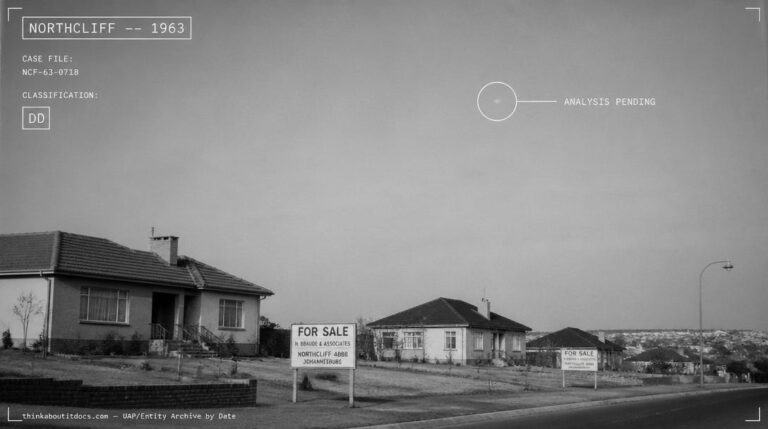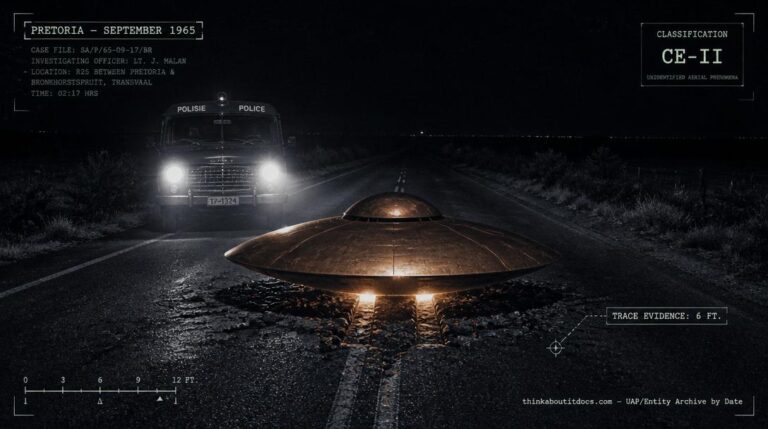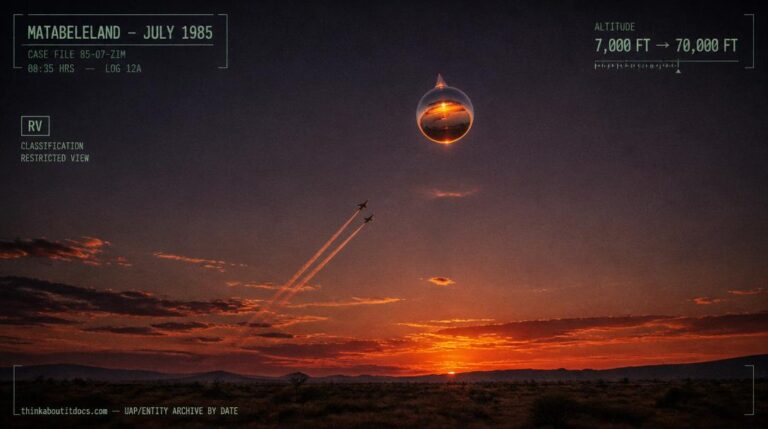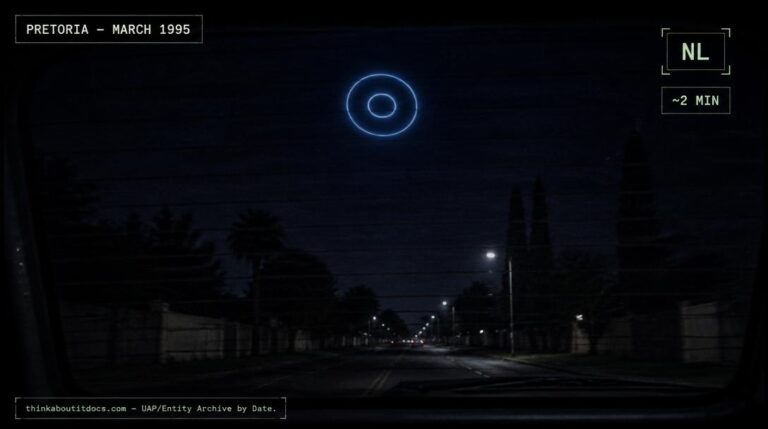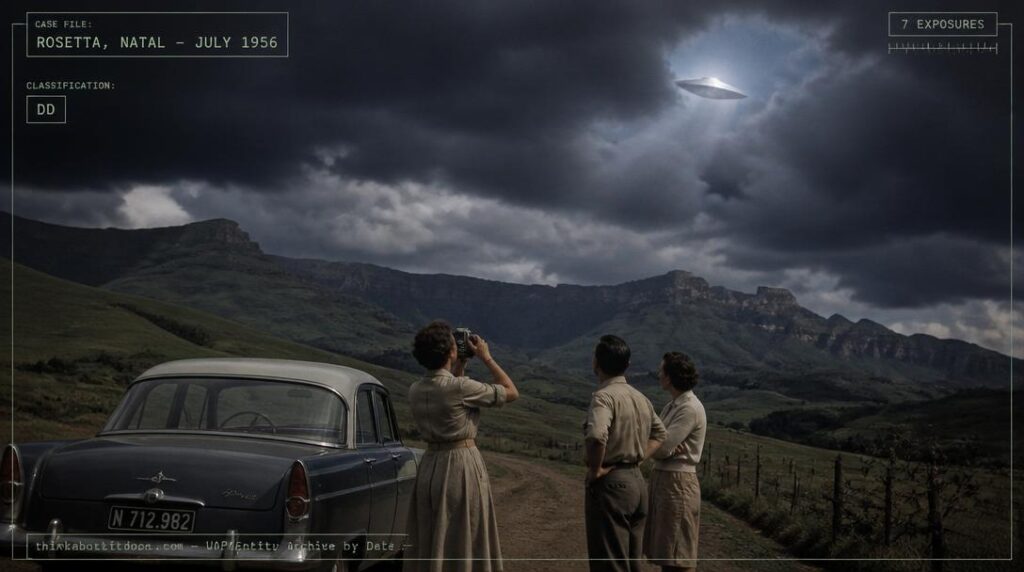
Dossier reconstruction of the metallic disc photographed by Elizabeth Klarer near Rosetta, Natal, South Africa, July 17, 1956.
THINK ABOUTIT UFO|UAP ENCOUNTER REPORT
1956 Drakensberg Photos | Elizabeth Klarer UFO Case Archive
On the afternoon of July 17, 1956, South African meteorologist Elizabeth Klarer drove two companions into the Drakensberg foothills to show them the site of her very first UFO sighting — and, by her own account, ended up photographing a second one. A flash of light between gathering thunderclouds resolved into a metallic disc; she fired off seven frames on a simple Brownie box camera before it shot away and the sky broke into hail. She swore to the photos’ authenticity in a notarized affidavit and never wavered from the story until her death in 1994.
Klarer is one of ufology’s most extraordinary contactees — her later claims extended to a years-long relationship with an extraterrestrial she called Akon, and eventually to giving birth to his child on his home planet. This entry concerns only the July 17, 1956 photographs, and even that narrower question is genuinely contested: a rival investigator reported that Klarer’s own family saw her leave the farmhouse alone that day, directly at odds with the two-companion account this page’s source relies on. Both versions are preserved here.
Date: July 17, 1956
Sighting Time: Approximately 4:00 PM
Day/Night: Daytime
Location: Rosetta, Natal (KwaZulu-Natal), South Africa — the Klarer family farm in the Drakensberg foothills
Urban or Rural: Rural
No. of Entity(‘s): 0 for this specific incident — no entity is described as present during the July 17, 1956 photo session itself; see Hynek Classification and Researcher’s Notes
Entity Type: Not applicable to this specific incident. Background only: Klarer’s broader, separately dated contact claims describe a humanoid entity she called Akon
Entity Description: Not applicable to the July 17, 1956 photographs. Background only: per the cited source, Klarer separately described Akon as a tall, white-haired spaceship pilot, encountered on other occasions distinct from this photo session
Hynek Classification: DD (Daylight Disc) — corrected from CE-III. The source’s own account of this specific event describes only a distant metallic disc, photographed and then departing; no entity is reported present. CE-III appears to have been carried over from Klarer’s separate, later contact narrative rather than this incident. See Researcher’s Notes.
Duration: Undocumented in the source used for this page (Hesemann); described as a rapid sequence of seven photographs. Other secondary accounts of the same event describe activity lasting up to an hour — see Researcher’s Notes
No. of Object(s): 1
Description of the Object(s): A metallic disc first noticed as a flash of light between thunderstorm clouds, slowly approaching before suddenly accelerating away; captured across seven photographs taken in rapid succession
Shape of Object(s): Disc
Size of Object(s): Undocumented
Color of Object(s): Metallic; described elsewhere in the broader literature on this case as a dull grey craft that shone like silver in sunlight
Distance to Object(s): Undocumented
Height & Speed: Undocumented — described only as approaching slowly before suddenly accelerating out of sight
Number of Witnesses: 3 per Hesemann’s account (Klarer plus two companions) — directly disputed by South African ufologist Edgar Sievers, who reported that Klarer’s family saw her leave alone that day. See Researcher’s Notes.
Special Features/Characteristics: Klarer, a meteorologist and Air Force Intelligence employee whose husband was a South African Air Force major, was a well-regarded member of South African society at the time; she took seven photographs on a simple Brownie box camera and swore to their authenticity in a notarized affidavit; a thunderstorm and hail reportedly followed the object’s departure; Africa’s leading UFO investigator, Cynthia Hind, later located and interviewed eyewitnesses connected to Klarer’s broader contact claims
Case Status: Insufficient Data — see Researcher’s Notes for rationale
Source: Michael Hesemann
Summary/Description: On July 17, 1956, South African meteorologist Elizabeth Klarer, driving through the Drakensberg foothills near Rosetta, Natal, photographed a metallic disc she said approached slowly through gathering storm clouds before suddenly flying off. She took seven photographs and later swore to their authenticity under oath. The case is best known through Klarer’s far larger and more contested claim of an ongoing relationship with an extraterrestrial named Akon, though this specific photo session is documented separately, with disputed witness accounts.
Related Cases: Undocumented by name in this entry — the July 17, 1956 photographs are connected in the wider literature to Klarer’s own broader, separately dated contact claims (including an earlier 1954 sighting and a later claimed landing/contact), which are not separately indexed here
Detailed Report
Elizabeth Klarer was, by the standards of 1950s South African society, an unlikely figure to become one of the era’s most controversial UFO contactees. A trained meteorologist, she worked for South African Air Force Intelligence, and her husband held the rank of major in the same air force. That respectability is part of why her case drew serious attention rather than being dismissed outright — and part of why it remained controversial for decades afterward, since her claims eventually grew to include a years-long telepathic and physical relationship with an extraterrestrial she called Akon, culminating in a claimed pregnancy and the birth of their son on Akon’s home planet. Her 1980 book, Beyond the Light Barrier, told that fuller story in a style closer to romantic fiction than field investigation, and it drew a skeptical reception even within ufology.
The July 17, 1956 photographs are a narrower, separately documented piece of that larger story. By Hesemann’s account — the source this entry follows — Klarer drove two companions into the Zululand foothills of the Drakensberg that afternoon, intending to show them the site of her first, earlier sighting. As they traveled, she noticed a flash of light between the clouds of a gathering thunderstorm. She stopped the car, got out with her companions, and, camera already in hand, saw a metallic disc in the dark sky, approaching slowly. In what she described as a reflex action, she fired off seven photographs before the disc suddenly accelerated away; a thunderstorm broke moments later, with hail falling over the field. Klarer later confirmed the photographs’ authenticity in a notarized affidavit and maintained the story without wavering until her death in February 1994, at age 83. Analysis of the photographs accompanying this account notes that cloud formations barely changed between the final two frames, suggesting they were taken only seconds apart, and that the disc’s path traces a smooth curve inconsistent with a tumbling thrown object.
Cynthia Hind, widely regarded as Africa’s most respected UFO researcher and MUFON’s representative on the continent, later investigated Klarer’s broader claims and managed to locate and interview several people connected to her reported contacts, lending Klarer’s overall credibility more weight than a typical isolated contactee claim.
That said, the July 17 photographs specifically have a documented skeptical counter-history that this entry preserves rather than resolves. South African ufologist Edgar Sievers investigated independently and reported that Klarer’s own family had seen her leave the farmhouse alone that day — directly contradicting the two-companion, three-witness account central to Hesemann’s version. Sievers also weighed the possibility that Klarer had thrown a car hubcap into the air and photographed it, a common explanation offered for saucer photos of this era, but he complicated that explanation on two fronts: he judged it physically difficult for her to have thrown an object and photographed it simultaneously while alone, and he found no hubcap design that adequately matched the disc’s shape as it appeared in the photographs. More broadly, outside investigators from North American and European UFO research organizations have generally characterized Klarer’s photographic evidence as weak and never subjected to rigorous scientific authentication.
Separately, other secondary retellings of this same event describe noticeably different conditions: rather than a brief encounter cut short by a thunderstorm, some accounts describe the disc darting and weaving over the site for up to an hour in clear, bright sunlight before streaking away. This entry follows Hesemann’s storm-and-hail version, since that is the source cited for this page, but the divergence between accounts is real and unresolved in the available material.
RESEARCHER’S NOTES
The Drakensberg Photographs — South Africa 1956 and a Case Split Between Two Investigators
- Classification Correction: The source’s own account of the July 17, 1956 event describes no entity present — only a distant metallic disc that approached, was photographed, and departed. CE-III (an encounter involving an observed animate being) does not apply to this specific incident and appears to have been carried over from Klarer’s separate, later contact narrative involving an entity she called Akon, reported on other occasions. This entry reclassifies the July 17 photo incident itself as DD.
- Witness Count Dispute: Hesemann’s account states Klarer took the photographs in the presence of two companions, for three witnesses total. Edgar Sievers, investigating independently, reported that Klarer’s own family saw her leave the farmhouse alone that day — a direct contradiction. This archive presents both without resolving the conflict.
- The Hubcap Hypothesis: Sievers considered whether Klarer might have thrown a car hubcap and photographed it, but reported two complicating factors: the physical difficulty of throwing an object and photographing it simultaneously while alone, and his own finding that no hubcap design adequately matched the disc’s shape in the photographs. The hypothesis was raised and seriously examined, not confirmed.
- Divergent Secondary Accounts: Hesemann’s version — the basis for this page — describes a brief encounter ending as a thunderstorm and hail arrived. Other secondary retellings describe the object darting over the site for up to an hour in bright, clear sunlight, with no storm mentioned at all. These are not easily reconciled and are preserved here as a genuine, unresolved divergence rather than resolved in favor of either version.
- Evidentiary Weight: Outside investigators have generally described Klarer’s photographs as weak evidence that has never undergone rigorous scientific authentication. Her notarized affidavit affirms her own sincere belief in the story but is not independent verification of what the camera captured.
- Broader Context: These photographs are one small piece of a far larger, and far more extraordinary, set of claims Klarer made over the following decades, including a claimed physical relationship with Akon and the birth of their child on his home planet. That broader mythology is treated with near-universal skepticism even by researchers, such as Cynthia Hind, who took Klarer’s core sighting claims seriously — noted here as context, not evaluated as part of this specific entry.
Few cases in this archive split as cleanly down the middle as the Drakensberg photographs: a respected meteorologist’s sworn, lifelong insistence on one side, and a rival investigator’s direct, family-sourced contradiction of her own account on the other. Neither side is dismissed here. It is filed as Insufficient Data because the two most basic facts about that afternoon — who was there, and what, exactly, the camera caught — remain genuinely in dispute more than sixty years later.
“The disc seems to follow a clean curve.”
Media