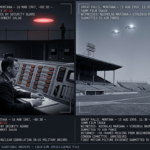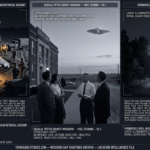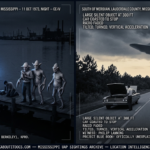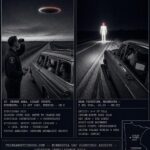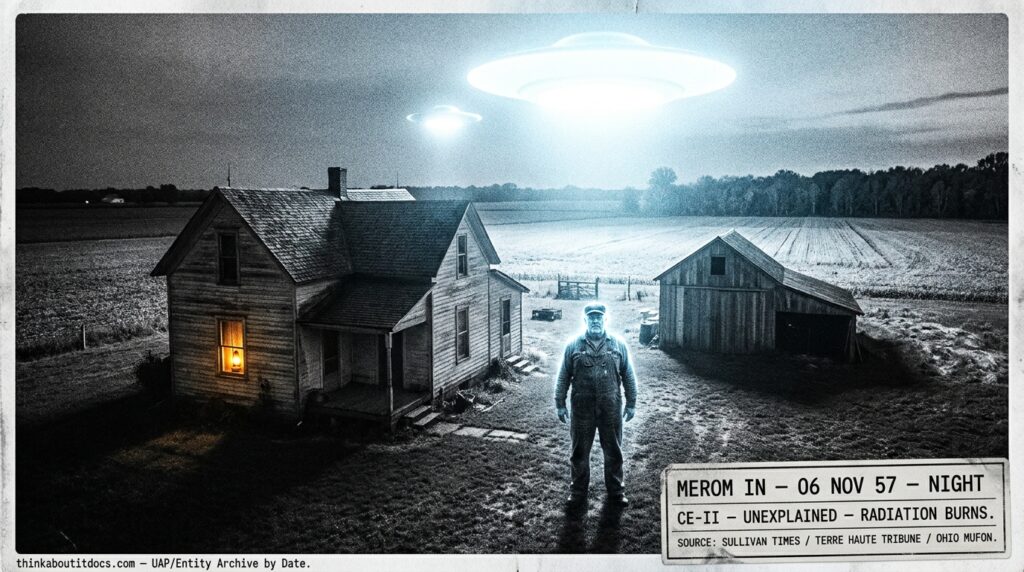
Merom, Indiana, November 6, 1957 — Ironworker Rene Gilham stands beneath a brightly luminous object at 1,000 feet whose light will leave him with radiation-type facial burns requiring hospitalization. Dr. Joseph Drake diagnosis on file. Hospital records subsequently destroyed.
THINK ABOUTIT UFO|UAP SIGHTING REPORT
1957 Merom Indiana UFO: The Rene Gilham Radiation Burn Case
On the night of November 6, 1957 — in the middle of the most intense UFO wave in American history — an ironworker named Rene Gilham stood outside his farm home near Merom, Indiana, and stared up at a brightly luminous object hovering at approximately 1,000 feet. For ten minutes, the object bathed his farm in what witnesses described as an eerie, penetrating light. The next day, Gilham’s face began to itch and redden. By November 8, the pain was severe enough to send him to a doctor. Dr. Joseph Drake examined him and determined that the condition was not a rash, not poison ivy, not an allergy — but a real burn, comparable to the burns inflicted on the face and eyes when working near an arc welder without a mask. Gilham had not been near a welder in three weeks. Two days later his condition worsened and he was hospitalized at Mary Sherman Hospital in Sullivan, Indiana. Hospital staff refused to speak to reporters. They refused to say whose orders had placed the patient incommunicado. The Terre Haute Tribune reported that military authorities had been informed. Then the trail goes cold. The hospital later told NICAP investigators that a small fire in the records room had destroyed the files. Years afterward, a MUFON Indiana investigator learned that an Air Force officer had indeed been dispatched to investigate the case for Project Blue Book.
Date: November 6, 1957
Sighting Time: Evening — approximately 6:30 PM (inferred from concurrent Sullivan, Indiana observations at that time; exact time for Gilham not recorded)
Day/Night: Night
Location: Merom, Sullivan County, Indiana — Gilham farm, approximately 30 miles south of Terre Haute on the Wabash River
Urban or Rural: Rural — farming community on the Indiana-Illinois border along the Wabash River
No. of Entity(‘s): None observed
Entity Type: N/A
Entity Description: N/A
Hynek Classification: CE-II (Close Encounter of the Second Kind) — observation of a luminous object at close range with documented physiological effects: radiation-like facial and ocular burns requiring hospitalization
Duration: Approximately 10 minutes
No. of Object(s): 1 primary object, temporarily joined by a smaller secondary object
Description of the Object(s): Brightly luminous object that bathed the surrounding farm in an eerie, penetrating light intense enough to illuminate the entire area. A smaller secondary object briefly joined the primary before both departed. Upon departure, the larger object went straight up and headed west with increasing light intensity and a whirring noise compared to a high-speed electric motor gaining revolutions.
Shape of Object(s): Not described in detail — luminous object, shape obscured by intense light output
Size of Object(s): Estimated 40 feet in diameter
Color of Object(s): Brightly luminous — white/intense light; concurrent Sullivan observers described a glowing orange-red object
Distance to Object(s): Estimated 1,000 feet altitude, directly overhead
Height & Speed: Hovering at approximately 1,000 feet for ~10 minutes; departed vertically at high speed heading west
Number of Witnesses: Multiple — Rene Gilham (primary), his wife and children, and his father-in-law in an adjacent house all observed the object. Concurrent witnesses in Sullivan, Indiana (~11 miles northeast) reported a glowing orange-red object in the southwest consistent with Merom’s direction.
Special Features/Characteristics: Physiological effects — severe radiation-like facial and ocular burns developing 12–24 hours after exposure, diagnosed by Dr. Joseph Drake as consistent with arc-welder burns. Hospitalization at Mary Sherman Hospital, Sullivan, Indiana. Hospital imposed media blackout and visitor ban under undisclosed orders. Auditory effect — whirring noise like a high-speed electric motor increasing in RPM during departure. Secondary object — a smaller object briefly joined the primary before departure.
Case Status: Unexplained
Source: Herb Taylor, Ohio MUFON Case Notebook, via Project-1947 Discussion List (November 5, 2003). Original newspaper sources: Sullivan Times (November 11, 1957) and Terre Haute Tribune (November 12, 1957). Supplementary: Jerry Sievers, MUFON Indiana State Director (June 2004) — confirmed NICAP investigation attempt and Air Force Blue Book involvement.
Summary/Description: On November 6, 1957, ironworker Rene Gilham, age 33, observed a brightly luminous object hovering at approximately 1,000 feet over his farm near Merom, Sullivan County, Indiana for approximately 10 minutes. The object bathed the farm in intense light. Within 24 hours Gilham developed severe facial burns diagnosed by Dr. Joseph Drake as radiation-type burns consistent with unshielded arc-welder exposure. He was hospitalized at Mary Sherman Hospital under a media and visitor blackout whose ordering authority was never disclosed. Military authorities were informed. Hospital records were later reported destroyed in a fire. An Air Force officer was dispatched for a Project Blue Book investigation. No civilian investigation was completed.
Related Cases: 1973 Princeton Indiana CE-I (Wabash River corridor) | November 1957 wave — Levelland, Texas (November 2–3) | Fort Itaipu, Brazil (November 4) | Playa del Rey, California (November 6) — global CE-II cluster
Detailed Report
The Merom case belongs to the extraordinary November 1957 wave — one of the most concentrated periods of high-quality UFO reports in history. In the first two weeks of November 1957, cases with electromagnetic effects, physiological injuries, and multiple independent witnesses erupted across the United States, Brazil, and Europe. Levelland, Texas (November 2–3) produced multiple independent vehicle-interference reports in a single night. Fort Itaipu, Brazil (November 4) produced burn injuries to military sentinels. Merom, Indiana fell on November 6, the same night as the Playa del Rey, California incident. The Gilham case is one of the few American cases from this wave involving documented medical treatment for radiation-type injuries.
Rene Gilham was a 33-year-old ironworker living on a farm near Merom, a small community in Sullivan County on the Wabash River, approximately 30 miles south of Terre Haute. On the night of November 6, he noticed an unusual light and went outside. Hovering directly overhead at an estimated 1,000 feet was a brightly luminous object roughly 40 feet in diameter. From this object, a light beamed out that bathed the farm in an eerie, penetrating illumination. His wife, children, and father-in-law in the adjacent house also saw the object and confirmed that its light was intense enough to illuminate the entire surrounding area.
Gilham stood watching for approximately 10 minutes. During this period, a smaller secondary object briefly joined the primary. Then the larger object departed — rising straight up and heading west. As it ascended, the light intensified and the object emitted a whirring noise compared to a high-speed electric motor gaining revolutions.
The physiological consequences emerged the following day. Gilham’s face began to itch and redden. By the evening of November 8, the pain was severe enough to require medical attention. Dr. Joseph Drake examined him and made a clinically significant determination: the condition was not dermatological — not a rash, not poison ivy, not an allergic reaction. It was a real burn, specifically comparable to the burns sustained from working near an arc welder without a protective face mask. Gilham confirmed he had not been near a welder in three weeks.
By November 10, Gilham’s condition had worsened. He was admitted to Mary Sherman Hospital in Sullivan, Indiana. What happened next is the most troubling element of the case. Hospital staff refused to speak to reporters about the case. They refused visitors. They refused to disclose whose orders had placed the patient incommunicado. The Terre Haute Tribune noted this media blackout and added that it was known that military authorities had been informed about the case. On November 11, it was announced that the swelling around Gilham’s eyes and the reddening of his skin had lessened and he was expected to be released the next day. Whether he was or not is unrecorded, and nothing further was reported in the press.
Years later, Jerry Sievers — then MUFON Indiana State Director — described his own earlier attempt to investigate the case as part of a NICAP inquiry. He and a colleague had called Mary Sherman Hospital and were told that patient records were not public property and that a small fire in the records room had rendered the records unavailable. Subsequently, through an unrelated investigation in Illinois, Sievers met an Air Force officer who confirmed that he had been dispatched to investigate the Gilham case for Project Blue Book. The case, however, does not appear in the declassified Blue Book files that are publicly accessible.
Researcher’s Notes
The Merom Radiation Burn — Sullivan County 1957 and the November Wave
- Source Chain and Evidence Quality: The source chain is two-layered. The primary sources are the Sullivan Times (November 11, 1957) and the Terre Haute Tribune (November 12, 1957) — contemporaneous local newspaper accounts published within days of the event. These are complemented by Herb Taylor’s Ohio MUFON Case Notebook analysis, published on the Project-1947 Discussion List in November 2003, and Jerry Sievers’s supplementary notes from June 2004 confirming the NICAP investigation attempt and the Air Force involvement. The medical diagnosis by Dr. Joseph Drake — a named physician providing a specific clinical assessment (radiation-type burns consistent with arc-welder exposure, explicitly excluding rash and allergy) — is the single strongest evidentiary element. Medical professionals who document injury causation in real time provide a category of evidence that is extremely difficult to fabricate retroactively.
- Classification and Physiological Effects: CE-II is the correct and necessary classification. The object was observed at close range (1,000 feet overhead) and produced documented physiological effects requiring medical treatment and hospitalization. The burn pattern — facial and ocular, consistent with UV/IR radiation exposure from above — is physically consistent with a luminous aerial source at the reported altitude and duration. Ten minutes of unshielded exposure to a high-intensity UV source at 1,000 feet could plausibly produce the symptoms described. The delayed onset (12–24 hours) is characteristic of radiation burns rather than thermal burns, which present immediately.
- Institutional Response and Record Suppression: The hospital media blackout, the undisclosed ordering authority, the refusal to identify who imposed the incommunicado status, and the subsequent destruction of records in a “small fire” constitute a pattern that Herb Taylor correctly identified as demanding full investigation — which never occurred. The confirmation by Jerry Sievers that an Air Force officer was dispatched for Blue Book but the case does not appear in the publicly accessible Blue Book archive raises the possibility that it was either classified at a higher level or filed under a different designation. The institutional response alone — regardless of the UFO itself — represents a documented case of record suppression in a medical context.
- November 1957 Wave Context: The Merom case occurred on November 6, 1957 — the fourth day of the most intense concentrated UFO wave in history. Between November 2 and November 15, high-quality reports with electromagnetic effects, physiological injuries, and multiple independent witnesses erupted across North America, South America, and Europe. The Merom case sits alongside Levelland (vehicle interference), Fort Itaipu (burn injuries to military guards), and Playa del Rey (same date) as part of a global CE-II cluster. Viewing the Merom case in isolation understates its significance. It is one data point in a pattern that includes medically documented injuries on multiple continents in the same two-week period.
An ironworker’s face blistered under a light that was not from a welder. A doctor said so in writing. A hospital sealed the records. The military came and went. A fire consumed the files. Herb Taylor wrote in 2003 that the Merom case cried out for a full and thorough inquiry by competent investigators, and that this apparently never occurred. The archive agrees. This is one of the strongest uninvestigated CE-II cases in the American record.