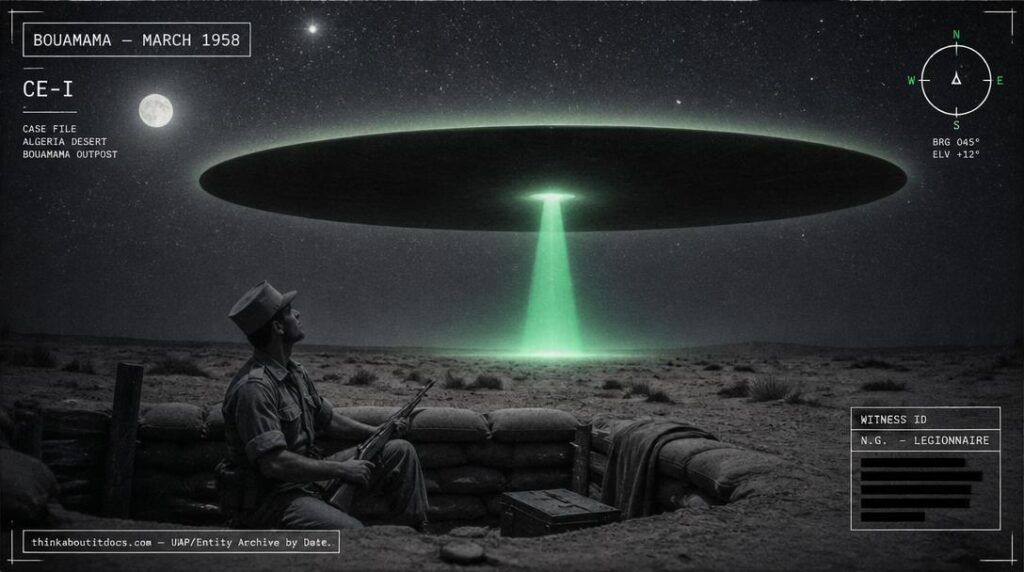
Dossier reconstruction of the object reported hovering over the desert at Bouamama, Algeria, March 1958.
THINK ABOUTIT UFO|UAP ENCOUNTER REPORT
1958: Enormous UFO seen during Algerian War
A few minutes after half past midnight in March 1958, a French Foreign Legionnaire on solitary sentry duty outside a fortified camp at Bouamama, Algeria, heard a whistling note fall out of the night sky — and looked up to find an enormous, silent, elliptical shape descending toward him, ringed in pale green light with a beam of emerald radiance pouring from its underside to the sand.
The object is said to have hovered for nearly fifty minutes at a distance of roughly 150 feet, and the witness — a well-regarded three-year veteran identified only as N.G. — reported not fear but an overwhelming, almost narcotic calm. He was the sole witness. A second sentry posted at the opposite end of the same camp, who should by the reported geometry have had a partial view of the object, reported seeing nothing at all — a discrepancy this record does not attempt to resolve away.
Date: March 1958 (exact date not given in source)
Sighting Time: A few minutes after 00:30 hours
Day/Night: Night (clear, moonlit sky)
Location: Bouamama, Sud Constantinois, Algeria
Urban or Rural: Rural — desert, French Foreign Legion outpost during the Algerian War
No. of Entity(‘s): 0 — no entities reported
Entity Type: Not applicable — no entities reported
Entity Description: Not applicable
Hynek Classification: CE-I (Close Encounter I) — detailed observation of an object within 500 feet, no landing or physical interaction
Duration: Approximately 45–50 minutes of stationary hovering, per witness account
No. of Object(s): 1
Description of the Object(s): An enormous roundish/elliptical craft, silent apart from a whistling tone on arrival and departure, surrounded by a pale green glow with an intense conical beam of emerald-green light projecting from the center of its underside to the ground
Shape of Object(s): Disc/elliptical
Size of Object(s): Witness estimated up to 350 meters (roughly 1,000 ft) wide; his own arm-span reenactment of the angle suggested a span closer to 250 meters — the source preserves both estimates rather than reconciling them
Color of Object(s): Pale green surrounding glow; intense emerald-green beam from the underside
Distance to Object(s): Roughly 50 meters (150 ft) to the nearest edge, per witness estimate
Height & Speed: Hovered at 35–40 meters (100–120 ft) altitude; climbed to roughly 100–120 meters before departing at what the witness called “tremendous speed” toward the northwest — no numeric speed given in source
Number of Witnesses: 1 (sole witness; a second sentry stationed at the opposite end of the camp, who by the reported geometry might have had partial visibility, reported seeing nothing)
Special Features/Characteristics: Whistling sound on arrival and departure; profound, sustained euphoria and loss of anxiety in the witness during observation, followed by sadness at the object’s departure; no physical trace evidence recovered despite a careful ground search (no footprints, marks, or odor); witness later hospitalized for a week of neurological and psychiatric observation, with a normal EEG and no findings of instability
Case Status: Unexplained
Source: Joel Mesnard, Flying Saucer Review, Vol. 19, No. 3
Summary/Description: A French Foreign Legionnaire on solitary sentry duty at Bouamama, Algeria, during the Algerian War reported an enormous, silent, glowing disc that descended, hovered for nearly fifty minutes at close range, and departed at high speed — leaving him in a euphoric state that later drew a week of military hospital evaluation, which found nothing abnormal.
Related Cases: Undocumented — Mesnard’s original article notes the case “invites comparison with a number of other cases” but does not name them
Detailed Report
The Foreign Legion camp at Bouamama sat in the Sud Constantinois, a desert sector of Algeria under active French counter-insurgency operations in 1958. Legionnaire N.G., three years into his service and by his superiors’ account a steady, unremarkable soldier, was posted alone that night in a fortified, dug-in sentry position outside the camp perimeter, equipped with a rifle and a field telephone. The sky was clear and moonlit; nothing about the shift suggested anything out of the ordinary.
That changed a few minutes after half past midnight. N.G. described hearing a whistling tone — the kind of note produced by blowing across the neck of a bottle — descending from overhead. Looking up, he saw an enormous roundish object dropping toward him. It leveled off at an estimated 35 to 40 meters (100–120 feet) above the ground and went still: motionless, silent, hanging in place.
By his own reckoning the object’s nearest edge was only about 50 meters (150 feet) from his position, and he judged its total width at as much as 350 meters — though when Mesnard later asked him to physically re-create the angle it subtended with his outstretched arms, the resulting geometry implied a somewhat smaller span, closer to 250 meters. Seen slightly from below, it read to him as elliptical rather than perfectly circular, which he was careful to note was not simply the ordinary foreshortening one would expect of a disc viewed off-axis. A pale green light enveloped the object’s surface, and a much more intense, narrow beam of emerald-green light projected from the center of its underside straight down to the sand.
For the better part of an hour, N.G. neither fired his rifle nor picked up the telephone, as procedure required. Instead he simply watched. He later described the greens surrounding the object as the most beautiful and relaxing colors he had ever seen, and said that every trace of the tension and vigilance that came with wartime sentry duty drained out of him — he was, in his own word, happy. When the whistling tone returned and the object began climbing again, rising to perhaps 100 to 120 meters before accelerating away to the northwest at what he described only as tremendous speed, the euphoria gave way first to a distinct sadness at losing sight of it, and then, gradually, to his ordinary state of mind.
His first report, phoned in immediately after the object departed, was met with indifference — the duty officer told him it would be looked into the following morning. A second, more attentive debriefing followed once he was relieved from his post, and opinion within the camp split: some officers, weighing N.G.’s reputation as serious and reliable, were inclined to credit the story; others attributed it to the psychological strain of desert wartime service. A ground search at the reported site turned up nothing — investigators are recalled examining the sand with a magnifying lens, but found no footprints, scorch marks, unusual material, or odor of any kind.
Largely as a medical precaution, N.G. was sent to the Val de Grâce military hospital in Paris, where he spent a week under observation by neurologists and psychiatrists. An electroencephalogram showed nothing abnormal, and the medical conclusion was that he was in good physical and mental health, with no history of instability and no drinking problem — the implicit standard, the source notes, for continued fitness in the Foreign Legion.
When Joel Mesnard interviewed N.G. directly in May 1970 — twelve years after the event, and with N.G. by then a civilian — he found a man with no apparent taste for publicity, who recounted the episode plainly to his own family without embellishment. Mesnard was unable to locate any surviving military records of the incident; Val de Grâce’s own patient files are not retained beyond ten years. Mesnard also pressed the geometry of the sighting: at the estimated size and distance, the object should have subtended an angle of roughly 60 degrees from the camp itself, and a second sentry posted at the opposite perimeter would have had a sightline of nearly 40 degrees — yet that sentry reported nothing. N.G. offered no resolution beyond noting that most of the camp was asleep at the time, and he did not believe the terrain itself could have blocked the view.
N.G. told Mesnard he had experienced nothing similar before or since, that the event left him with a settled, if untestable, conviction that “there is something” watching from elsewhere, and that he recalled the sighting’s strange peacefulness in terms closer to altered perception than fear — time, he said, seemed to run very slowly, and the experience felt like being briefly in another world.
RESEARCHER’S NOTES
The Bouamama Sentry — Algeria 1958 and the Problem of Solitary Witness Testimony
- Classification Notes: The witness’s own distance estimate — roughly 150 feet to the object’s nearest edge — sits comfortably within Hynek’s 500-foot threshold for a CE-I, and nothing in the account involves landing, physical interaction, or occupants, ruling out CE-II or CE-III. CE-I is the correct classification as reported.
- Source Chain Assessment: The account comes from Joel Mesnard’s direct 1970 interview with the witness, published in Flying Saucer Review — a long-running, case-focused journal, not a tabloid source. The twelve-year gap between event and interview, and the fact that Val de Grâce’s patient records are routinely purged after ten years, explain the absence of surviving institutional paperwork; this is a documented records gap, not evidence against the sighting.
- Corroboration Gap: Mesnard’s own angle calculations suggest the object, if as large and as close as described, should have been visible to a second sentry stationed elsewhere in the camp at nearly a 40-degree elevation. That sentry reported nothing. The record does not resolve this discrepancy, and it remains the single largest evidentiary weakness in an otherwise carefully investigated case.
- Physical & Psychiatric Evidence: No footprints, scorch marks, or odor were found despite a deliberate ground search. In their absence, the case’s evidentiary weight rests almost entirely on witness credibility — reinforced here by a week of neurological and psychiatric evaluation, including a normal EEG, that found no grounds to doubt N.G.’s mental stability, though it likewise cannot independently confirm what he saw.
- Pattern Context: The euphoria, loss of anxiety, and subjective slowing of time N.G. described during the sighting, followed by sadness at the object’s departure, is a recurring motif in mid-twentieth-century high-strangeness literature involving intensely lit, hovering craft — a general pattern in the wider literature rather than a link to any specific named case.
- Historical Context: The sighting occurred during active French counter-insurgency operations in the Algerian War, at a fortified desert outpost under wartime discipline. That setting — an isolated, armed sentry expecting hostile contact, not UFOs — is part of what officers weighed in judging N.G.’s credibility, and it distinguishes this report from the civilian, contactee-culture UFO reports more typical of the late 1950s.
#WRAP-UP PARAGRAPH
More than sixty years on, the Bouamama sighting remains exactly what Joel Mesnard found it to be in 1970: a case with a single, credible, apparently stable witness, a total absence of physical evidence, and one unresolved geometric problem that neither confirms nor disposes of the story. It is recorded here as Unexplained — not because the evidence compels belief, but because no conventional account, and no evidence of fabrication, has ever been produced to close it.
“It was like time running very slowly.”
Media

Representation of the craft seen by the soldier.