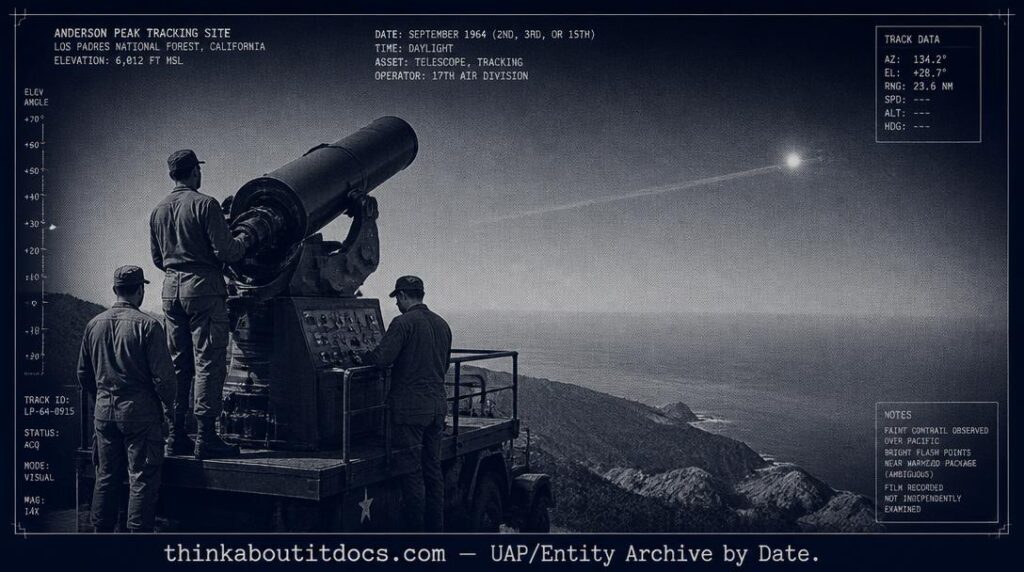
Archival-style rendering of the September 1964 Big Sur tracking site near Vandenberg Air Force Base, where the disputed footage at the center of Bob Jacobs's UFO claim was recorded.
THINK ABOUTIT UFO SIGHTINGS REPORT
1964: The Big Sur UFO Filming, Vandenberg Air Force Base
In September 1964, an Air Force team stationed on Anderson Peak above Big Sur, California, used a borrowed Boston University tracking telescope to film an Atlas missile launch from Vandenberg Air Force Base, 124 miles away. First Lieutenant Robert (Bob) Jacobs, officer-in-charge of the detachment, later claimed the footage showed an unidentified, disc-shaped object flying a circular pattern around the missile’s dummy warhead, emitting flashes of light, after which the warhead malfunctioned. Jacobs said he was shown the film the next day by his commanding officer in the presence of unidentified men in gray suits and ordered to say it never happened. Eighteen years later, in 1982, he went public. A decade after that, the project’s own engineer offered a detailed, named, technical rebuttal: what the camera had actually recorded, he argued, was the classified deployment of decoy reentry vehicles and chaff, malfunctioning and trailing packing debris, information Jacobs did not have the security clearance to be told about at the time.
Date: September 1964; Jacobs’s own recollection places it as September 2nd, 3rd, or 15th, with later independent research (T. Scott Crain, Jr., via NICAP) favoring September 15, 1964, though even NICAP’s own researchers have noted the exact date remains unsettled
Sighting Time: Undocumented (missile launch conducted in daylight)
Day/Night: Day
Location: Filming site: Anderson Peak, Los Padres National Forest, near Big Sur, California, elevation approximately 3,400 feet. Launch site: Vandenberg Air Force Base, California, approximately 124 miles to the south.
Urban or Rural: Rural (remote mountain tracking site)
No. of Entity(s): Not Applicable
Entity Type: Not Applicable
Entity Description: Not Applicable
Hynek Classification: DD — Daylight Disc, applied provisionally. The object was not seen directly by any witness in real time; it exists only in footage reviewed after the fact, and a detailed, technically specific alternative explanation for that footage has been offered by the project’s own engineer (see Researcher’s Notes).
Duration: Undocumented; the anomalous object was recorded only during a portion of the missile’s powered/post-powered flight, reviewed later on film rather than observed live by any witness
No. of Object(s): 1, per Jacobs’s account (a disc-shaped object observed circling the missile’s warhead package on film); per Kingston George’s account, the footage instead showed multiple decoy reentry vehicles and associated debris deploying and malfunctioning
Description of the Object(s): Per Jacobs: a classic flying-saucer shape with a central dome, emitting four distinct bright flashes at roughly the four cardinal points of a circling path around the warhead package, then departing. Per George: the same footage instead showed decoy reentry vehicles deployed as radar countermeasures, which failed to separate cleanly from Styrofoam packing material used in their launch tubes, producing bright, puff-like anomalies inconsistent with a properly deployed decoy but consistent with debris and malfunction, not a controlled craft.
Shape of Object(s): Disc with central dome, per Jacobs; irregular debris/packing material, per George’s counter-explanation
Size of Object(s): Undocumented
Color of Object(s): Undocumented beyond “bright flashes” described by Jacobs
Distance to Object(s): Filmed at a range of roughly 100+ nautical miles via long-focal-length telescope; the missile itself was reported at an altitude of roughly 60 miles and 300–500 nautical miles downrange at the time of the anomaly
Height & Speed: The missile package itself was traveling at an estimated 18,000 miles per hour at the time; no independent speed estimate exists for the anomalous object itself
Number of Witnesses: The launch and filming were witnessed in real time by the Big Sur tracking crew, but the anomalous object was not seen by anyone until the film was reviewed the following day. Only Jacobs, his commanding officer Major Florenz Mansmann, and a small group of unidentified men present at that private screening are reported to have viewed the footage.
Special Features/Characteristics: Jacobs reports being told the footage never happened and instructed, if pressed, to attribute the flashes to nonexistent “laser tracking” technology; Mansmann reportedly gave partial, ambiguous corroboration in later letters (1980s–1990s) whose interpretation remains disputed; Kingston George, the project’s engineer, published a detailed named rebuttal in 1993 arguing the footage showed malfunctioning decoy reentry vehicles and packing debris, information classified at the time specifically because it revealed a weakness in a U.S. missile defense countermeasure system, not because of any UFO; no independent examination of the original film has ever been possible, as its current status and location are unknown; extensive FOIA requests by multiple researchers have not produced the footage
Case Status: Insufficient Data — a genuine dispute between two named, credentialed participants, with a detailed and technically specific mundane explanation offered but never independently verified against the original film, which has not surfaced
Source: Bob Jacobs, Ph.D., “Deliberate Deception: The Big Sur UFO Filming,” MUFON UFO Journal, Issue No. 249 (1989), reprinted from the National Enquirer (1982); Kingston A. George, “The Big Sur ‘UFO’: An Identified Flying Object,” Skeptical Inquirer, Vol. 17 (Winter 1993), with a 2009 follow-up in Skeptical Inquirer Vol. 33; NICAP research by T. Scott Crain, Jr.
Summary/Description: In September 1964, an Air Force detachment led by 1st Lt. Bob Jacobs used a Boston University tracking telescope from a mountaintop site near Big Sur, California, to film an Atlas missile launch from Vandenberg Air Force Base. Jacobs later said the footage showed an unidentified disc-shaped object circling the missile’s warhead and emitting flashes of light before the warhead malfunctioned, and that he was ordered by his commanding officer to keep silent about it. Jacobs went public in 1982. In 1993, project engineer Kingston George published a detailed technical rebuttal, arguing the footage actually showed malfunctioning decoy reentry vehicles and launch-tube packing debris, information Jacobs was not cleared to know about at the time, and that the film was classified because it exposed a real defense-system vulnerability, not because of extraterrestrial content. Neither account has been independently verified against the original film, which has never resurfaced despite extensive research efforts.
Related Cases: None documented
Detailed Report
Bob Jacobs was, by his own account, an Air Force officer serving as Officer-in-Charge of Photo-Optical Instrumentation in the 1369th Photographic Squadron at Vandenberg Air Force Base from May 1963 to May 1966. In 1964, engineers evaluating Vandenberg’s missile tracking footage wanted a side-on view of powered flight, something impossible from any point on the base itself due to the coastline’s geography. Jacobs and colleagues, including operations analyst Kingston A. George, identified a site near Anderson Peak above Big Sur, high enough to clear the coastal fog and provide a line of sight back to Vandenberg 124 miles away. The Air Force arranged to borrow a highly sensitive tracking telescope, informally called the B.U. Scope, from Boston University via the Air Force Eastern Test Range, capable of resolving very faint light sources at extreme range through an image-orthicon sensor.
The Big Sur detachment, camped near the mountain site from late August 1964, filmed a series of Atlas missile launches over a roughly 30-day test period, comparing footage from the B.U. Scope against a conventional tracking camera. According to Jacobs, one of these launches, involving an Atlas missile flown in support of Nike-Zeus anti-missile testing, produced footage of an anomaly. As the missile’s warhead package traveled downrange at high altitude, Jacobs says the footage showed a disc-shaped object entering the frame, appearing to circle the warhead package, and emitting several bright flashes of light before departing. He states the warhead subsequently malfunctioned and fell short of its intended target.
Jacobs recounts being summoned the next day to the office of his commanding officer, Major Florenz Mansmann, where the film was screened in front of several unidentified men. When asked directly what he thought he had filmed, Jacobs says he told Mansmann, “It looks to me like we got a UFO.” He recalls Mansmann responding with an instruction to treat the event as though it never happened, and, if ever pressed, to attribute the flashes to laser tracking equipment, technology Jacobs maintains did not exist in any deployable form in 1964.
Jacobs states he remained silent on the matter for roughly eighteen years, during which he pursued a career in academia and continued independent research into UFO phenomena. He first spoke publicly about the incident on a radio program in 1973 and published a full account in 1982, after struggling to place the story anywhere other than a tabloid outlet; it eventually appeared in the National Enquirer and, in fuller form, in the MUFON UFO Journal in 1989. In his account, Jacobs concluded that the object was most likely extraterrestrial in origin, that the flashes represented a directed energy or plasma beam that disabled the warhead, and that the entire test may have been prearranged by an outside party with foreknowledge of the encounter. He reported that Mansmann later corroborated his account to some degree in private correspondence.
Kingston George, the project’s engineer, offered a substantially different account in a 1993 article in Skeptical Inquirer, later expanded in a 2009 follow-up. George, who worked at Vandenberg from 1961 and went on to a long career as a recognized expert in optical, radar, and telemetry tracking systems, stated that the Atlas launch in question included the deployment of decoy reentry vehicles intended to confuse Soviet defensive radar. According to George, the B.U. Scope footage showed these decoys failing to separate cleanly from Styrofoam packing material in their launch tubes, producing bright, irregular visual anomalies as the packing material and decoys tumbled away together, distinct from the cleanly-separated genuine warhead. George stated that Strategic Air Command analysts subsequently recognized this as a shortcoming in a major weapons system and classified the footage as Top Secret on that basis, not because of any unidentified craft. George further argued that Jacobs, without the security clearance needed to understand what the decoy deployment test actually involved, misinterpreted the footage as evidence of extraterrestrial interference.
RESEARCHER’S NOTES
Big Sur, 1964 — A Rare Case With a Named, Technical Rebuttal
- This case has an unusually strong, named, technically specific counter-explanation. Most UFO cases that receive an “official” mundane explanation get one from an institutional spokesperson with no personal presence at the event. Here, the counter-explanation comes from Kingston George, an on-site project engineer with direct, contemporaneous technical responsibility for the exact instrumentation involved, publishing under his own name in a venue that allows scrutiny of his claims. That does not make George correct by default, but it is a meaningfully stronger source than a generic institutional denial.
- The classification timeline supports a mundane reading, but does not settle the dispute. George’s account, that the film was classified because it revealed a specific weapons-system vulnerability (improperly separating decoys), offers a coherent, non-extraterrestrial reason for exactly the kind of official secrecy and instruction to deny the event that Jacobs experienced. A government wanting to hide a defense shortcoming from Soviet analysts has an obvious motive to tell an officer the footage “never happened,” independent of anything relating to UFOs.
- Jacobs’s own uncertainty about the date is a minor but real credibility factor. Jacobs himself could not settle on whether the event occurred September 2nd, 3rd, or 15th, 1964, describing his own records as “sketchy.” For an event Jacobs describes as one of the most significant of his life, this level of date uncertainty, while understandable after nearly two decades, is worth noting plainly rather than smoothing over.
- Mansmann’s later corroboration is genuinely disputed, not a clean confirmation. Sources describing Mansmann’s later letters characterize them as offering only partial or ambiguous support for Jacobs’s account, with the interpretation of those letters itself a point of contention between Jacobs’s supporters and skeptical researchers. This should not be read as an uncomplicated confirmation of the extraterrestrial interpretation.
- Neither account has been independently tested against the actual film. The original footage has never resurfaced despite extensive Freedom of Information Act requests by multiple independent researchers over several decades. Without the film itself, no outside party has been able to independently adjudicate between Jacobs’s and George’s competing readings of what the B.U. Scope actually recorded. That absence is why this entry is filed as Insufficient Data rather than either Explained or Unexplained: George’s explanation is detailed, technically coherent, and comes from the most qualified named source available, but it remains, like Jacobs’s account, ultimately unverifiable without the footage itself.
What survives of the Big Sur case is not a photograph or a film clip but two competing, detailed, named accounts of what one now-vanished reel of 35mm film once showed: a company officer’s conviction that he witnessed an extraterrestrial craft disable an American warhead, and his own project engineer’s technical case that he witnessed a malfunctioning Cold War countermeasure and packing debris, classified for reasons having nothing to do with aliens. Both men were there. Only one of them had the clearance to know for certain, and the film that could settle the question has never been found.
“It looks to me like we got a UFO.”
— Bob Jacobs, recalling his response to Major Florenz Mansmann after viewing the Big Sur footage, September 1964