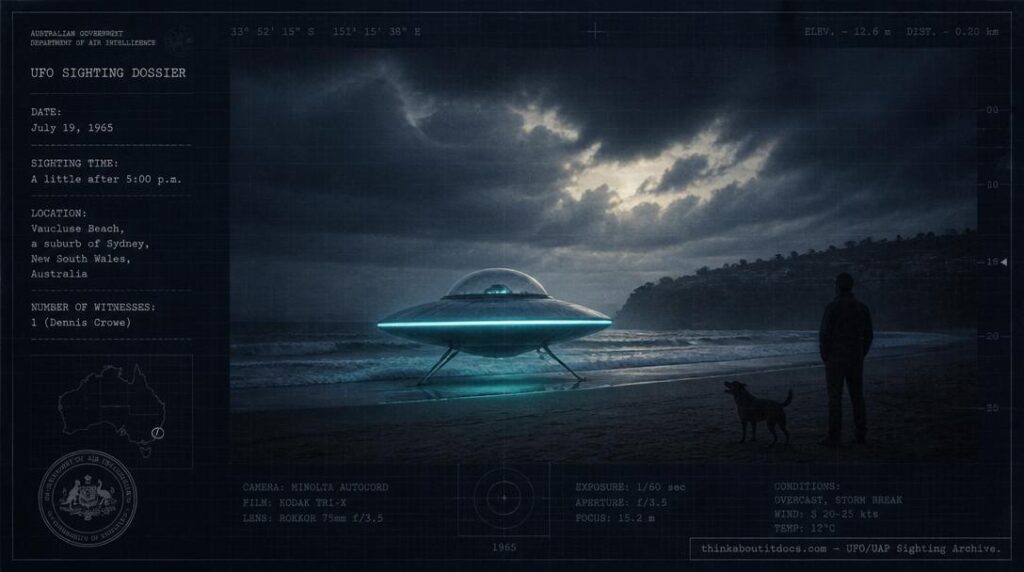
Dennis Crowe watched a glowing, disc-shaped object lift off from Vaucluse Beach, Sydney, leaving physical evidence at the site, July 19, 1965.
THINK ABOUTIT UFO SIGHTING REPORT
1965 Vaucluse Beach, Sydney UFO Landing: Dennis Crowe’s Encounter
Walking along Vaucluse Beach, a Sydney suburb, in the calm between winter storms on the evening of July 19, 1965, former English aircraft technical artist Dennis Crowe saw a glow ahead of him on the sand — a disc-shaped object, resting on legs, its rim glowing blue-green, a transparent dome on top. Local dogs barked furiously at it. As he closed to within 60 feet, the object lifted off with a sound like air escaping a balloon and vanished within ten seconds. A geologist who later inspected the site confirmed something had rested there — and found the surrounding plant life dying.
Date: July 19, 1965
Sighting Time: A little after 5:00 p.m.
Day/Night: Late afternoon/dusk (winter in Sydney; sunset falls close to this time in mid-July)
Location: Vaucluse Beach, a suburb of Sydney, New South Wales, Australia
Urban or Rural: Urban — suburban beach
No. of Entity(‘s): None documented
Entity Type: None documented
Entity Description: None documented
Hynek Classification: CE-II (Close Encounter II) — corrected from the source material’s duplicated “CE2 CE-II” label; appropriately applied given the documented physical trace (ground impression, affected plant life) left at the site
Duration: Not documented precisely for the full observation; the object’s departure, from liftoff to disappearance, took approximately 10 seconds
No. of Object(s): 1
Description of the Object(s): A disc-shaped object resting on legs on the sand, with a glowing blue-green rim and a dullish grey body in two parts, topped by what appeared to be a transparent dome; sat silently on the beach before departing with a sound compared to air being forced out of a balloon
Shape of Object(s): Disc
Size of Object(s): Estimated diameter of 20 feet
Color of Object(s): Glowing blue-green rim; dullish grey body
Distance to Object(s): First observed from several hundred feet away; approached to within approximately 60 feet before the object departed
Number of Witnesses: 1 (Dennis Crowe) — corrected from the source material’s original “Multiple,” which directly contradicts the full report’s own statement that Crowe was the only person to see the object
Special Features/Characteristics: Local dogs barked directly at the object while it sat on the beach, falling silent immediately after it departed; a geologist who inspected the site afterward confirmed that some object had definitely rested at the location, and found the surrounding plant life dying; the RAAF proposed a tornado as a possible explanation, which Crowe categorically rejected
Case Status: Unexplained — a single, detailed witness account supported by independent geological inspection confirming physical ground evidence and affected vegetation; the RAAF’s proposed tornado explanation was rejected by the witness and is part of a documented pattern of similar official explanations offered for other well-known Australian physical-trace cases of the era
Source: UFO Casebook
Summary/Description: Dennis Crowe, a former technical artist for English aircraft companies, observed a glowing, disc-shaped object resting on Vaucluse Beach, Sydney on the evening of July 19, 1965. As he approached to within 60 feet, the object lifted off and disappeared within about ten seconds. A subsequent geological inspection confirmed physical ground disturbance and dying plant life at the site. The RAAF’s proposed tornado explanation was rejected by Crowe, and the case remains unresolved.
Related Cases: Cited directly by researcher Bill Chalker alongside the 1966 Tully saucer nest and the 1963 Willow Grove close encounter as part of a documented pattern of Australian physical-trace cases where official investigators proposed a “tornado-like meteorological manifestation” explanation
Detailed Report
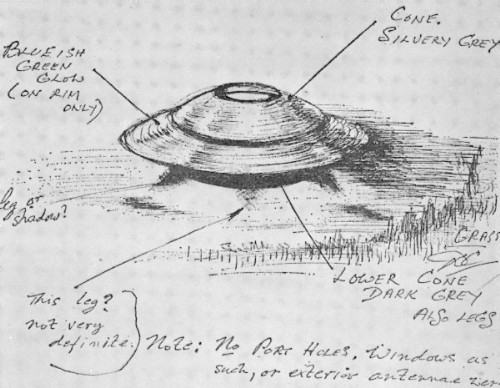
Witness sketch of the object seen at Vaucluse Beach, Sydney, July 19, 1965.
Vaucluse Beach, a Sydney suburb, was the site of an unusual encounter on July 19, 1965. Dennis Crowe, a former technical artist for English aircraft companies, was walking along the beach near his home a little after 5:00 p.m. The sea had been rough that day, with high winds and frequent rain showers, and Crowe was taking advantage of a lull between storms.
In the distance, he noticed a glow, and as he approached, he could make out a disc-shaped object resting on legs on the sand. He estimated its diameter at 20 feet, with a glowing blue-green rim around a dullish grey body composed of two sections, topped by what appeared to be a transparent dome. The craft sat silently; the only sound at the time came from local dogs barking directly at the object. Crowe made his initial observations from several hundred feet away, and as he closed to within about 60 feet, the object lifted off the ground, now producing a sound resembling air being forced out of a balloon.
The disc climbed quickly into the sky and disappeared within about ten seconds. The dogs fell silent immediately afterward. Crowe was the only person to witness the object. He reported what he’d seen, and a geologist subsequently inspected the site, confirming that some object had definitely rested at the location and finding that the surrounding plant life was dying.
The sighting drew enough attention to bring in the Royal Australian Air Force, which offered a tornado as a possible explanation for the event. Crowe categorically rejected this explanation. With no further research forthcoming, Crowe maintained his account, and no evidence ever emerged to contradict his claims. The object that landed on Vaucluse Beach that day has never been identified.
Researcher’s Notes
The Vaucluse Beach Landing — 1965 and Part of a Recognizable Official Pattern
- The witness count field was simply wrong, and the correction is unambiguous. The full report states directly that Crowe was the only person to see the object — there is no room for interpretation here, unlike some other cases where witness counts required careful parsing.
- This case fits a documented, recognizable pattern in Australian UFO history. Researcher Bill Chalker explicitly grouped this case together with Willow Grove (1963) and Tully (1966) as examples of Australian authorities proposing a “tornado-like meteorological manifestation” to explain physical-trace encounters that, in each case, involved detailed witness testimony and independently confirmed ground evidence. Seeing the same official explanatory pattern applied across three separate, well-documented cases is itself a notable feature of Australian ufology from this era.
- The geological inspection is a genuine, if not fully named, piece of independent corroboration. A geologist confirming that “some type of object had definitely rested” at the site, and separately noting dying plant life, represents real physical evidence assessed by someone with relevant expertise — even though this account doesn’t preserve the geologist’s name or a more detailed technical report.
- The dogs’ reaction is a small but consistent detail worth noting. Animal distress or attention directed at an unexplained object recurs across multiple cases in this archive, and here it’s specifically tied to the object’s presence and departure — barking while present, silent once it left.
- This remains a single-witness case, and that should be weighed honestly alongside its other strengths. Despite the physical corroboration, Crowe’s account of the object itself rests on his testimony alone — a genuine limitation even for an otherwise well-supported case.
The Vaucluse Beach landing endures as a clear example of a recurring official response pattern in 1960s Australian UFO cases — a detailed, single witness account, independently confirmed physical evidence, and a “tornado” explanation the witness himself never accepted.
“The only sound at the time was barking from some dogs. They were barking directly at the object.”
— as recorded from Dennis Crowe’s account, July 1965