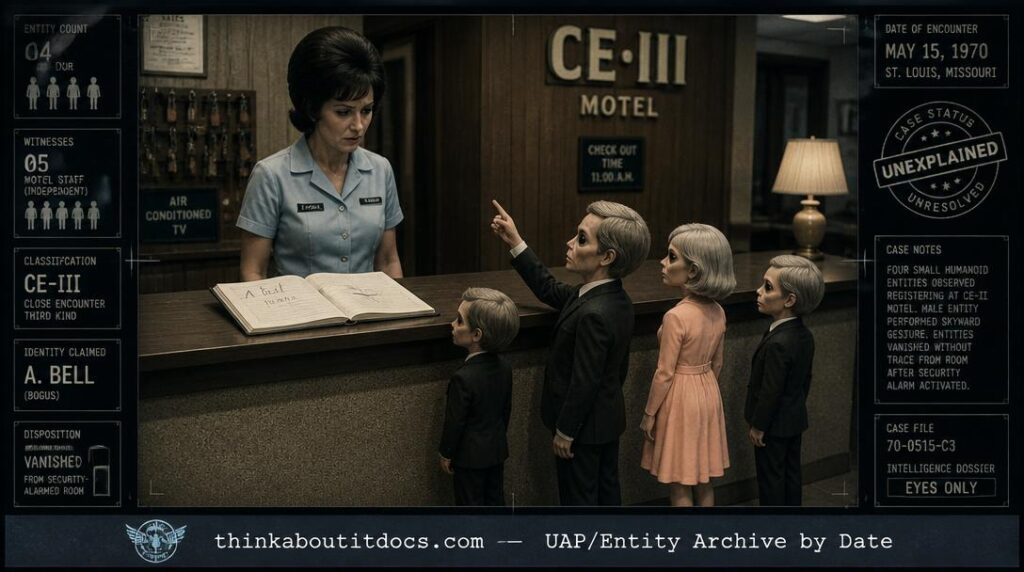
May 15, 1970 — St. Louis, Missouri. Four extremely small humanoid entities check into a suburban motel, pay with authentic currency, demonstrate unfamiliarity with pens and elevators, and vanish from a security-alarmed room. Five staff witnesses. CE-III. Unexplained.
THINK ABOUTIT ENTITY SIGHTING REPORT
1970: The Saint Louis Motel Encounter — A Family of Humanoid Entities Checks In and Vanishes
On the evening of May 15, 1970, a motel clerk in suburban Saint Louis looked up from her billing documents to find four strikingly identical, impossibly small people standing at her desk — a man, a woman, a boy, and a girl, all expensively dressed in tailored suits and pastel peach dresses, all wearing what appeared to be wigs, and all possessing faces that narrowed abruptly from wide-set, large dark eyes to tiny lipless mouths no wider than their slit-like nostrils. Over the next several hours, five separate motel employees interacted with the strange family, watched them eat individual peas with a sucking sound, observed the man point skyward when asked where he came from, and discovered the next morning that the group had vanished from a locked room without triggering a single security alarm.
Date: May 15, 1970
Sighting Time: Evening
Day/Night: Night
Location: Suburb of Saint Louis, Missouri
Urban or Rural: Urban / Suburban
No. of Entity(‘s): 4
Entity Type: Humanoid
Entity Description: Four extremely small beings resembling a human family — a man, a woman, a boy, and a girl — all strikingly alike in appearance. They barely reached the desk or table. Faces were wide at eye level, narrowing abruptly to pointed chins. Eyes were large, dark, and slightly slanted. Noses had virtually no bridges with two slit-like nostrils. Mouths were tiny, lipless, no wider than the nostrils. Skin tones ranged from pearl to pale pink to light grey. Hair appeared artificial (wig-like). Males wore tailored suits; females wore pastel peach dresses. The man spoke in a high-pitched voice, repeating questions. All demonstrated unfamiliarity with pens, elevators, and common food origins.
Hynek Classification: CE-III (Close Encounter III) — Close observation with animate beings associated with the phenomenon
Duration: Several hours (check-in through disappearance)
No. of Object(s): None observed
Description of the Object(s): No craft observed; no vehicle with matching license plate located in the parking lot
Shape of Object(s): Not Applicable
Size of Object(s): Not Applicable
Color of Object(s): Not Applicable
Distance to Object(s): Not Applicable
Height & Speed: Not Applicable
Number of Witnesses: Multiple (at least 5 motel employees: desk clerk Dorothy Simpson, motel manager, bellhop, restaurant hostess, waitress)
Special Features/Characteristics: Entities demonstrated unfamiliarity with pens, elevators, and basic food knowledge; carried authentic but extremely crisp U.S. banknotes; gave a bogus name (“A. Bell”) and false Hammond, Indiana address; ate individual peas by inhaling them with a sucking sound; the man could not fit a small piece of steak through his slit-like mouth; the group vanished from a locked room without triggering security alarms; no vehicle found in parking lot with Indiana plates
Case Status: Unexplained
Source: Albert Rosales, Humanoid Reports — 1970; John E. Schroeder, UFO Study Group of Greater St. Louis (field investigation)
Summary/Description: Five motel employees in suburban St. Louis independently interacted with four extremely small, identical-looking humanoid beings who checked in, dined, and then vanished from a security-alarmed room. The entities demonstrated unfamiliarity with basic human objects and customs, provided false identification, and departed without any traceable vehicle or exit path. Promptly investigated by local ufologist John E. Schroeder, who found all five witnesses sincerely bewildered.
Related Cases: 1957 Atlantic City Hotel Entity | 1954 French Entity Encounters
Detailed Report
On the evening of May 15, 1970, Dorothy Simpson was working the front desk at a motel in a suburb of St. Louis, Missouri, examining billing documents, when she heard what she described as a “whistling sigh.” Looking up, she found four people standing at her desk. They were immediately and profoundly abnormal. All four were extremely small — so short that they barely reached the desk surface. They looked strikingly alike, as if members of the same family: a man, a woman, a boy, and a girl. The “children” were nearly as tall as the “parents.” All appeared young.
Simpson noted their clothing first: the males wore tailored suits, the females wore pastel peach dresses, and all appeared expensively dressed. Their hair looked artificial — Simpson believed they were wearing wigs. In a high-pitched voice, the man asked, repeatedly, “Do you have a room to stay?” Simpson quoted a price, but the man seemed unable to comprehend the figure. He turned to the woman, who said nothing. After an uncomfortable silence, the man reached into his pocket and produced a pile of banknotes, some of high denomination. Simpson noticed the bills were unusually crisp — crisp enough to raise suspicion of counterfeiting — but informal testing suggested they were authentic. She took two twenty-dollar bills, returned the rest, and asked the man to sign the registration form.
The man was too small to reach the form on the desk, so Simpson completed it for him. He gave his name as “A. Bell.” As he stepped forward, Simpson got a clear look at his face and was struck by how strange it was. When she asked where they were from, the man shot his arm upward, pointing at the sky, and declared, “We come from up there. Up there.” The woman immediately pushed his arm down and, speaking for the first time, said they were from Hammond, Indiana, providing a street address.
The man then attempted to sign the register but handled the pen so awkwardly that Simpson concluded he did not know how to use one. The woman asked where they could eat, and Simpson directed them to the motel’s restaurant.
Over the following hours, several additional staff members interacted with the group. The motel manager, alarmed by the situation, had Simpson check the Hammond, Indiana address — both the name and address proved bogus. The bellhop searched the parking lot for a vehicle with Indiana plates and found none. The restaurant hostess noted that the adults’ chins barely reached the tabletop. The man read the menu aloud, asking peculiar questions about where milk, vegetables, and other common foods came from. The woman ordered peas and milk for herself and the children, and peas, a small steak, and water for the man.
Their eating behavior was extraordinary: each entity picked up a single pea with a knife, brought it to the tiny mouth, and inhaled it with an audible sucking sound. The man was unable to get even a small piece of steak through his mouth, which was little more than a slit. They all stopped eating simultaneously, the man left a twenty-dollar bill for the waitress, and when she returned with change, they had vanished from the table.
The bellhop located them and attempted to escort them to their room via elevator. When the elevator door opened, the small family stepped back in apparent fright and confusion, and the bellhop had to reassure them there was no danger. After letting them into the room and turning on the lights, the man shouted at the bellhop that the light would hurt the children’s eyes. The bellhop, now frightened himself, fled without waiting for a tip.
The bellhop, manager, and Simpson agreed to watch for the family’s departure the next morning. They never saw them again. The front door was the only exit that would not trigger a security alarm, and the alarms were verified to be in working order. The group had simply vanished.
The case came to the attention of the UFO Study Group of Greater St. Louis, and ufologist John E. Schroeder traveled to the motel to interview the five employees who had interacted with the entities. He found all of them sincerely bewildered by the experience. Schroeder compiled the consistent physical description from the independent witnesses: faces wide at eye level, narrowing abruptly to pointed chins; large, dark, slightly slanted eyes; noses with virtually no bridges and two slit-like nostrils; mouths tiny, lipless, and no wider than the nostrils. Skin color descriptions varied from pearl to pale pink to light grey.
Researcher’s Notes
The St. Louis Motel Family — Saint Louis 1970 and the Problem of Integrated Entity Behavior
- Classification Rationale — CE-III Without Observed Craft: This case is classified CE-III despite the absence of an observed craft. The entities’ anomalous physical characteristics, demonstrated unfamiliarity with basic human technology and food, the man’s skyward gesture when asked about origin, the bogus identity, the absence of any vehicle, and the impossible departure from a security-alarmed building collectively establish a phenomenon-associated encounter. CE-III does not require simultaneous craft observation — it requires animate beings associated with the phenomenon, and the totality of evidence here meets that threshold.
- Witness Chain — Five Independent Observers: The evidentiary strength of this case rests on the number and independence of the witnesses. Five separate motel employees — desk clerk, manager, bellhop, hostess, and waitress — each interacted with the entities in different contexts (check-in, dining, elevator, room assignment) and independently corroborated the same anomalous details. Schroeder’s prompt on-site investigation found all five witnesses credible and sincerely confused. This is not a single-witness narrative subject to individual perception bias; it is a multi-witness, multi-context encounter documented within days of the event.
- Behavioral Analysis — Technological Unfamiliarity Pattern: The entities’ inability to use a pen, fear of an elevator, ignorance of where common food comes from, and the peculiar pea-inhalation eating technique form a coherent pattern of technological and cultural unfamiliarity that is difficult to explain as a prank or psychiatric episode. A human hoaxer sophisticated enough to produce authentic U.S. currency, tailored clothing, and a sustained multi-hour performance would presumably know how to use a pen and an elevator. The behavioral details point consistently toward genuinely anomalous entities attempting — imperfectly — to pass as human.
- Disappearance and Security System: The most analytically intractable element is the departure. The entities vanished from a room in a building where the only non-alarmed exit was the monitored front door, and the alarms were confirmed operational. This detail transforms the case from an unusual encounter into an impossible one by conventional standards, and it remains unexplained by any prosaic mechanism.
The St. Louis motel encounter stands as one of the most richly detailed, multi-witness CE-III cases in the North American humanoid catalog — a record of entities who tried to blend in, failed spectacularly, and then simply ceased to be present.
The record holds what five motel employees saw that night in 1970: four impossible people who paid with real money, ate peas one at a time with a sucking sound, and vanished from a locked, alarmed building. John Schroeder found their witnesses credible. No one has found their explanation. The case remains Unexplained, and the archive keeps it exactly as the staff described it — strange, thorough, and stubbornly irreducible.