THINK ABOUTIT UFO SIGHTING REPORT
Date: November 16, 1977
Sighting Time: 09:00 PM
Day/Night: Nighttime
Location: South Dakota Missile Field
Urban or Rural: USAF Missile Base
No. of Entity(‘s): 0
Entity Type: None reported
Entity Description: The witness only observed the craft’s exterior and maneuvers
Hynek Classification: CE-I (Close Encounter I) Observation of an object in close proximity to the witness (i.e. within 500’)
Duration: 4 seconds
No. of Object(s): 1
Height & Speed: Rose from ground level to high altitude at “super speed”
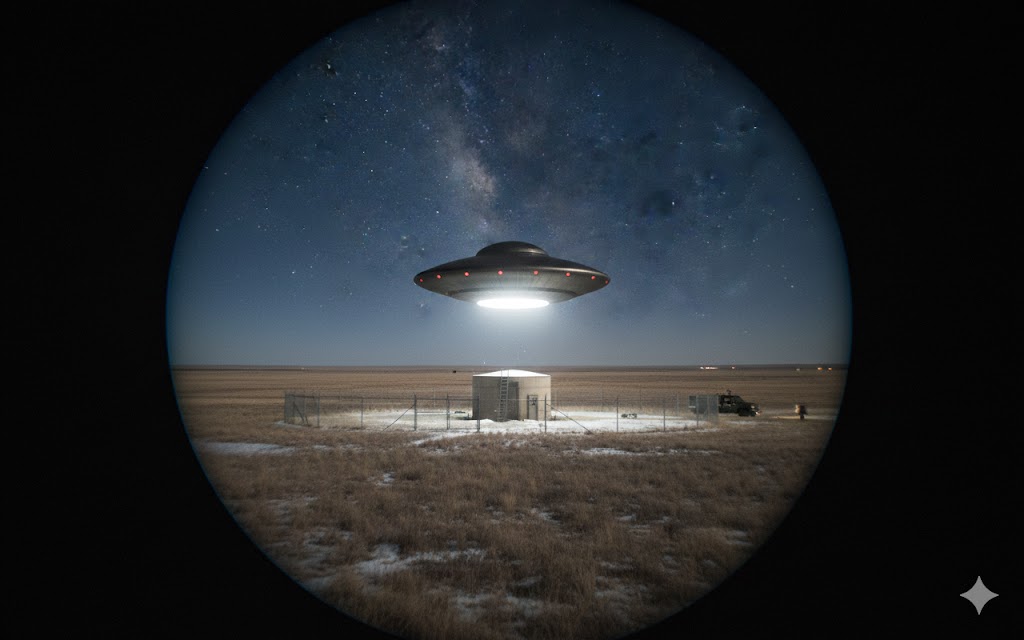
Size of Object(s): Approx. 30Ft across. Bright white across the bottom.
Distance to Object(s): Estimated within 500 feet (consistent with CE-I classification).
Shape of Object(s): saucer
Color of Object(s): Bright white on the bottom; body color indeterminate due to brightness.
Number of Witnesses: 2
Source: This information was obtained through the government Freedom of Information Act.
Summary or Description:My sat member & I were sent to Lima 11 are10. This was over 35 years ago. We were told to back our truck onto the missile site & watch toward the west. Sounded crazy to us. We did what we were told. At approx. 20:15 we observed a large object rise up toward us & took off away from us at a super speed and disappeared over the horizon. I called the LCF & asked the Sgt. if he believed in UFOs. I have just told my family about this.
Historical Context: Cold War Missile Field Security
The late 1970s was a notable period for UFO sightings over nuclear missile sites. The mention of Lima 11 refers to a specific Launch Facility (LF) within the Minuteman missile fields. Historical corroboration from similar declassified incidents suggests that security teams (SAT members) were often placed on high alert for “unidentified intrusions” that defied conventional aircraft capabilities, particularly those exhibiting “super speed” and high-angle ascents.
Analysis of the FOIA Documentation
Since this information was obtained via the Freedom of Information Act, there is an opportunity to discuss the official paper trail. You can expand on why SAT members were ordered to “back their truck onto the site and watch toward the west”—an instruction that implies command centers may have already been tracking an anomaly on radar before the visual confirmation at 20:15.
The Command Response and LCF Confirmation
The witness’s interaction with the Sgt. at the Launch Control Facility (LCF) is a critical narrative point. Elaborate on the “Crazy” nature of the orders and the subsequent psychological impact on the personnel involved. This helps establish the physical reality of the craft, moving the story beyond a simple light-in-the-sky report to a documented military encounter involving nuclear security.
Scientific and Military Significance of Nuclear Site Encounters
The incident at Lima 11 on November 16, 1977, is part of a broader, documented pattern of unidentified aerial phenomena (UAP) appearing over sensitive nuclear installations during the Cold War. Historically, these encounters are characterized by objects exhibiting “super speed” and “incredible maneuvers” that exceed the capabilities of any known terrestrial aircraft of that era. The fact that this specific 30-foot saucer was observed by Air Force security (SAT) members provides a high degree of forensic credibility, as these personnel are trained observers tasked with identifying conventional threats like Soviet aircraft or early drone technology.
From a military standpoint, the order for security teams to “back their truck onto the site” suggests a proactive defensive posture. It implies that the Launch Control Facility (LCF) may have had prior radar or sensor indications of an intrusion before the visual sighting occurred. This type of electronic corroboration is a hallmark of significant UAP cases involving military assets, where visual reports are backed by radar data that is often later declassified through the Freedom of Information Act (FOIA).
The scientific interest in these cases often centers on the propulsion and flight characteristics of the objects. Rising from ground level to high altitude in just four seconds indicates an acceleration that would likely be fatal to a human pilot and would cause structural failure in standard aerodynamic craft. This suggests a propulsion system not based on traditional thermodynamics or jet propulsion. Furthermore, statistical studies have confirmed a significant correlation between UAP reports and technologically significant or nuclear sites, suggesting an intelligent interest in humanity’s strategic capabilities.
The Psychological Toll on SAT Personnel
One often overlooked aspect of these military UAP encounters is the psychological strain placed on the Security Alert Team (SAT) members involved. Being ordered to perform “crazy” maneuvers, such as backing a truck onto a live missile site to watch for an unknown intruder, creates an environment of intense high-pressure uncertainty. For many veterans of the Ellsworth Air Force Base missile fields, these events were life-altering. The culture of the military in 1977 often discouraged the reporting of such anomalies, leading many witnesses to wait decades—sometimes over 35 years—before finally sharing the truth with their families and the public.
Tactical Geography: The Lima 11 Launch Facility
The Lima 11 site is part of a vast network of hardened underground silos spread across the South Dakota landscape. These sites were designed to be isolated, yet they were under constant electronic surveillance from a centralized Launch Control Facility (LCF). When an object is reported rising from ground level at “super speed” in such a sensitive area, it represents a total breach of protected airspace. The fact that the object disappeared over the horizon in a matter of seconds suggests a level of mobility that could effortlessly bypass the entire defensive perimeter of the United States’ nuclear triad.
The 1977 encounter at the South Dakota Missile Field stands as a cornerstone case for researchers utilizing the Freedom of Information Act (FOIA). It provides rare, first-hand testimony that links unidentified craft directly with nuclear weapons infrastructure. As more reports from this era are declassified, the narrative of the 1977 saucer at Lima 11 serves as a stark reminder that some of the most technologically advanced aerial anomalies in history have been witnessed by the very people we trust with our national security.