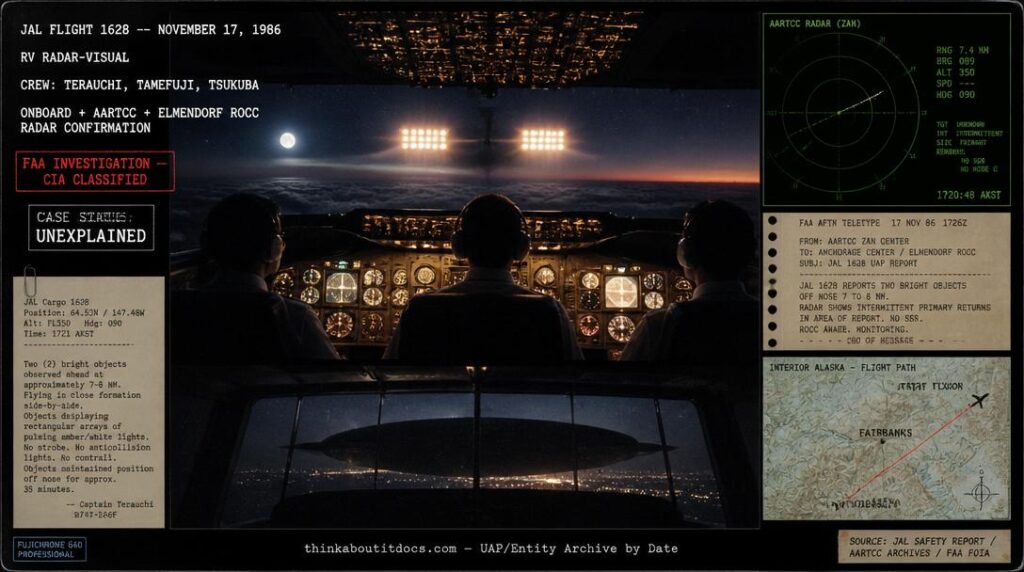
November 17, 1986: The three-man crew of JAL Flight 1628 tracked three unidentified objects — two smaller craft and a massive walnut-shaped object — for 50 minutes over interior Alaska at 35,000 feet. Confirmed by onboard, FAA, and Elmendorf military radar. CIA classified the FAA briefing. RV Radar/Visual — Unexplained.
THINK ABOUTIT UFO|UAP SIGHTING REPORT
1986: Japan Air Lines Flight 1628
On the evening of November 17, 1986, the three-man crew of Japan Air Lines Flight 1628 — a Boeing 747 cargo freighter carrying French wine from Paris to Tokyo — watched three unidentified objects pace their aircraft for approximately fifty minutes over the dark interior of Alaska at 35,000 feet. Two smaller craft with pulsating amber and white lights flew in formation ahead of them before repositioning, and then a massive object — which Captain Kenju Terauchi described as walnut-shaped and twice the size of an aircraft carrier — appeared silhouetted against the sky behind the 747 near Fairbanks. The encounter was tracked on the aircraft’s onboard radar, detected intermittently by Anchorage Air Route Traffic Control Center ground radar, and confirmed by Elmendorf Air Force Base military radar as an unexplained primary return. The FAA conducted a formal investigation, and FAA Division Chief John Callahan later testified that he briefed representatives of the CIA, FBI, and President Reagan’s scientific staff, after which the CIA declared the briefing classified and confiscated the evidence. Callahan had kept copies.
Date: November 17, 1986
Sighting Time: Approximately 5:11 PM – 5:51 PM Alaska Standard Time
Day/Night: Night (sunset had occurred; dark skies with a full moon rising)
Location: Over northeastern interior Alaska, from approximately 30 miles southeast of Fort Yukon through the Fairbanks area to approximately Talkeetna, at 35,000 feet descending to 31,000 feet
Urban or Rural: In flight — remote Arctic/subarctic airspace
No. of Entity(‘s): 0
Entity Type: Not applicable
Entity Description: Not applicable
Hynek Classification: RV (Radar/Visual) — visual observation by multiple trained aircrew confirmed by onboard and ground-based radar returns
Duration: Approximately 50 minutes (5:11 PM to approximately 5:51 PM AST; radar intermittent tracking for 31 minutes)
No. of Object(s): 3 (two smaller craft and one very large object)
Description of the Object(s): Two smaller objects initially appeared approximately 2,000 feet below the 747, then repositioned directly ahead of the cockpit in a stacked configuration before shifting to side-by-side. They displayed amber and whitish lights described as resembling flames from multiple rocket exhaust ports arranged in rectangular rows, pulsating in sequence. The large object, seen near Fairbanks when city lights provided a backdrop, appeared as a dark silhouette described as walnut-shaped with a wide rim. Captain Terauchi estimated it was twice the size of an aircraft carrier. Co-pilot Tamefuji described the smaller objects’ lights as “Christmas assorted” with salmon, red/orange, white, and weak blinking green — pulsating slowly rather than strobing. Flight Engineer Tsukuba saw clusters of lights in two parts shaped like airplane windows.
Shape of Object(s): Two smaller craft: undefined shape, known only from light arrays in two rectangular rows. Large object: walnut-shaped with a wide circumferential rim (seen in silhouette near Fairbanks)
Size of Object(s): Large object estimated by Terauchi as twice the size of an aircraft carrier (approximately 1,600–2,000 feet across if taken literally). Smaller objects indeterminate.
Color of Object(s): Smaller objects: amber, white, salmon/red-orange lights with weak green strobing. Large object: dark silhouette, pale white flat lights
Distance to Object(s): Smaller objects initially 2,000 feet below and forward; later directly ahead of cockpit. Large object detected on onboard radar at 7–8 nautical miles. Estimated by crew to be relatively close when silhouetted near Fairbanks.
Height & Speed: Objects initially at approximately 33,000 feet (2,000 feet below the 747 at 35,000 feet); paced the 747 at ground speed of approximately 600 mph; the large object maintained station behind the aircraft through course changes and altitude adjustments to 31,000 feet
Number of Witnesses: 3 primary (Captain Kenju Terauchi, Co-pilot Takanori Tamefuji, Flight Engineer Yoshio Tsukuba) plus multiple ATC controllers, Elmendorf ROCC radar operators, and a United Airlines crew vectored for visual confirmation (UA crew did not see the object — it had departed by the time they were in range)
Special Features/Characteristics: Objects tracked on the 747’s onboard digital weather radar at 7–8 nautical miles. Intermittent primary radar returns detected by Anchorage AARTCC and Elmendorf Regional Operational Control Center military radar (“surge primary return” — unaccompanied by transponder). FAA system initially filtered the large return as weather due to its size. The large object appeared to retreat when a United Airlines flight was vectored toward the JAL 747 for visual confirmation, then disappeared. Crew reported cockpit illuminated brightly and facial warmth during close approach of smaller objects. No radio transponder signal from any of the objects. Cameras aboard the 747 malfunctioned — Terauchi could not operate an unfamiliar camera, and Tsukuba’s autofocus failed in the dark.
Case Status: Unexplained
Source: FAA official investigation and documentation; translated written statement by Captain Kenju Terauchi; FAA Division Chief John Callahan testimony and preserved documentation (FOIA); Anchorage AARTCC audio recordings and radar data; Elmendorf ROCC radar logs; Loy Lawhon article (About.com); UPI contemporaneous reporting (December 30, 1986); Leslie Kean, “UFOs: Generals, Pilots, and Government Officials Go on the Record” (2010); Enigma Labs case file
Summary/Description: A three-man JAL crew on a 747 cargo flight tracked three unidentified objects — two smaller craft and one massive walnut-shaped object — for approximately 50 minutes over interior Alaska at 35,000 feet. The encounter was confirmed by onboard radar, Anchorage ATC, and Elmendorf military radar. The FAA conducted a formal investigation. FAA Division Chief John Callahan testified that he briefed CIA, FBI, and presidential staff, after which the evidence was classified and confiscated. Klass’s proposed explanations (Jupiter/Mars, ice crystals) were debunked. The FAA’s official explanation — split radar return from the 747 itself — does not account for the visual observations by three experienced aircrew. One of the best-documented aviation UFO cases on record.
Related Cases: 1950: Kodiak, Alaska — Navy Radar/Visual | 1958: Eielson AFB Multi-Radar Tracking | 1948: Chiles-Whitted Case
Detailed Report
On November 16, 1986, Japan Air Lines Flight 1628 — a Boeing 747-246F cargo freighter — departed Paris carrying a load of French wine bound for Tokyo with intermediate stops in Reykjavik, Iceland and Anchorage, Alaska. The crew consisted of Captain Kenju Terauchi, a veteran pilot with extensive trans-Pacific experience, Co-pilot Takanori Tamefuji, and Flight Engineer Yoshio Tsukuba.
The flight proceeded without incident from Paris to Reykjavik and then across Greenland and northern Canada. Just after crossing into Alaskan airspace, Anchorage Air Route Traffic Control Center (AARTCC) made initial radar contact at 5:09 PM AST and instructed the flight to turn 15 degrees left toward Talkeetna on a heading of 215 degrees. The aircraft was at 35,000 feet and traveling at a ground speed of approximately 600 mph.
At approximately 5:11 PM, Captain Terauchi noticed lights from what he assumed was an American military jet on patrol — about 2,000 feet below and 30 degrees to the left of the 747. He initially ignored the lights. After several minutes, he noticed they were maintaining pace with the aircraft, which would be unusual for patrol jets. Then, without warning, two objects appeared to jump directly in front of the cockpit. The interior of the cockpit was brightly illuminated and Terauchi felt warmth on his face.
The two craft, one above the other, maintained formation with the 747 for approximately seven minutes, rocking in unison. They then shifted to a side-by-side configuration. Terauchi described their light arrays as amber and whitish, resembling multiple rocket exhaust ports arranged in two rectangular rows, firing in sequence as if for stabilization — similar to maneuvering thrusters on the Space Shuttle. He also noted sparks resembling a gasoline or carbon fuel fire.
Co-pilot Tamefuji described the lights differently: “Christmas assorted” with salmon, red/orange, white, and weak blinking green colors. He said they pulsated slowly — stronger, weaker, stronger, weaker — unlike strobe lights. He perceived them as two aircraft in very close formation. Flight Engineer Tsukuba, seated behind the copilot with a more limited view, saw clusters of undulating lights in two parts shaped like airplane windows, white or amber in color.
Tamefuji contacted Anchorage ATC, and for the next thirty minutes the 747 and AARTCC maintained constant communication about the UFO. Terauchi attempted to photograph the objects but was unfamiliar with the camera and could not operate it. Tsukuba also tried but his camera’s autofocus failed in the dark conditions. No photographs were obtained.
Anchorage ATC repeatedly asked about cloud conditions near the aircraft. Terauchi reported thin clouds near the mountains below but clear air at his altitude with steady air currents. The smaller objects eventually moved off to the left. Terauchi then observed a pale white flat light at the horizon, moving in formation with the 747.
Terauchi set the 747’s onboard digital weather radar to 20 nautical miles and detected a large green return at 7–8 nautical miles in the direction of the object. He reported this to Anchorage ATC. At 5:25:45, after two minutes of searching, the military radar at Elmendorf Air Force Base’s Regional Operational Control Center also detected something — described as a “surge primary return,” meaning an intermittent radar echo with no accompanying transponder signal.
As the 747 approached Fairbanks, with the crew’s eyes now adapted to darkness and the city lights providing a backdrop, Terauchi saw the silhouette of what he described as a gigantic walnut-shaped craft with a wide rim. He urgently requested a 45-degree course change to the right. After the turn, the Fairbanks Approach Radar controller reported no target other than JAL 1628. The aircraft proceeded toward Talkeetna at 31,000 feet with the object apparently still following.
At approximately 5:40, a United Airlines passenger jet departing Anchorage for Fairbanks was asked to look for the object. The AARTCC controller directed the two aircraft to pass within five miles of each other at different altitudes. As the UA flight approached, the UFO apparently dropped back. When the planes were about 12 miles apart, the UA pilot confirmed visual on the JAL aircraft but reported nothing else. A military TOTEM flight was also vectored toward the JAL aircraft and likewise saw no other traffic. The object had departed. JAL 1628 landed at Anchorage at 6:20 PM.
The FAA conducted a formal investigation. John Callahan, Division Chief of the FAA’s Accidents and Investigations Branch in Washington, D.C., analyzed the audio recordings and synchronized them with the radar data. He found intermittent primary radar returns matching Terauchi’s reported positions of the object, tracked near the 747 for 31 minutes. The FAA’s computer had filtered the UFO’s return as weather because the target was extremely large. Callahan testified that he briefed FAA Administrator Donald Engen, who then arranged a classified briefing on January 5, 1987 attended by representatives of the CIA, FBI, and President Reagan’s scientific study team. According to Callahan, a CIA official declared the briefing classified at its conclusion, stating the meeting “never happened,” and ordered all data confiscated. Callahan had retained copies of the original files, which were later made public.
Philip Klass of CSICOP initially proposed that the crew had misidentified Jupiter and Mars — a solution debunked because the objects were observed in a part of the sky opposite the planets’ positions and moved between vertical and horizontal configurations. CSICOP later proposed ice crystal reflections, which was undermined by the clear sky at the aircraft’s altitude. The FAA’s official explanation attributed the radar returns to a “split radar return from the JAL Boeing 747,” which does not account for the visual observations by three experienced crew members.
Researcher’s Notes
The JAL 1628 Encounter — Alaska 1986 and the Gold Standard for Aviation Radar/Visual Cases
- Multi-Layer Confirmation: JAL 1628 is one of the most thoroughly documented UFO cases in aviation history because the evidence chain includes multiple independent layers: visual observation by three experienced airline crew members (each describing the lights differently, which is a reliability marker — truthful witnesses rarely give identical descriptions); onboard radar detection at 7–8 nautical miles; intermittent ground radar confirmation from both civilian (Anchorage AARTCC) and military (Elmendorf ROCC) systems; continuous ATC audio recordings; and a formal FAA investigation. The radar evidence is imperfect — the returns were intermittent, consistent with an object filtered as weather by the automated system due to its enormous apparent size — but it exists, and Callahan’s synchronized analysis confirmed positional correlation with the visual reports.
- Classification Correction and Source Chain: The original page classified this as CE-I (Close Encounter of the First Kind), which applies to ground-based visual observations within 500 feet. The correct classification is RV (Radar/Visual) — an airborne visual observation confirmed by multiple radar systems. The existing page’s source was a single republished article by Loy Lawhon. The actual source chain is extensive: the FAA’s official investigation documents, Captain Terauchi’s translated written statement, ATC audio recordings, Elmendorf ROCC radar logs, Callahan’s preserved documentation (released via FOIA), contemporaneous UPI and AP reporting, and subsequent analysis in Leslie Kean’s 2010 book and multiple declassified government files.
- The Terauchi Factor: Captain Terauchi’s credibility has been both the case’s greatest asset and its most contested element. He was a veteran pilot with extensive experience on trans-Pacific routes. His detailed, technically specific descriptions of the objects — the exhaust-port analogy, the walnut shape, the sequential firing pattern — suggest an observationally rigorous witness. However, Terauchi also made statements in subsequent interviews suggesting he believed the objects were extraterrestrial, and he reported a previous UFO sighting. Skeptics have used these points to question his objectivity. The co-pilot and flight engineer, notably, provided more conservative descriptions focused on the lights rather than the structure, which is consistent with their more limited viewing angles. JAL briefly grounded Terauchi and reassigned him to a desk job after the publicity.
- Assessment: The case is classified Unexplained. The official explanations — Jupiter/Mars (wrong position), ice crystals (clear sky), split radar return (does not address visual observations) — have each been individually debunked or are insufficient. The multi-radar confirmation, the three-witness visual observation with detailed but non-identical descriptions, the FAA’s formal investigation, and the subsequent intelligence-community briefing make this case one of the hardest aviation UFO encounters to dismiss. It is not, however, perfect: no photographs were obtained, the radar returns were intermittent, the United Airlines crew vectored for confirmation did not see the object, and the enormous size estimate for the “mothership” relies on Terauchi’s subjective judgment in darkness. The case is retained as Unexplained — one of the strongest radar/visual aviation encounters in the post-Blue Book era.
On a dark November evening over the Alaskan interior, three experienced Japanese aircrew watched unidentified objects pace their 747 for fifty minutes, tracked them on their own radar, and reported them to Anchorage air traffic control, which confirmed an intermittent return that the military radar also detected. The FAA investigated, the CIA classified, and Phil Klass debunked — but the debunking was debunked, the classification was eventually pierced by FOIA, and John Callahan’s copies survived. More than three decades later, the JAL 1628 encounter remains exactly what Callahan told the CIA it was: something that happened, that was tracked, that three people saw, and that no one has adequately explained.
Media

Illustration of the object, with the Boeing 747 airplane on the right. (International UFO Reporter)

Japan Airlines Captain Kenju Terauchi describes the encounter with three UFOs over Alaska.

Captain. Terauchi’s drawing of the huge object.