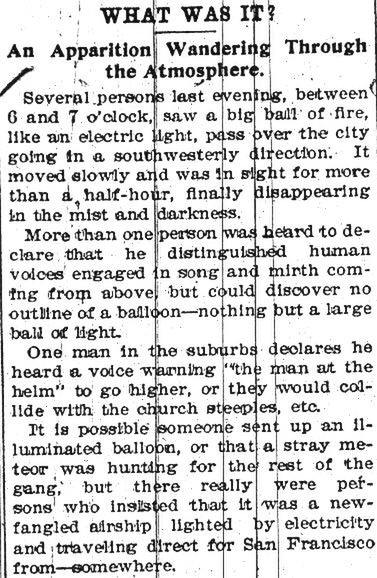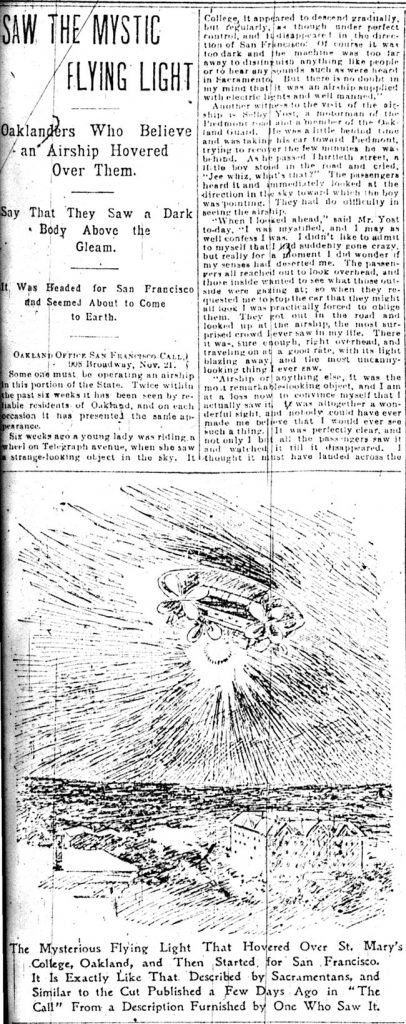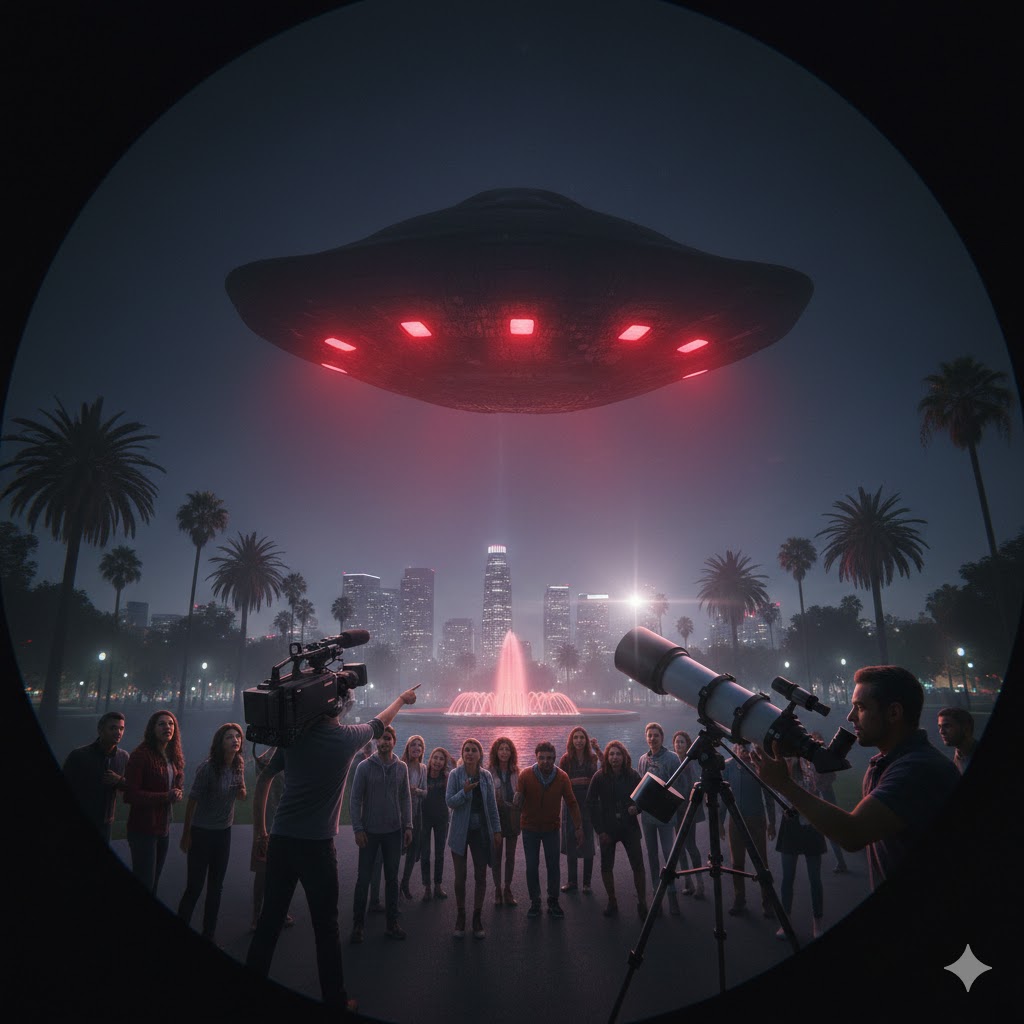
A reconstruction of the dark anomaly with red spots witnessed by 30 people in MacArthur Park.
THINK ABOUTIT UFO SIGHTINGS REPORT
Date: January 26, 2014
Sighting Time: 01:00 AM
Day/Night: Daytime
Location: MacArthur Park, Los Angeles California
Urban or Rural: Park with an open lawn of grass
Entity Type: None reported / Possible EBE (Extraterrestrial Biological Entity)
Entity Description:
Hynek Classification: NL (Nocturnal Light) Point or extended luminous source observed at night.
Duration: 10 minutes
No. of Object(s): 1
Appearance / Description of the Object(s): Anomaly with an odd body or shape with red windows or spots on it
Distance to Object(s): 500-1,000 feet
Shape of Object(s): Anomaly with odd body/shape
Color of Object(s): Dark/Indeterminate with red windows or spots
Number of Witnesses: 30
Special Features/Characteristics: Multiple witness corroboration, captured on telescope and secondary cameras
Source: Reported To Think AboutIt
Summary/Description: This Unidentified Ariel Phenomenon was Documented On a Telescope By Jay Lee and Myself, it was on January 26 2014 in MacArthur Park. It’s a two man Job to record with a telescope and not an easy one either, Hans has to track this object on the view finder then the person manning the camera has to notify him when it is in frame and focus the image.
This anomaly is to date my favorite at how By Far in it’s features it displays and how clear an image we were able to Record off of it. We have no idea if it is mechanical or biological but the on thing that is certain is that this Ufo is till today unexplained.
some refer to it as an ebe, uap, aap or even ovni. This object was also captured on multiple cameras that day so there isn’t just the telescope footage of it but however the telescope did get the best look at it.
Here is the video if you would like to take a look
The Technical Challenge of Telescope Tracking
Recording a fast-moving or high-altitude UAP via telescope is a sophisticated “two-man job”. It requires perfect synchronization between the spotter, who tracks the object via the viewfinder, and the camera operator, who must maintain focus while the object is in frame. This level of technical effort adds a layer of forensic validity to the report, as it moves the evidence beyond a simple “shaky phone” video into the realm of structured telescope documentation.
MacArthur Park: An Urban Mass Sighting
MacArthur Park is one of the most densely populated urban green spaces in Los Angeles. Having 30 witnesses simultaneously observe an anomaly at 01:00 AM is a significant sociological data point. In urban settings, observers have consistent reference points—like the LA skyline—to judge the size and speed of an object, making the description of its “odd body” and “red windows” far more reliable than a sighting in an empty desert.
Historical Context: MacArthur Park and the LA Sighting Corridor
MacArthur Park occupies a storied place in Los Angeles history, but in the context of aerial anomalies, it sits within what researchers often call the “LA Sighting Corridor”. Historically, the Westlake district has been a focal point for urban observations due to its clear sightlines toward the downtown skyline and its proximity to major transit routes.
The January 26, 2014, event is significant because it mirrors the “mass sighting” patterns seen in historical cases like the 1942 Battle of Los Angeles. While the 1942 event was characterized by wartime anxiety, the 2014 encounter occurred in a modern era of high-definition digital documentation. Having 30 witnesses in such a central, public location at 01:00 AM provides a sociological weight that isolated rural sightings often lack. In the history of California ufology, urban mass sightings are rare because of the overwhelming presence of conventional aircraft; for an object to be identified as an “anomaly” by so many people simultaneously, its physical characteristics must be profoundly distinct from standard aviation.
Technical Analysis: The Telescope as a Forensic Tool
From a technical standpoint, the use of a telescope transforms this report from a subjective anecdote into a forensic case study. Standard consumer cameras often struggle with “autofocus hunting” when filming a light source against a black sky, resulting in the “blob-in-the-dark” footage common in many reports. However, recording through a telescope requires manual focus and precise mechanical tracking.
The “two-man job” described—where one person tracks the object through a high-magnification finder while the other monitors the camera feed—is a technical necessity to combat the narrow field of view inherent in high-power optics. At the magnification levels required to see “red windows or spots” on an object estimated to be within 500 to 1,000 feet, even a vibration of a few millimeters at the telescope base would cause the object to streak across the frame and disappear. The fact that stable footage was achieved suggests a high level of technical competence and corroborates the claim that the object was moving at a pace or in a manner that allowed for manual tracking. This technical data point effectively rules out standard “fast-mover” objects like meteors and points toward a structured craft under intelligent control.
The MacArthur Park encounter represents a significant case study in the intersection of traditional eyewitness accounts and modern technological verification. In an era where digital manipulation is increasingly common, the presence of multiple witnesses using diverse recording equipment—ranging from standard cameras to high-magnification telescopes—provides a “multi-modal” evidence base that is difficult to dismiss. Scientifically, the observation of an “odd-shaped” body with “red windows” that remains stationary or performs controlled maneuvers defies the typical signature of known atmospheric phenomena or civilian drone technology.
Furthermore, this sighting highlights the importance of urban UAP research. While rural sightings are often hindered by a lack of reference points, the MacArthur Park event allowed observers to gauge the object’s relative 500-1,000 feet distance against the backdrop of a known city skyline. As we move forward in the study of Nocturnal Lights (NL), cases like this serve as a vital reminder that the most compelling evidence often comes from a combination of human vigilance and technical precision in our own backyard.