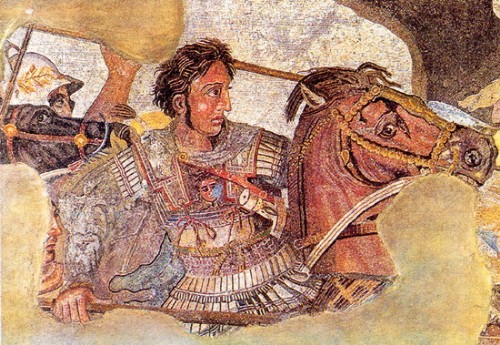
A classic depiction of Alexander the Great, whose chronicles include some of history's earliest recorded UFO sightings
THINK ABOUTIT UFO SIGHTING REPORT
Date: 329 BC
Sighting Time: Night (Jaxartes River)
Day/Night: Night
Location: Central Asia
Urban or Rural: Rural (Desert/River campaign)
No. of Entity(‘s): Multiple (Animate beings observed)
Entity Type: Unknown (Associated with craft)
Entity Description: Described as “animate beings” associated with the flying shields
Hynek Classification: CE-III (Close Encounter III) Close observation with animate beings associated with the object.
Duration: Several minutes (Long enough for circles over Tyre and repeated dives at Jaxartes)
No. of Object(s): 2 (Jaxartes River); 5 (Siege of Tyre)
Height & Speed:Very swift disappearance aloft
Size of Object(s):One exceedingly large lead craft; others half that size
Distance to Object(s): Close enough to dive at the army and strike walls
Shape of Object(s):Circular/Shield-like; Triangular formation
Color/Description of Object(s): Shining silvery shields spitting fire around the rims
Number of Witnesses: Famous Person, Witness Photo
Source: Bruno Mancusi, UFO Updates mailing list, Apr. 18, 2003
Summary/Description: A historian of the reign of Alexander the Great allegedly tells of two strange craft that dived repeatedly at his army, until the war elephants, the men, and all the horses panicked and refused to cross the river where the incident occurred… The historian describes the objects as “great shining silvery shields, spitting fire around the rims… things that came from the skies and returned to the skies.
Full Report
This remarkable incident was apparently paralleled by an equally fantastic visitation during the Siege of Tyre by Alexander in 332 BC. Quoting Giovanni Gustavo Droysens Storia di Alessandro il Grande, the erudite Italian Alberto Fenoglio, writes in CLYPEUS Anno 111, No 2, a startling revelation which we now translate
‘The fortress would not yeld, its walls were fifty feet high and constructed so solidly that no siege-engine was able to damage it. The Tyrians disposed of the greatest technicians and builders of war-machines of the time and they intercepted in the air the incendiary arrows and projectiles hurled by the catapults on the city.
One day suddenly there appeared over the Macedonian camp these “flying shields”, as they had been called, which flew in triangular formation led by an exceedingly large one, the others were smaller by almost a half. In all there were five. The unknown chronicler narrates that they circled slowly over Tyre while thousands of warriors on both sides stood and watched them in astonishment. Suddenly from the largest “shield” came a lightning-flash that struck the walls, these crumbled, other flashes followed and walls and towers dissolved, as if they had been built of mud, leaving the way open for the besiegers who poured like an avalanche through the breeches. The “flying shields” hovered over the city until it was completely stormed then they very swiftly disappeared aloft, soon melting into the blue sky.’120″
Historical Note: The Sources and Context
While the accounts of Alexander the Great witnessing “flying shields” are legendary in the field of ancient astronaut theory, their origins are often debated by modern historians.
-
The Tyre Encounter (332 BC): This account is frequently attributed to the works of Giovanni Gustavo Droysen, a 19th-century historian. It describes a high-strangeness event where the “shields” appeared to actively intervene in a military siege, a detail that many scholars believe may have been a later dramatization or a misinterpretation of atmospheric phenomena like bolides or meteors.
-
The Jaxartes River Incident (329 BC): This report highlights the physiological effect on the army’s animals, specifically the war elephants and horses. In the ancient world, such aerial anomalies were often interpreted as divine omens or celestial “prodigies” rather than technological craft.
-
Terminology: The term “flying shields” (Latin: clypeus) was a common Roman-era descriptor for unidentified circular objects in the sky, later popularized by researchers like Alberto Fenoglio.
In 329 BC, while campaigning in Central Asia, the army of Alexander the Great reportedly encountered two “great shining silvery shields” that dived repeatedly at their positions. The aerial anomaly caused such a panic among the war elephants and horses that the army was initially unable to cross the Jaxartes River. This high-strangeness event was allegedly preceded by a similar encounter during the Siege of Tyre in 332 BC, where five triangularly formed “flying shields” were said to have assisted the Macedonian forces by firing “lightning” that crumbled the city’s impenetrable walls. Classified as a CE-III, these accounts remain some of the most famous examples of unidentified aerial phenomena in ancient history.