THINK ABOUTIT UFO SIGHTING REPORT
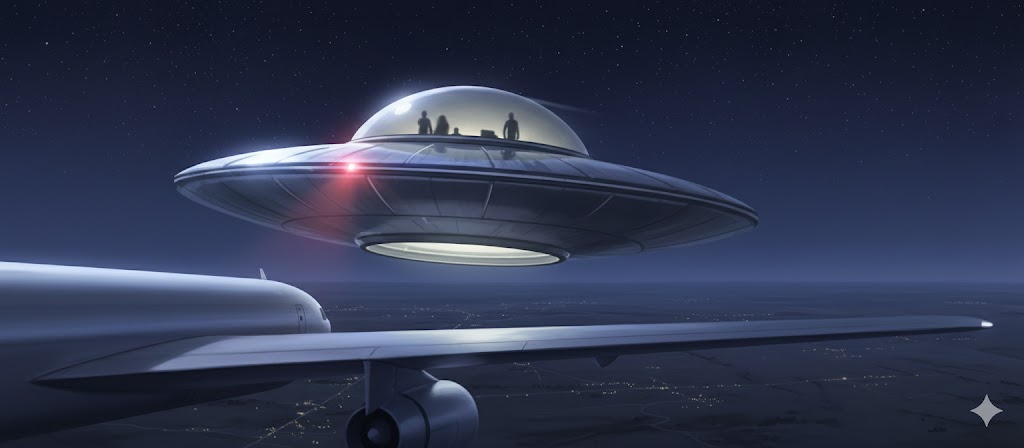
On February 14, 1973, at approximately 2:30 a.m., the crew of a DC-8 cargo flight traveling from St. Louis to Dallas encountered a highly anomalous object near McAlester, Oklahoma. The pilots observed a silvery, domed disc that maintained a constant position near their right wing before performing non-inertial maneuvers around the aircraft. Most significantly, the encounter was confirmed by the airplane’s airborne radar, which showed a solid target reacting directly to the radar sweeps. During the close-range observation, pilots reported seeing two or three shadowy entities moving within a dimly lit transparent dome on top of the craft.
Date: February 14, 1973
Time: 0230A
Location: McAlester, Oklahoma
Hynek Classification: CE-III (Close Encounter III) Close observation with animate beings associated with the object.
Duration: Several minutes (from initial wing-side observation to radar disappearance at 50 miles).
No. of Object(s): 1
Appearance / Description of the Object(s): Silvery, highly polished surface reflecting moonlight; features stubby protrusions
Distance to Object(s): Closest approach was 300 feet (90 meters).
Height & Speed: 5,000 feet (initial) and maintained same course/speed as the DC-8
Shape of Object(s): Disc-shaped with a transparent dome on top
Size of Object(s): Large enough to be mistaken for another aircraft; estimated significantly larger than a small drone
Color of Object(s): Silvery / Metallic
Special Features/Characteristics: Transparent dome; reflective polished surface; reactive to radar beams; oscillatory motion.
Number of Witnesses: Pilot/Co-Pilot/Air-Crew
Source: Richard Hall, Volume II, The UFO Evidence, A Thirty-Year Report, Richard Hall, (2001), page 131 / UFO Casebook Source
Summary: A domed disc near cargo airliner, confirmed by the airplane’s airborne radar. The object was disc-shaped with a transparent dome on top, and a silvery, highly polished surface. The object reacted to the sweep of the plane’s radar. Pilots from the airliner saw two or three shadowy entities moving around inside the object
Full Report
An airline DC-8 cargo flight was en route from St. Louis to Dallas on February 14, 1973, at about 2:30 a.m. At a point near McAlester, Oklahoma, the copilot noticed what he first thought was another aircraft just below the leading edge of the right wing about 5,000 feet (1,500 meters) away. The object was on the same course and speed, keeping a constant position. Only its steady amber light seemed unconventional.
Suddenly the object rose straight up like an elevator, made a sharp turn and approached the plane, taking up a position about 300 yards (270 meters) away and slightly above them. It was disc-shaped with a transparent dome on top, its silvery, highly polished surface reflecting the moonlight. Besides some stubby protrusions no other features were visible.
The captain switched on the weather radar and it confirmed that something real and solid was there. When the radar beam hit its surface, the object reacted immediately, ascending straight up, then moving sideways over the DC-8 and briefly out of sight. The object reappeared quickly, descending straight down and taking up a new position just below the leading edge of their left wing. It then dropped below and behind the plane, abruptly reappearing only about 300 feet (90 meters) below them.
Looking down into the dimly lit dome, the pilots saw two or three shadowy entities moving around. The object then darted out in front, performed various oscillatory motions and another sharp (noninertial) turn before speeding out of sight. It disappeared off the radar scope at a distance of 50 miles (80 km).16
Technical Radar-Visual Analysis: Sensor-Visual Correlation
The encounter over McAlester, Oklahoma, stands as a hallmark case in aviation ufology due to the high degree of sensor-visual correlation. In technical terms, the event transitioned from a simple pilot observation to a validated aerial anomaly when the crew engaged the DC-8’s onboard weather radar. Unlike civilian radar which primarily tracks transponders, weather radar reflects off solid physical masses, confirming that the object was not an optical illusion, a reflection, or a meteorological phenomenon, but a dense, metallic structure.
Electronic Intelligence (ELINT) and Reactive Behavior
One of the most significant technical takeaways from the McAlester report is the object’s immediate reaction to the radar sweep. When the pilots directed the radar beam toward the craft, it instantaneously performed an elevator-like vertical ascent. This suggests that the craft possessed Electronic Intelligence (ELINT) capabilities, allowing it to detect and respond to electromagnetic radiation in the X-band or C-band frequencies typically used by airliner radar. This level of reactive maneuvering indicates an intelligent control system capable of interpreting human technology and responding with non-ballistic flight paths.
Non-Inertial Propulsion and Flight Dynamics
The visual description provided by the pilots—specifically the “elevator-like” rises and the ability to maintain a constant position at high airspeed—defies the laws of inertial propulsion known in 1973. Conventional aircraft require forward velocity to generate lift over wings; however, this domed disc operated independently of these requirements, moving vertically and sideways without any visible control surfaces like rudders or ailerons. The radar confirmation of these maneuvers at a close range of 300 feet (90 meters) eliminates the possibility of “ground clutter” or “false targets,” as the proximity would have created a massive, unmistakable return on the cockpit scope.
Radar Tracking to Vanishing Point
The technical conclusion of the event is equally impressive: the object was tracked as it accelerated away from the DC-8, remaining on the radar scope until it reached a distance of 50 miles (80 km). To cover such a distance and remain a trackable “solid target” implies an extreme rate of acceleration that far exceeds the capabilities of any military interceptor of that era. For researchers, this case remains a primary example of a Radar-Visual (RV) encounter, where the technical data from the aircraft’s sensors perfectly mirrors the extraordinary visual testimony of the flight crew.
Researcher’s Notes
-
Radar-Visual Correlation: Visual observations by the DC-8 crew were backed by onboard weather radar, which confirmed a solid physical mass.
-
Anomalous Propulsion: The craft demonstrated “elevator-like” vertical rises and oscillatory motions that do not align with conventional 1970s aviation technology.
-
Entity Observation: Classified as a CE-III, this is one of the rare instances where pilots of a commercial airliner were close enough to observe occupants inside a craft during flight.
-
Radar Disappearance: The object was tracked as it sped away, finally disappearing from the radar scope at a distance of 50 miles (80 km).
The 1973 encounter over McAlester stands as a cornerstone of aviation-based research due to the rare and powerful combination of multi-witness pilot testimony and hard sensor data. The cargo crew’s ability to observe the craft at a proximity of just 300 feet allowed for the identification of structural details—including the transparent dome and its shadowy occupants—that are seldom captured with such clarity in commercial flight. When these visual observations are paired with the airborne radar’s confirmation of a solid, metallic mass reacting intelligently to electromagnetic sweeps, the case moves beyond anecdotal evidence and into the realm of a verified physical anomaly.
Ultimately, this incident highlights a profound technological gap, as the craft demonstrated non-inertial flight dynamics and ELINT-responsive behavior that far outpaced the capabilities of mid-20th-century aerospace engineering. By tracking the object from a stationary wing-side hover to its high-speed departure 50 miles away, the radar data provides a quantifiable record of performance that remains unexplained by conventional science. As part of the Think AboutIts archives, this report serves as a vital reminder of the complex, structured, and often interactive nature of unidentified phenomena within our controlled airspace.