THINK ABOUTIT UFO SIGHTING REPORT
Date: 1034 CE
Sighting Time: sunset
Day/Night: Day
Location: Nuremberg | Europe
Urban or Rural: Rural & Urban
Hynek Classification: DD (Daylight Disc) Metallic or whitish object was seen in the day.
Duration: “Unknown” (The text describes a specific trajectory from south to east, but does not record the exact minutes)
No. of Object(s): 1
Size of Object(s): “Large sphere/Cigar form” (The illustration depicts it as significantly larger than a standard star or meteor, appearing as a structured craft in the woodcut).
Distance to Object(s): “Aerial/High Altitude” (Described as “in the sky” rather than a ground-level encounter).
Shape of Object(s): cigar-shaped form haloed by flames
Color of Object(s): Flamey
Number of Witnesses: Mass
Source: The Nuremberg Chronicle (Liber Chronicarum)
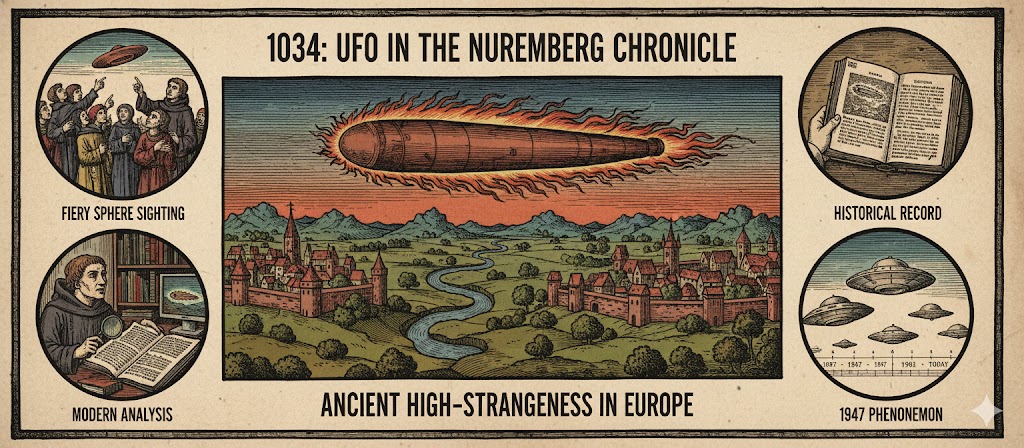
Summary: A rare typeset book from 1493 contains what may be the earliest pictorial representation of a UFO. The book Liber Chronicarum describes a strange fiery sphere, seen in 1034, soaring through the sky in a straight course from south to east and then veering toward the setting sun.
Full Report
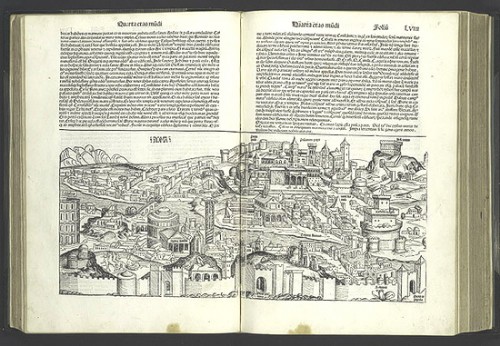
A rare typeset book from 1493 contains what may be the earliest pictorial representation of a UFO. The book Liber Chronicarum (or commonly known as the Nuremberg Chronicle), describes a strange fiery sphere, seen in 1034, soaring through the sky in a straight course from south to east and then veering toward the setting sun. The illustration accompanying the account shows a cigar-shaped form haloed by flames, sailing through a blue sky over green, rolling countryside. This may be the first work that actually contains actual illustrations of UFOs.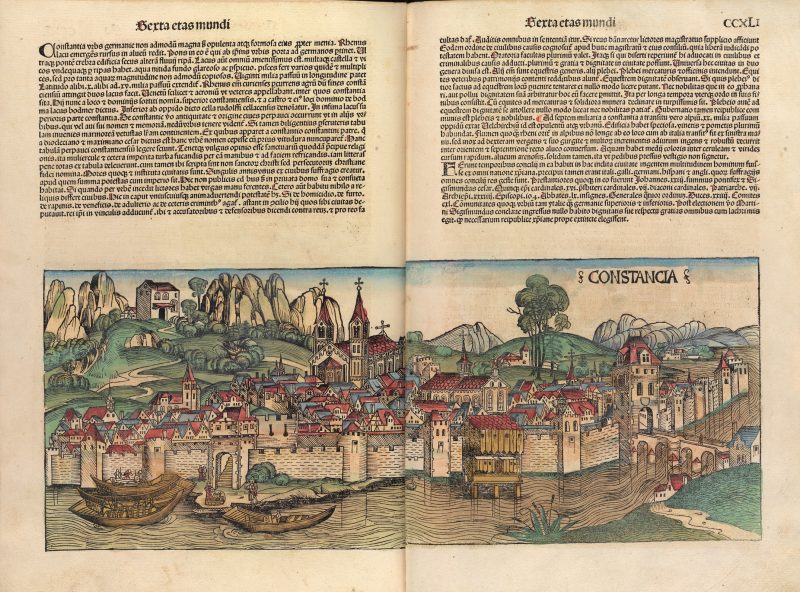
——————–
Background information about The Nuremberg Chronicle (Liber Chronicarum)
The Nuremberg Chronicle is one of the best-documented early printed books. The Chronicle is an illustrated world history. It was first published in Latin on 12 June 1493 and was quickly followed by a German translation on 23 December 1493. Scholars estimate that 1400-1500 Latin, and 700-1000 German, copies were published. A document from 1509 records that 539 Latin versions and 60 German versions had not been sold. Approximately 400 Latin and 300 German copies survived into the twenty-first century. Its author is Hartmann Schedel, while Georg Alt is credited with the German translation. The prominent artist Albrecht Dürer was an apprentice during the making of the woodblock illustrations.
As was common at the time, the book did not have a title page. Latin scholars refer to it as Liber Chronicarum (Book of Chronicles) as the phrase appears in the index introduction of the Latin edition. English speakers have long referred to it as the Nuremberg Chronicle after the city in which it was published. German speakers refer to it as Die Schedelsche Weltchronik (Schedel’s World History) in honor of its author. (Wikipedia)
Latin Original & Translation
Latin Text: “Sphaera ignea in coelo visa est: quae a meridie in orientem recto tramite tendens: versus solem occiduum sese recepit.”
English Translation: “A fiery sphere was seen in the sky: which, stretching in a straight path from the south to the east, betook itself toward the setting sun.”
Researcher’s Notes
-
Historical Context: The event occurred during the reign of Holy Roman Emperor Conrad II. While the Nuremberg Chronicle was printed in 1493, it relies on much older manuscripts and oral traditions to document the 1034 CE event.
-
Visual Analysis: The woodcut illustration depicts a classic “cigar-shaped” craft. In medieval iconography, “fiery beams” or “spheres” were often the only vocabulary available to describe structured, glowing objects in the sky.
-
Trajectory Data: The report specifically mentions a non-ballistic flight path—moving straight from south to east before “veering”—which suggests intelligent control rather than a natural meteor fall.
-
Artistic Influence: Notable artist Albrecht Dürer was an apprentice at the workshop where these illustrations were produced, lending significant historical weight to the accuracy of the depiction as intended by the author.
The 1034 CE Nuremberg account stands as a pillar of ancient astronaut theory and historical Ufology. The combination of a mass sighting, a documented flight trajectory, and a contemporary (15th-century) visual representation makes it one of the most compelling pre-modern UFO cases. It suggests that the “Daylight Disc” and “Cigar” archetypes are not modern inventions but have been interacting with human history for over a millennium.