THINK ABOUTIT CLOSE ENCOUNTER REPORT
Date: 1662
Sighting Time:
Day/Night:
Location: Near Saalfeld, Germany
Urban or Rural: rural
Entity Type: earth-woman
Entity Description: The humanoid was a short dwarf-like creature.
Hynek Classification: CE-III (Close Encounter III) Close observation with animate beings associated with the object.
Duration:
No. of Object(s): 1
Size of Object(s):
Distance to Object(s):
Shape of Object(s):
Color of Object(s):
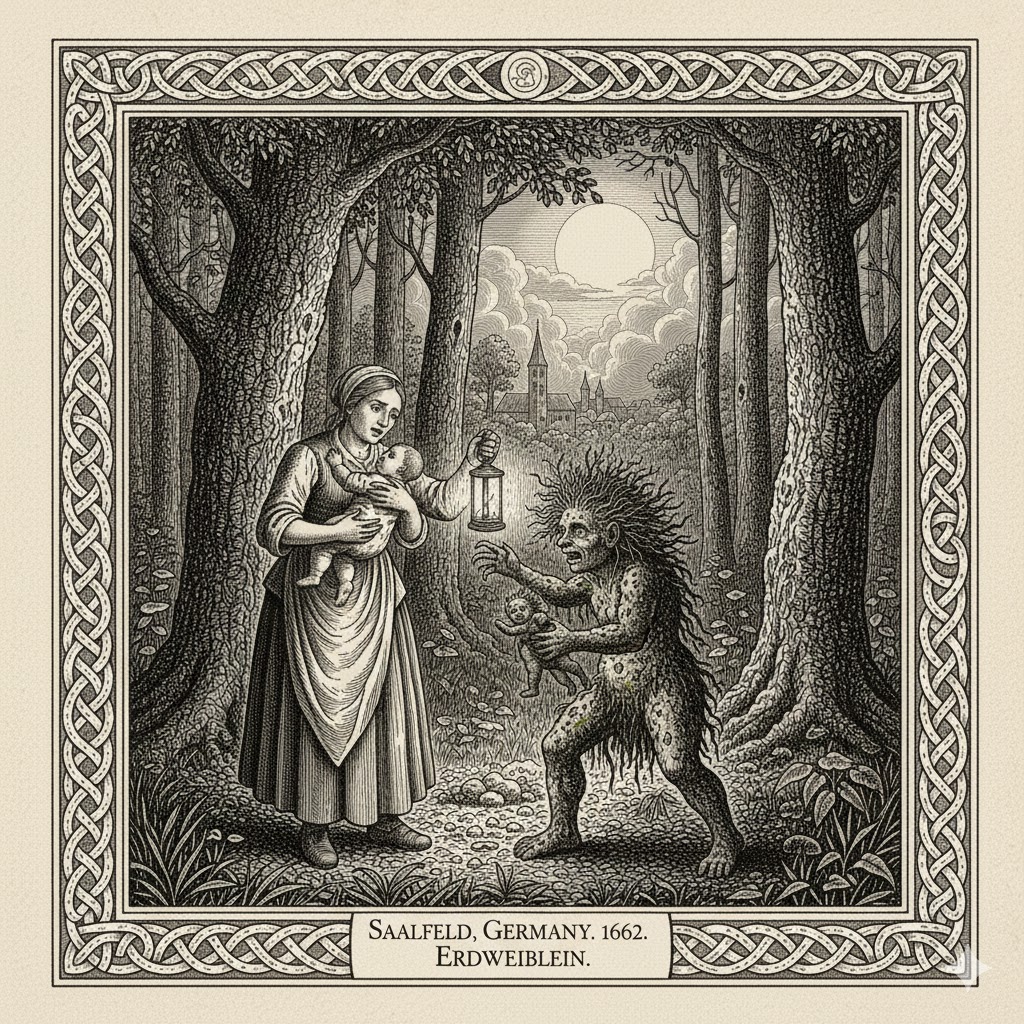
Number of Witnesses: 1 – “The woman of the earth appeared as if from the very soil itself, her skin the color of deep loam and her garments woven from roots and moss. She did not speak in a tongue I knew, but her intent was clear as she reached for the cradle. There was a heaviness in the air, a stillness that felt as though time itself had paused in the presence of this small, powerful creature. It was only through a desperate plea and the sign of the cross that she finally retreated, vanishing back into the shadows of the forest near Saalfeld, leaving behind a scent of damp stone and ancient places.”
Source: Ulrich Magin
Summary/Description: An “earth-woman” tried to steal a human child and replace it with her own near this city. The humanoid was a short dwarf-like creature.
Investigative Analysis
The 1662 Saalfeld encounter presents a fascinating crossover between folklore and anomalous entity reports. Classified as a CE-III, this case involves the sighting of an “earth-woman,” a term that mirrors traditional German legends of the Erdweiblein—elemental beings believed to dwell within the ground.
The specific detail of the entity attempting to swap a human child for her own is a classic “changeling” motif frequently found in European accounts of the era. In a modern context, these reports are often analyzed for their “high strangeness” elements, where humanoid entities exhibit behaviors that are both bizarre and deeply rooted in the cultural myths of the time. This account, sourced from researcher Ulrich Magin, highlights the enduring nature of small humanoid sightings across centuries.