THINK ABOUTIT ENTITY SIGHTING REPORT
Date: 1836
Sighting Time: Unknown
Day/Night: night
Location: Szeged, Hungary
Urban or Rural: -Rural
Entity Type: Humanoid
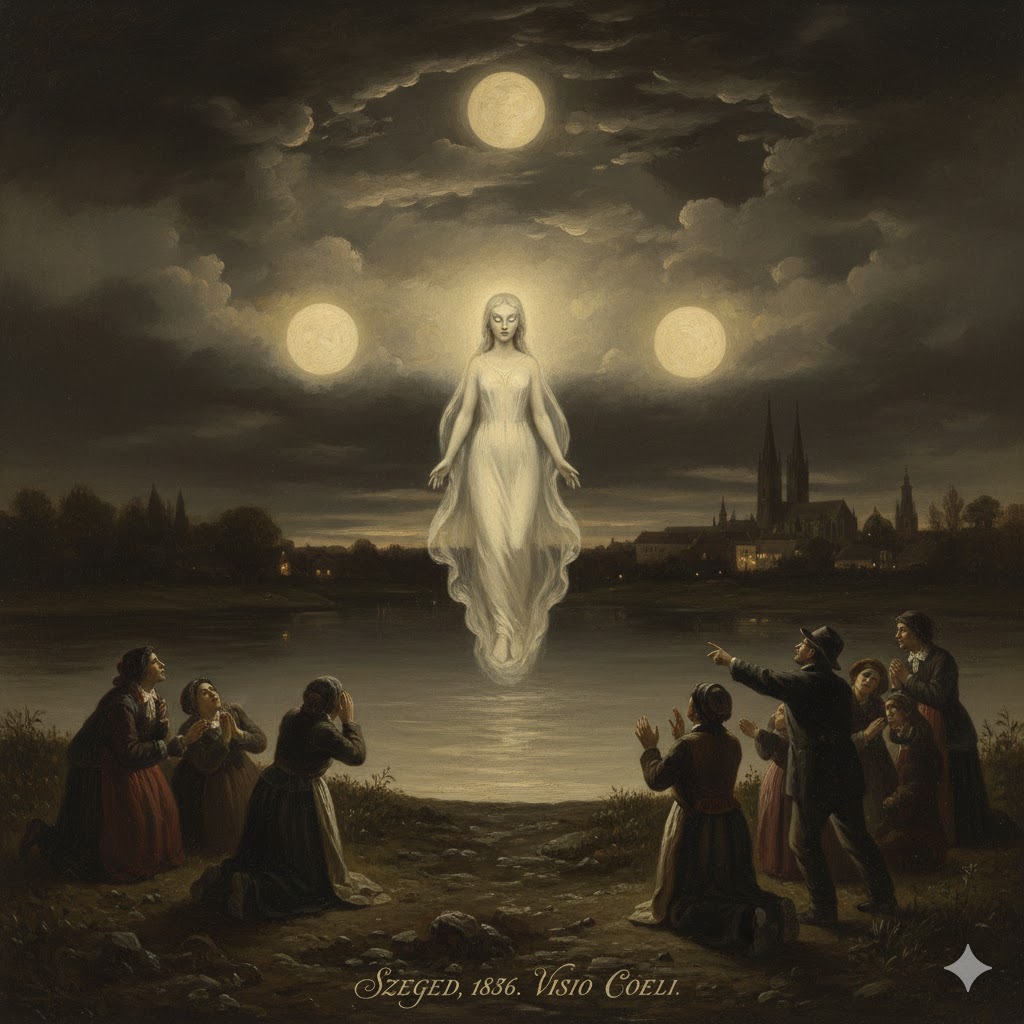
Entity Description: “lady in white”
Hynek Classification: CE-III (Close Encounter III) Close observation with animate beings associated with the object.
Duration: Unknown
No. of Object(s): Unknown
Size of Object(s): Unknown
Distance to Object(s): Unknown
Shape of Object(s): spherical lights
Color of Object(s): Unknown
Number of Witnesses: Local accounts from the period describe a scene of collective bewilderment as the residents of Szeged observed the luminous spheres descending toward the town’s outskirts. One witness, cited in historical chronicles, noted that the “Lady in White” appeared to move with a weightless, gliding motion, her form emitting a soft, pulsating glow that matched the frequency of the nearby lights.
The testimony highlights that while the apparition appeared human-like, its sudden disappearance into the spherical objects caused many onlookers to flee in terror. The “uproar” described in contemporary reports suggests that the event was not an isolated observation but a widely witnessed phenomenon that left a lasting mark on the region’s historical record.
Source: Ion Hobana, & Julien Weverbergh, UFO’s Behind the Iron Curtain
Summary/Description: Near the Romanian border, spherical lights and the appearance of what looks like a “lady in white” create uproar in a part of the town.
Investigative Analysis
The 1836 encounter in Szeged stands as a profound historical example of High Strangeness that bridges the gap between traditional folklore and modern ufology. The simultaneous appearance of spherical lights and a spectral “lady in white” suggests that witnesses were observing a physical phenomenon rather than a purely psychological or spiritual one. In the context of Close Encounters of the Third Kind (CE-III), the structured nature of the lights—often described as behaving with a form of intelligence—points toward an aerial presence that predates modern aviation by decades.
This case is particularly notable for the “uproar” it caused within the local community near the Romanian border. During this era, such events were frequently interpreted through a religious or supernatural lens; however, the physical description of the spherical objects aligns closely with what would later be classified as “foo fighters” or nocturnal lights in 20th-century reports. The persistent “Lady in White” archetype in this report may represent a cultural interpretation of a non-human entity or an environmental effect associated with the craft’s propulsion system.