THINK ABOUTIT UFO PAINTING REPORT
Date:1606
Sighting Time: Not explicitly stated, though the painting depicts a divine/celestial scene.
Day/Night: Day/Bright (implied by the “shining” quality and “strange glow”).
Location: The Church of San Lorenzo in San Pietro in Montalcino, Italy.
Urban or Rural: – Urban/Interior (Church setting).
No. of Entity(‘s): 3 (The Holy Trinity: God the Father, God the Son, and the Holy Spirit as a Dove).
Entity Type: Divine/Celestial.
Entity Description: God the Father (right) and God the Son (left) holding “antennae” rods; Holy Spirit depicted as a Dove above.
Hynek Classification: CE-I (Close Encounter of the First Kind – visual of a craft/object).
Duration: painting
No. of Object(s): 1
Height & Speed: Stationary/Celestial.
Size of Object(s): Large enough to be held between two figures.
Distance to Object(s): Physical contact (The entities are holding the rods attached to the sphere).
Shape of Object(s): sphere
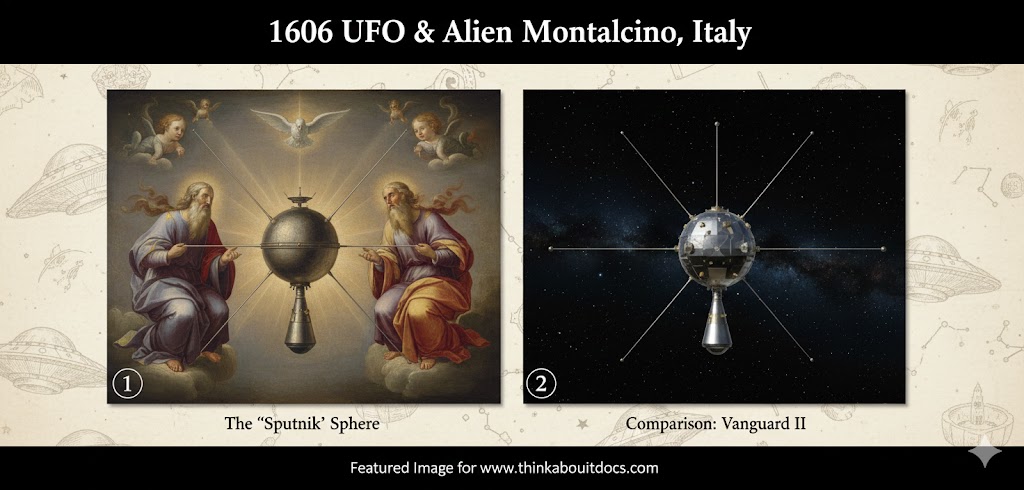
Color/Description of Object(s): shining almost metallic coloured sphere with a strange glow rising at the top? And what are those two long straight rods attached to the surface of the sphere? The rods appear to widen at the bottom to form a round base on the sphere, while at the very tip of the narrow end of the rod, we find a tiny round ball.
The Object: A shining, metallic-colored sphere with two long straight rods (antennae) and a telescope-like protrusion at the bottom.
Number of Witnesses: The Artist: Bonaventura Salimbeni, who painted this “Glorification of the Eucharist” in the year 1600.
Source: Glorification of the Eucharist – From: A UFO in Pianello?
Summary/Description: Glorification of the Eucharist” ~ painting by Bonaventura Salimbeni. Painted in 1600, today it hangs in the church of San Lorenzo in San Pietro, Montalcino, Italy. Notice the Sputnik Satellite like device that some consider to be a stylized representation of the Earth.
Glorification of the Eucharist” – From: A UFO in Pianello?
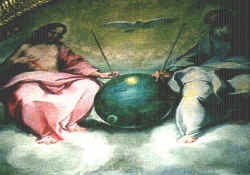 Ufologists from all parts of the globe come to Montalcino to stare at this amazing painting. Read the story, but you’ll need to come and see it for yourself – only you can decide! The painting is structured vertically and the Holy Eucharist is placed in the geometric centre surrounded by various holy people and priests on each side. In the upper part of the painting the Holy Trinity is depicted: On the right is God the Father, on the left is God the Son, and above Them in the centre, is the Dove which represents the Holy Spirit. In the lower left one of the people wears a crown similar to that of a Pope – it is believed to be Pope Clemente VII. But what’s this strange object in the upper centre? What is it that sits between God the Father and God the Son, directly below the Dove? Is it not a shining almost metallic coloured sphere with a strange glow rising at the top? And what are those two long straight rods attached to the surface of the sphere? The rods appear to widen at the bottom to form a round base on the sphere, while at the very tip of the narrow end of the rod, we find a tiny round ball.
Why is God the Father holding on to one rod, and God the Son holding the other? Are these rods some kind of antennae? Look again at the sphere. What is that small round tube shaped protrusion at the bottom left? It is very evident to the eye, but could it be possible? Is it a telescope…or a tiny telecamera? Perhaps you remember man’s first venture into space, the years of the ‘sputniks’? This painting has Ufologists baffled because this sphere is uncannily reminiscent of early satellites launched into space during the 1950’s. The Vanguard II satellite launched by the USA in 1959, for example. This painting was put to canvas in the year 1600. What did Bonaventura Salimbeni see in the skies above Sienese territory more than four hundred years ago? What on earth – or in space – prompted him to depict the Holy Trinity in this strange manner?
Symbolism and Comparison: The Sphaera Mundi vs. Sputnik
To understand the profound mystery of Bonaventura Salimbeni’s work, one must examine the intersection of traditional religious iconography and modern technological parallels. In classical Catholic art, the sphere between God the Father and God the Son is traditionally identified as the Sphaera Mundi, or the “Sphere of the World,” representing the entirety of creation under the watchful eye of the Holy Trinity. The “antennae” held by the divine figures are often interpreted by art historians as scepters of power, symbolizing their joint sovereignty over the physical universe.
However, the specific technical details Salimbeni included in his 1600 masterpiece in Montalcino defy standard 17th-century conventions in a way that continues to fuel the Ancient Astronaut theory. Unlike other Renaissance depictions of the Earth, which were often opaque or featured geographical outlines, this shining, metallic sphere possesses a distinct reflective quality and a telescope-like protrusion at the bottom left. This protrusion is remarkably similar to the telemetry equipment found on 20th-century satellites like the Vanguard II or the Soviet Sputnik.
The visual comparison is so striking that it has become a cornerstone of historical UFO research. When the Vanguard II was launched in 1959, its spherical body and extending antennas mirrored the Montalcino painting with such precision that it led many to wonder if Salimbeni had experienced a “vision” of future technology or a close encounter that he could only interpret through the lens of religious dogma. Whether one views the object as a stylized globe or an anachronistic satellite, its presence in the San Lorenzo in San Pietro church remains one of Italy’s most enduring and visually arresting anomalies.
Researcher Notes: The “Sphaera Mundi” Mystery
-
Artistic Anomaly: While the object is often identified as a “Creation Globe” or Sphaera Mundi, Bonaventura Salimbeni’s inclusion of specific “rods” and a “telescope-like” base remains highly unusual for the period.
-
Technological Parallels: The resemblance to the Vanguard II (1959) and Sputnik (1957) is the primary driver of modern ufo interest in this 17th-century work.
-
Historical Context: The painting was completed in 1600, long before the invention of the telescope or the dawn of the space age, raising questions about the source of Salimbeni’s inspiration.
Ultimately, the Glorification of the Eucharist remains one of the most debated pieces of art in the historical UFO community. Whether it depicts a divine representation of the universe or an anachronistic glimpse of future satellite technology, its presence in Montalcino, Italy, ensures that San Lorenzo in San Pietro will continue to be a site of pilgrimage for art historians and ufologists alike. This enduring mystery serves as a bridge between the spiritual wonders of the Renaissance and the technological marvels of the modern age.