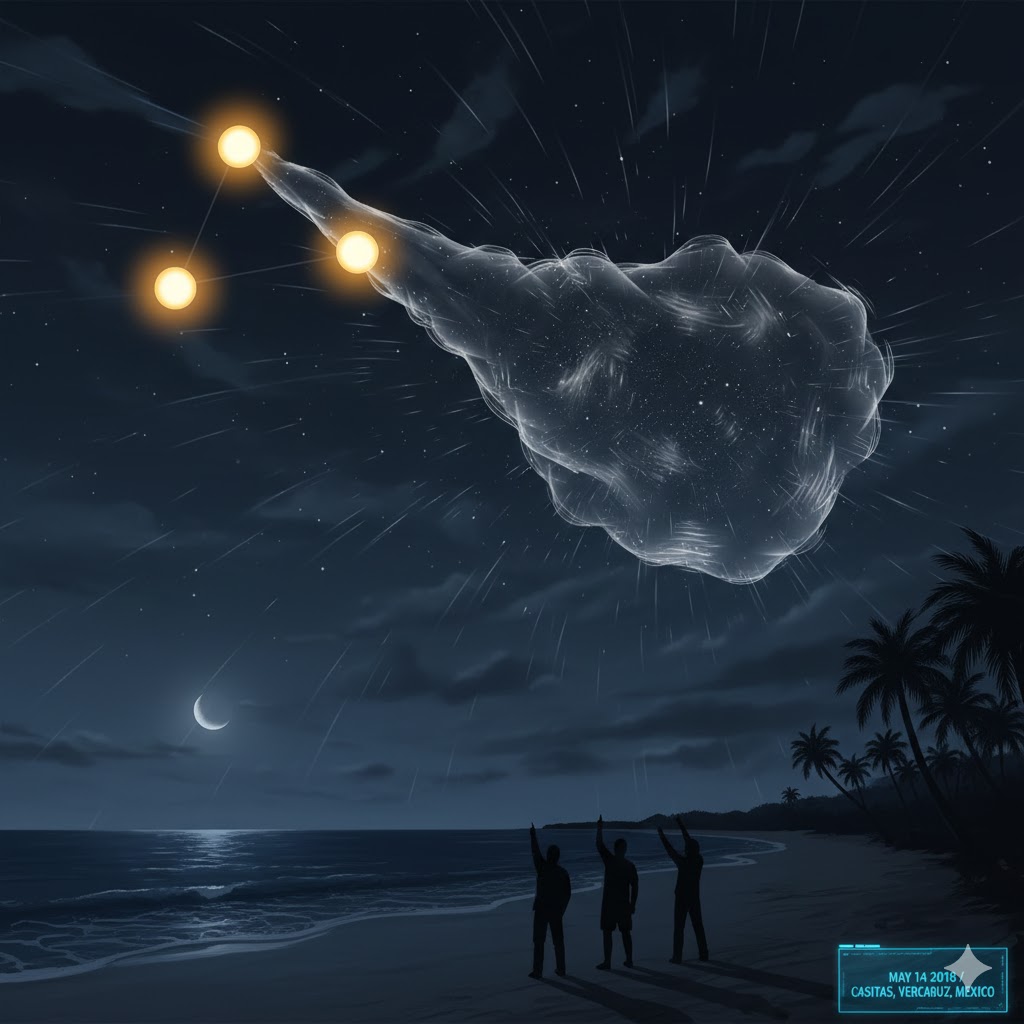
Visualizing the May 14, 2018, sighting in Casitas, Mexico: Three yellowish lights attached to a transparent, shimmering mass
THINK ABOUTIT UFO SIGHTING REPORT:
The Casitas Veracruz Report
Date: May 14, 2018
Sighting Time: 10:00 PM
Day/Night: Night
Location: Casitas, Veracruz, Mexico
Urban or Rural: Rural tropical area in Mexico, near the beach. Only farms around.
Entity Type: NA
Entity Description: NA
Hynek Classification: NL (Nocturnal Light) Point or extended luminous source observed at night.
Duration: 30 seconds
No. of Object(s): 3
Size of Object(s): Relative size was 3-4 inches in the sky. I am not sure about the actual size. At least 10 times bigger than an airplane.
Distance to Object(s): Not sure, but one of the witnesses says it appeared closer than an airplane.
Shape of Object(s): Three lights, yellowish about as bright as stars or a little less, but bigger. Mass behind them appeared transparent and distorted.
Color of Object(s): Three lights, yellowish about as bright as stars or a little less
Number of Witnesses: 1
Special Features/Characteristics: NA
Source: REPORTED To Think AboutIt
Summary/Description: Three yellow lights crossing the sky, not bright at all. Could see a mass behind the lights but it was not a solid color. It was see through, it was just distorted, kind of when you can see hot air in the road. It crossed the sky faster than an airplane but slow enough to see. Three witnesses. Object was very hard to spot and could have passed undetected if we were not star gazing that night. The length in the sky was about 4 inches, object sharply turned around eventually and disappeared.
Historical Context: The Veracruz Sighting Wave
Veracruz has long been a focal point for aerial anomalies in Mexico, often linked to its extensive coastline and strategic maritime importance.
-
The 1990s Mexican Wave: The 2018 Casitas event echoes the massive Mexican UFO wave that began in 1991 during the solar eclipse. That era established Mexico as a “hotspot,” where massive, multi-light objects were frequently documented by civilian and military pilots alike.
-
Regional Precedents: Historically, sightings in Veracruz have clustered around sensitive areas, most notably the Laguna Verde nuclear power plant. The 2018 report of a “distorted mass” near the beach in Casitas suggests that these objects may utilize coastal corridors for transit, perhaps using the water as a navigational benchmark or a source of energy.
Technical Analysis: Gravitational Lensing & Propulsion
The witness description of a “transparent and distorted mass” similar to “hot air on the road” provides significant clues into the object’s potential propulsion technology.
-
Optics of Invisibility: The “heat-blur” effect is a classic indicator of gravitational lensing. If a craft utilizes a localized gravity field—similar to a theoretical Alcubierre warp drive—it would bend light around the hull, creating a shimmering, see-through appearance rather than a solid metallic surface.
-
Speed vs. Maneuverability: The report highlights a “sharp turn” performed at speeds greater than a conventional airplane. In standard physics, such a maneuver at high velocity would generate G-forces capable of destroying any known airframe. This suggests the object possesses “inertia-less” travel, where the mass of the object is effectively canceled by its internal propulsion field.
-
Luminous Sources: Classified as a Nocturnal Light (NL), the three yellowish lights may not be “navigation lights” in the human sense. Instead, they could represent ionized plasma—a byproduct of the high-energy field required to distort the surrounding space-time. This specific light signature suggests a highly energized state of matter surrounding the craft’s hull.
High-Strangeness: The “Distorted Mass” Phenomenon
The most unsettling aspect of the Casitas report is the lack of a solid physical form, which pushes the encounter into the realm of “high-strangeness”.
-
Interdimensional Hypothesis: Some researchers suggest that the “shimmering” effect is a visual signature of an object that is only partially manifested in our three-dimensional reality. This would explain why it was “very hard to spot” and appeared to “distort the stars” rather than block them entirely.
-
Holographic Camouflage: The description of a mass that was “not a solid color” but “see-through” points toward advanced holographic camouflage. By projecting the background stars onto the front of the craft, the object remains nearly invisible to the casual observer, appearing only as a slight ripple in the night sky.
Comparative Archive: The “Distorted Mass” Phenomenon
The Casitas report is part of a rare but significant subset of sightings where the object is defined not by its solid surface, but by its distortion of the environment. This “shimmering” or “translucent” quality is a hallmark of high-strangeness cases worldwide.
-
The “Predator” Effect in Modern Ufology: The description of a mass that looks like “hot air on the road” is remarkably consistent with the “translucent” or “cloaked” craft reported in the 2004 Nimitz encounter and several California coast sightings. In these instances, witnesses describe an object that is nearly invisible except for a gravitational ripple that bends the light of the stars behind it.
-
The 1970s “Jellyfish” Objects: Historically, reports from the 1970s European wave often described “jellyfish-like” translucent structures. While the Casitas object featured three distinct yellow lights, the “see-through” mass suggests a similar non-solid or plasma-shielded exterior.
-
Radar-Visual Discrepancies: In many Mexico sightings, objects that appear “distorted” or “blurred” to the naked eye often fail to register on conventional radar, or conversely, register as a solid mass much larger than the visual light signature suggests. This supports the theory that the “mass” witnessed in Veracruz was a physical field of energy rather than a fuselage.
The May 14, 2018, encounter in Casitas stands as one of the most compelling modern reports in the Mexico UFO sighting archives. What makes this case particularly valuable is the tri-witness verification of the object’s physical behavior—specifically the “sharp turn” and the star-distorting mass. These details move the report beyond a simple “light in the sky” and into the realm of advanced physics and potential interdimensional transit.
As we continue to archive these encounters in Veracruz, the pattern of coastal sightings near energy-sensitive sites like Laguna Verde becomes impossible to ignore. Whether a product of secret human technology or an extraterrestrial visitation, the Casitas anomaly remains a vivid reminder that our skies hold mysteries that conventional science is only beginning to understand.