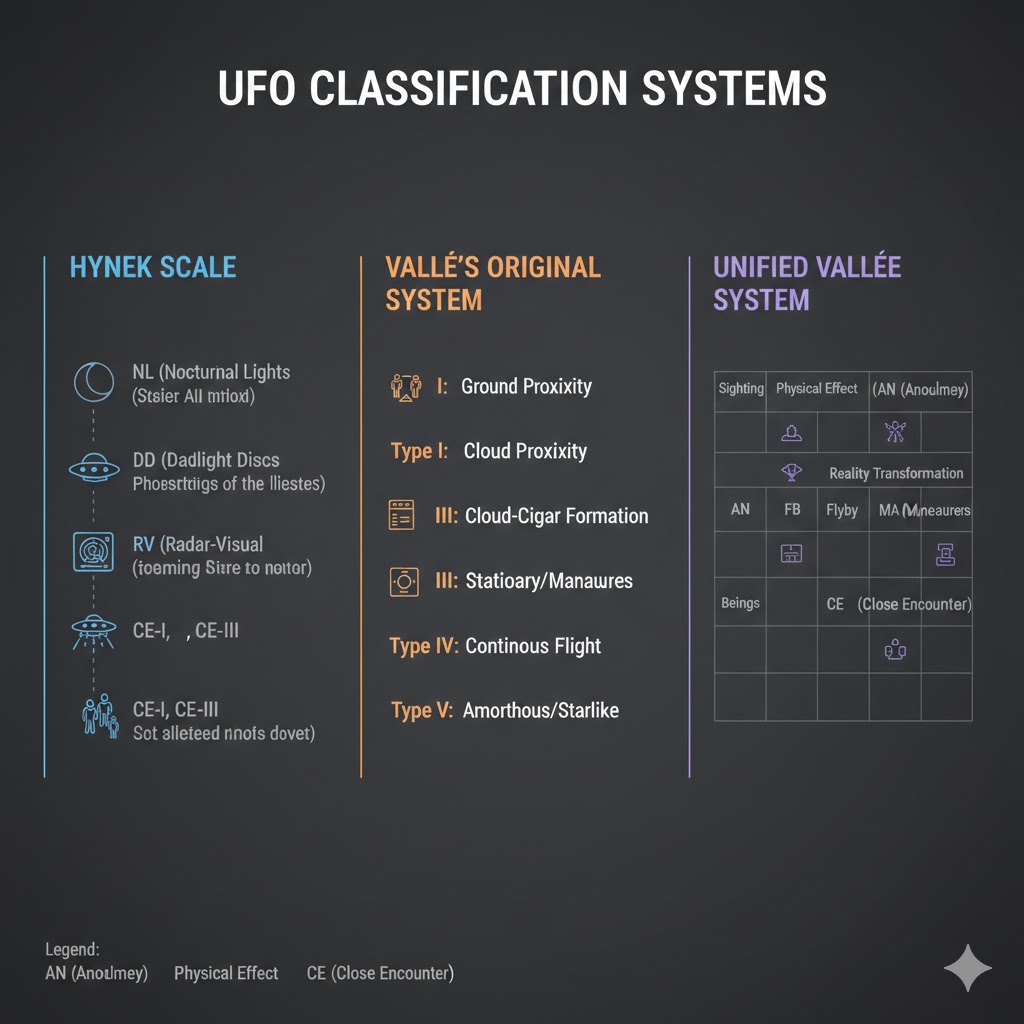
A comparison of the primary classification systems used in Ufology to standardize reports of aerial anomalies and close encounters.
Executive Summary: The Language of Ufology
Understanding UFO phenomena requires a standardized scientific language to move beyond anecdotal evidence into data-driven analysis. This guide provides a comprehensive overview of the three primary classification systems that define the field: Vallee’s Original Types, the Hynek Scale, and the modern Unified Vallee Classification System. Together, these frameworks allow researchers to categorize sightings based on behavior, proximity, and physical impact, providing the structural backbone for modern investigative efforts.
This is the final form of Jacques Vallee’s original classification system. It still remains one of the best and most descriptive classification systems, particularly when the subtypes are used.
Class Name Description
Type – I (a,b,c,d)
Observation of an unusual object, spherical discoidal, or more complex in form, on or close to the ground (no higher than tree height), which may be associated with traces – physical effects of a thermal, luminous, or mechanical order.
a – On or near the ground
b – Near or over a body of water
c – Occupants displaying an interest in witnesses by gestures or luminous signals
d – Scouting a terrestrial vehicle
Type – II (a,b,c)
Observation of an unusual object with the vertical cylindrical formation in the sky, associated with a diffuse cloud. This phenomenon has been given various names such as cloud-cigar or cloud-sphere.
a – Moving erratically through the sky
b – Object is stationary and gives rise to secondary objects
c – Object surrounded by secondary objects
Type – III (a,b,c,d,e)
Observation of an unusual object of spherical, discoidal, or elliptical shape stationary in the sky.
a – Hovering between two periods of motion with “dead-leaf” descent, up and down, or pendular motion
b – Interruption of continuous flight to hover and then continue the motion
c – Alters appearance while hovering – i.e. change of luminosity, generation of a secondary object, etc.
d – “Dog-fights” or swarming among several objects.
e – Trajectory altered during the continuous flight to fly slowly above a certain area, circle, or suddenly change course
Type IV (a,b,c,d)
Observation of an unusual object in continuous flight.
a – Continuous flight
b – Trajectory affected by nearby conventional aircraft
c – Formation flight
d – Wave or zig-zag trajectory
Type V (a,b,c)
Observation of an unusual object of less definite appearance, appearing not fully material or solid in structure
a – Extended apparent diameter, non-point source luminous objects
b – Starlike objects, motionless for extended periods
c – Starlike objects rapidly crossing the sky, possible with peculiar trajectories
Hynek Classification System
Possibly the most famous UFO classification system, this is a system which does not classify reports based on the nature or behavior of the observed object, but instead simply on the visibility or proximity of the object. As such, it is significantly less useful than either of the Vallee classification systems.
Class Name Description
- NL (Nocturnal Light) Point or extended luminous source observed at night.
- DD (Daylight Disc) Metallic or whitish object was seen in the day.
- RV (Radar / Visual) Observation supplemented with radar.
- CE-I (Close Encounter I) Observation of an object in close proximity to the witness (i.e. within 500’)
- CE-II (Close Encounter II) Observation of an object in close proximity to the witness, where physical traces (impression, burn, medical effect, etc.) are left or (electrical effect, heat) are felt
- CE-III (Close Encounter III) Close observation with animate beings associated with the object.
Since Hynek’s original classification several more types have been suggested, although these are not universally recognized:
- CE-IV (Close Encounter IV) Abduction of the witness or other direct contact
- CE-V (Close Encounter V) Voluntary bilateral contact between humans and extraterrestrials.
- CE-VI (Close Encounter VI) Death of a human or animal associated with a UFO sighting. Cattle mutilations would fall into this category.
- CE-VII (Close Encounter VII) The creation of a human/alien hybrid, either by sexual reproduction or by artificial scientific methods.
Current Vallee Classification System
This is Vallee’s attempt to unify his classification system with Hynek’s, and to incorporate those “psychic” or otherwise anomalous reports which he believes have a connection with the UFO phenomenon, and to regularize the classification system.
|
Footnotes
1. Jacques and Janine Vallee: Challenge To Science: The UFO Enigma, LC# 66-25843
2. Dr. J. Allen Hynek, The UFO Experience, ISBN 0-345-27361-3,
3. This category was not explicitly approved by Dr. Hynek but is in wide use.
4. Jacques Vallee, Confrontations, ISBN 0-345-36501-1
The Scientific Influence on Project Blue Book
The classification systems developed by Dr. J. Allen Hynek weren’t just theoretical; they were the operational backbone of the United States Air Force’s Project Blue Book. Originally a skeptic hired to debunk sightings, Hynek realized that a rigorous taxonomic approach was the only way to separate atmospheric phenomena from truly “unidentified” cases.
By standardizing reports into categories like Nocturnal Lights or Close Encounters, investigators could look for cross-case patterns that human memory alone would miss. While the Air Force often used these classifications to file away cases as “identified,” Hynek and later Jacques Vallee used them to prove the existence of a persistent, worldwide phenomenon that defied simple explanation. This shift from debunking to data-driven research remains the most significant legacy of their collaboration.
The Future of Classification: AI and Digital Sensors
As we move further into the 21st century, the classic classification systems are being augmented by the “Digital Age of Ufology.” While the Hynek Scale relied heavily on human testimony, modern researchers are increasingly prioritizing multi-sensor data. The introduction of high-resolution satellite imagery, forward-looking infrared (FLIR), and sophisticated radar-visual (RV) data means that a “Close Encounter” can now be verified by hard physics alongside human experience.
Furthermore, artificial intelligence is beginning to play a role in Vallee’s dream of a unified database. AI algorithms can now scan thousands of reports to find “Type III” maneuvers or “Type II” cloud-cigar formations across different decades and continents in seconds. This evolution doesn’t replace the work of Hynek and Vallee; rather, it provides the high-tech tools necessary to finally solve the taxonomic mysteries they first identified over fifty years ago.