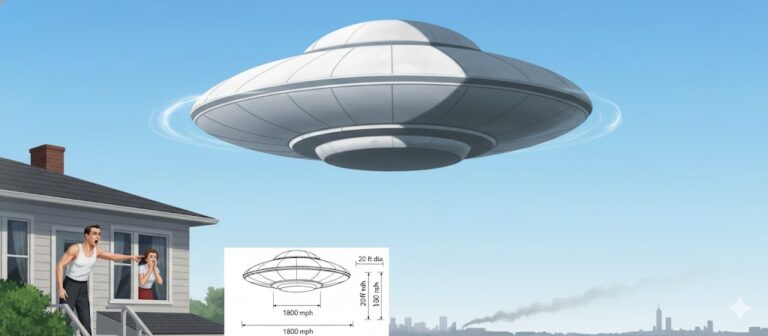
Reconstruction based on David Roeck's report to the APRO Bulletin.
THINK ABOUTIT UFO SIGHTING REPORT
In July 1977, multiple witnesses in Anderson, Indiana, observed a highly structured disc-shaped craft performing a silent, low-altitude transit over an urban motel. Described as having a “frisbee-like” geometry and adorned with a distinctive ring of gold-ball white lights and a central red beacon, the object displayed advanced flight characteristics, including a slow, tilted rotation and a non-linear flight path. This report, documented by the APRO Bulletin, stands as a significant Nocturnal Light (NL) case due to the proximity of the craft and the technical clarity of the witness’s observations.
Date: July 1977
Sighting Time: 9:39 P.M.
Day/Night: Night
Location: Anderson, Indiana
Urban or Rural: Urban
Hynek Classification: NL (Nocturnal Light) Point or extended luminous source observed at night.
Duration: 5 minutes
No. of Object(s): Single
Size of Object(s): The witness described the object as a “great disc” and compared its geometry to being “frisbee-like“.
Distance to Object(s): David Roeck estimated the craft was at a very low altitude, specifically “less than 1000 feet“.
Shape of Object(s): Disc
Color of Object(s): frisbee-like disc with “gold-ball” white spherical lights arranged around the rim and all touching each other, and one spherical red light of about the same size on the top center of the craft
Number of Witnesses: Multiple
Source: APRO Bulletin, Vol. 32 No. 7 (September 1984)
Summary: “I was staying in a motel in Anderson, Indiana, in the month of July of 1977, when my traveling companion burst in through the door to summon me outside. Once in the parking lot, I gazed up above the rooftop to witness a great disc gliding gently across our field of view, moving slowly and tilted at an angle.”
Full Report
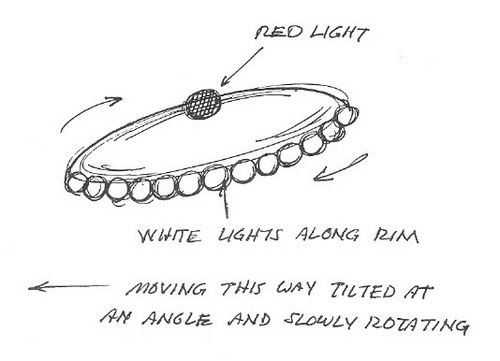
“1977 DISC IN INDIANA”
by David Roeck
I was staying in a motel in Anderson, Indiana, in the month of July of 1977, when my traveling companion burst in through the door to summon me outside. Once in the parking lot, I gazed up above the rooftop to witness a great disc gliding gently across our field of view, moving slowly and tilted at an angle. It was slowly rotating clockwise and at so low an altitude (my guess is less than 1000 feet) to make identification easy (for me, being familiar with conventional aircraft design).
I knew right away that this aircraft was not a conventional earthly machine, and instantly felt the rush of recognition of once again beholding a magnificent craft from a more advanced world, or whatever. The last such time was ten years before. It appeared simply as a great frisbee-like disc with “gold-ball” white spherical lights arranged around the rim and all touching each other, and one spherical red light of about the same size on the top center of the craft. Within five minutes it had gradually moved out of view, having traveled in an arc, not in a straight line. It was as simple as that– I only wished I’d been able to see it longer, and through binoculars. There were no sound, odors, or emissions. The time was 9:30 p.m., and the temperature was between 70° and 80°.
Historical Context: Indiana’s 1970s Sighting Wave
The July 1977 encounter in Anderson was not an isolated event but part of a broader “wave” of sightings across the Midwest during the mid-to-late 1970s. Researchers at the Aerial Phenomena Research Organization (APRO) noted that Indiana frequently served as a corridor for these objects, with Anderson and Indianapolis often reporting similar structured craft within the same calendar year.
-
The 1970s “Flap”: This era is characterized by a transition from blurry lights to the highly structured “metallic” or “light-rimmed” discs like the one witnessed by David Roeck. These reports often shared a commonality: low-altitude, silent operation in urban or semi-urban environments, suggesting a lack of concern for being observed by the public.
-
Regional Patterns: The Anderson report shares striking similarities with other Indiana cases where objects appeared to follow local geography or infrastructure, such as major highways or power grids, while maintaining a non-linear, arc-like flight path.
-
The APRO Connection: The documentation of this case in the APRO Bulletin (Vol. 32 No. 7) highlights the organization’s rigorous approach to witness interviewing. By capturing details like the exact clockwise rotation and the “gold-ball” light configuration, APRO preserved technical data that remains useful for modern Nocturnal Light (NL) statistical modeling.
Researcher Notes: Technical Analysis of the 1977 Anderson Disc
To further substantiate the high-credibility nature of the David Roeck report, researchers should consider these four technical pillars of the encounter:
-
Mechanics of Advanced Rotation: David Roeck’s specific observation of a slow, clockwise rotation is a critical technical detail. In theoretical aerospace models for disc-shaped craft, such a maneuver is often hypothesized to be a requirement for gyroscopic stability or a byproduct of a centrifugal propulsion system.
-
Geometric Lighting Array: The craft’s perimeter was adorned with a unique configuration of “gold-ball” white spherical lights, each physically touching the next. This, combined with a single red beacon positioned at the top center, aligns the Anderson craft with “classic” saucer morphologies often theorized to be navigation markers or plasma-based propulsion vents.
-
Low-Altitude Acoustic Anomaly: The object was estimated to be maintaining a remarkably low altitude of less than 1,000 feet over an urban environment. Despite this proximity, the witness confirmed an absolute absence of sound, odors, or exhaust emissions, which effectively rules out all known conventional 1970s combustion-based aviation technology.
-
Non-Linear “Arc” Trajectory: Deviating from standard ballistic or aerodynamic flight paths, the object traveled in a deliberate arc rather than a straight line. This “gliding” motion appeared entirely unaffected by the 70° to 80° evening air currents, suggesting a propulsion method that is independent of external atmospheric lift or drag.
In July 1977, multiple witnesses in Anderson, Indiana, reported a close encounter with a highly structured, disc-shaped craft as it performed a silent, low-altitude transit over an urban motel. The object, described by witness David Roeck as having a “frisbee-like” geometry, featured a distinctive ring of gold-ball white lights around its rim and a central red beacon. Witnesses observed the craft rotating slowly clockwise and moving in an arc-like flight path for approximately five minutes before it vanished from view.