THINK ABOUTIT UFO SIGHTING REPORT
Date: July 15 1952
Sighting Time: 1:00 pm
Day/Night:
Location: Litchfield, Pennsylvania
Urban or Rural: Rural
Hynek Classification: DD (Daylight Disc) Metallic or whitish object seen in the day.
Duration:
No. of Object(s): 2
Size of Object(s):
Distance to Object(s):
Shape of Object(s): craft which resembled jets
Color of Object(s):
Number of Witnesses: 2
Source: NUFORC
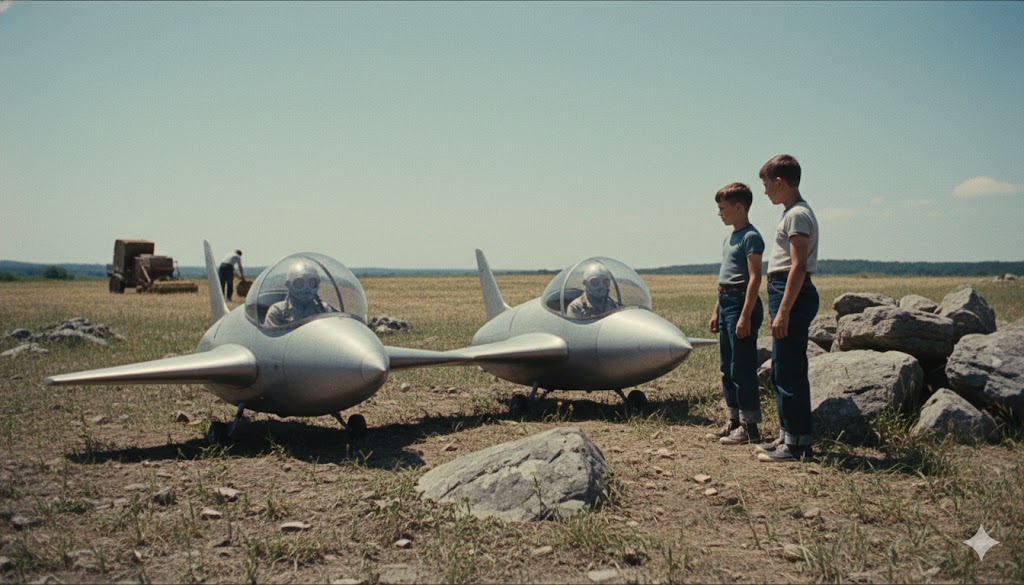
Summary/Description: On the afternoon of July 15, 1952, at approximately 1:00 pm, a remarkable close encounter occurred in the rural landscape of Litchfield, Pennsylvania. The primary witnesses, an eight-year-old boy and his brother, were exploring a rocky field situated atop a prominent hill. This location, covering no more than an acre, became the stage for a sighting that challenges conventional explanations of 1950s aviation technology.
The children reported seeing two distinct craft that closely resembled modern jets resting within the field. The proximity of the encounter allowed them to see the pilots clearly; the witnesses noted that the occupants were wearing what appeared to be oxygen masks. This detail is significant, as it mirrors the equipment used by high-altitude pilots of the era, yet the location—a short, rocky, hilltop field—was an impossible landing site for any standard jet aircraft of the time.
Excited by their discovery, the boys rushed to find their father, who was nearby bailing hay, but he dismissed their claims. This case, categorized as a Daylight Disc (DD) under the Hynek Classification system, remains a fascinating entry in the NUFORC archives. It suggests the presence of advanced technology capable of Short Take-Off and Landing (STOL) maneuvers, or perhaps highly sophisticated camouflaged UFOs operating during the height of the 1952 global sighting wave.
The encounter in Litchfield, Pennsylvania remains a significant case within the July 15 1952 archives due to its specific technological descriptions. While the witnesses initially identified the objects as jet-like craft, the location of the sighting—a rocky, one-acre hilltop field—was fundamentally incompatible with the landing and takeoff requirements of any known 1952 military aircraft. This discrepancy suggests that the boys may have observed advanced technology capable of vertical or near-vertical maneuvers, a hallmark of UFO reports from this era.
Furthermore, the detail regarding pilots wearing oxygen masks adds a layer of “high strangeness”. It reflects a period where the line between secret human military testing and extraterrestrial activity was frequently blurred in the public consciousness. Because the father did not personally witness the departure of the craft, the Litchfield incident stands as a poignant example of a “near-miss” in UFO documentation, where physical evidence was likely present but never formally investigated. This report continues to be a vital reference point for researchers studying the Daylight Disc phenomenon and the persistent mystery of the 1952 global sighting wave.