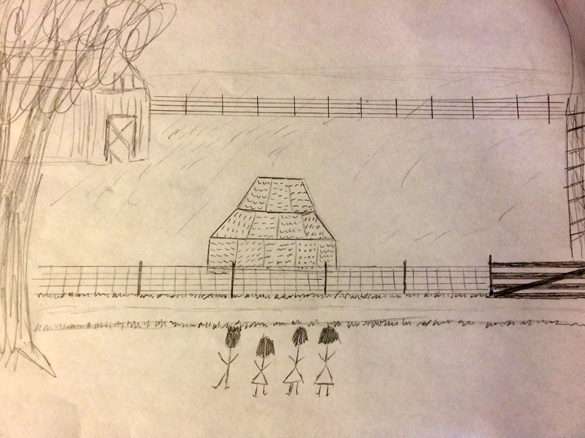
THINK ABOUTIT SIGHTING REPORT
On July 31, 1948, electrician Vernon Swigert witnessed a high-speed, cymbal-shaped domed disc over South Central Indianapolis. The object, moving at a calculated 1,800 mph, was officially classified as an “Unknown” in the Project Blue Book Special Report #14 (Battelle Institute Study). This report provides a technical breakdown of the sighting, including the object’s unique 3:1 ratio and silent, shimmering flight path that challenged the aeronautical limits of the late 1940s.
Date: July 31, 1948 BBU # 190
Sighting Time: 8:25 a.m.
Day/Night: Morning
Location: Indianapolis, Indiana
Urban or Rural: Urban
Hynek Classification: DD (Daylight Disc) Metallic or whitish object was seen in the day.
Duration: 10 seconds
No. of Object(s): 1
Size of Object(s): 20 ft across, and 6-8 ft thick
Distance to Object(s): 2 miles?
Shape of Object(s): cymbal shaped or domed disc object
Color of Object(s): white
Number of Witnesses: Multiple
Source: U.S. Air Force Project Blue Book Special Report #14 (Battelle Institute Study), 1955
Summary/Description: Vernon Swigert, an electrician, was standing by the bathroom window of his home when he first sighted an object. He ran to his kitchen where he pointed out the cymbal shaped or domed disc object to his wife. It was about 20 ft across, and 6-8 ft thick. Total time insight was approximately 10 seconds, during which the object flew on a straight and level course from horizon to horizon, west to east.
Full Report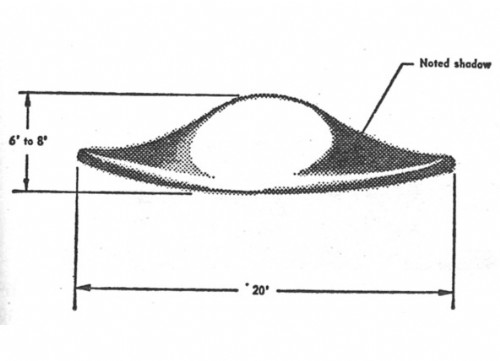
An electrician was standing by the bathroom window of his home, facing west, at 0825 hours on July 31, 1948, when he first sighted an object. He ran to his kitchen where he pointed out the object to his wife. Total time insight was approximately 10 seconds, during which the object flew on a straight and level course from horizon to horizon, west to east.
——————-
Entry on this case from Brad Sparks’ “Catalog of 1,500 Project Blue Book Unknowns”:
July 31, 1948. S central Indianapolis, Indiana. 8:25 a.m. Mr. and Mrs. Vernon Swigert saw a cymbal shaped or domed disc object or rounded coolie hat to the W, about 20 ft across, 6-8 ft thick, 3:1 ratio noted, white without any shine but shadowing on the upper right (sun from the left or E), fly straight and level from horizon to horizon W to E heading 90°, first through the window facing W then window facing S, altitude estimated at 2,000 ft covering a distance of 5 miles (1,800 mph? distance 2 miles? elevation 10°?), shimmering in the sun as if spinning. No sound or trail. (Battelle Unknown No. 8; FOIA)
Aerodynamic Anomalies & High-Speed Performance
The Swigert sighting presents several technical challenges to conventional 1948 aviation:
-
Silent Mach Performance: At a calculated speed of 1,800 mph, the object was traveling at approximately Mach 2.3. In 1948, the sound barrier had only recently been broken (1947), yet this craft produced no sonic boom or audible engine noise.
-
Extreme Velocity at Low Altitude: The estimated altitude of 2,000 feet is significantly low for a craft traveling at nearly three times the speed of sound. Conventional aircraft at this altitude and speed would experience extreme frictional heating and structural stress, none of which were observed.
-
Stabilization Without Control Surfaces: The object maintained a perfectly straight and level course without any visible wings, rudders, or propulsion exhaust. The “shimmering” or spinning effect noted by the witness suggests a possible gyroscopic stabilization method unknown to mid-century aerospace technology.
Project Blue Book & Battelle Statistical Analysis
This case remains a focal point for researchers because of its inclusion in the Battelle Memorial Institute’s statistical study:
-
Identification Probability: As Battelle Unknown No. 8, the case was subjected to rigorous cross-referencing against known weather balloons, astronomical phenomena, and conventional aircraft. The final classification of “Unknown” indicates that the data provided by the witnesses was sufficiently technical to rule out all mundane explanations.
-
Optical Analysis: The specific detail regarding shadowing on the upper right while the sun was to the East provides a rare data point for calculating the object’s three-dimensional volume and its interaction with ambient light. This suggests the object was a solid, three-dimensional craft rather than a light-based phenomenon or optical illusion.
Researcher Notes: The Vernon Swigert Case (1948)
These notes emphasize the analytical context and the high-speed characteristics of the Indianapolis encounter:
-
Battelle Unknown #8 Analysis: This case was officially classified as “Unknown” in the U.S. Air Force Project Blue Book Special Report #14. The Battelle Institute researchers highlighted the object’s specific 3:1 ratio (20 feet across by 6–8 feet thick), which defied conventional aircraft profiles of the era.
-
High-Velocity Calculations: While the witness observed the object for approximately 10 seconds, researchers calculated an estimated speed of 1,800 mph based on the distance covered across the horizon. This speed was significantly beyond the capabilities of any known atmospheric craft in 1948.
-
Shadowing and Texture: Vernon Swigert noted a distinct shadowing on the upper right side of the object, despite the sun being positioned to the East (left). This detail, along with the object’s “white without any shine” appearance, suggests a non-reflective, possibly matte surface texture.
-
Rotational Movement: The object was reported to be shimmering in the sun as if it were spinning, yet it maintained a perfectly straight and level course from horizon to horizon without producing any sound or exhaust trail.
On July 31, 1948, electrician Vernon Swigert and his wife witnessed a highly anomalous domed disc (often described as “cymbal-shaped” or a “rounded coolie hat”) over South Central Indianapolis. The object, measuring approximately 20 feet in diameter, was observed for 10 seconds as it traversed the sky at a calculated speed of nearly 1,800 mph.
Despite the high speed and low altitude (estimated at 2,000 feet), the craft was completely silent and left no visible wake or trail. Its classification as an “Unknown” by the Battelle Institute Study cements its status as one of the most credible and technically baffling Daylight Disc (DD) cases from the early Project Blue Book era.